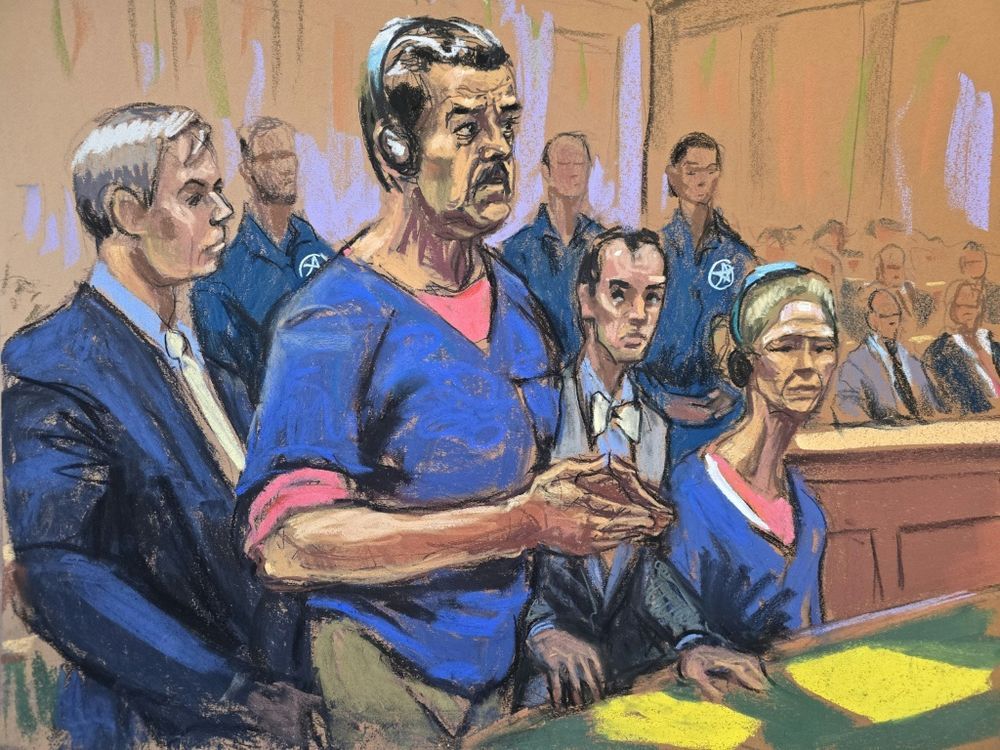
NEW YORK — As the United States prepares for a high-stakes courtroom showdown involving deposed Venezuelan President Nicolás Maduro, all eyes are on the judge presiding over the case: 92-year-old Alvin K. Hellerstein. Hellerstein, a veteran of the federal bench in the Southern District of New York, will see Maduro and his wife, Cilia Flores, appear before him on Thursday for what could be a pivotal hearing in their drug trafficking trial. Both have pleaded not guilty to the charges, and Maduro's legal team is expected to argue for the dismissal of the indictment, which stems from allegations of narco-terrorism and conspiracy to flood the U.S. with cocaine.
The case against Maduro, arrested in January following a dramatic U.S. raid on his compound in Venezuela, has reignited international interest in a sprawling investigation that Hellerstein has overseen for more than a decade. Already, the probe has led to the conviction of Venezuela's former intelligence chief, Hugo Armando Carvajal, on similar charges. Prosecutors accuse Maduro of leading the Cártel de los Soles, a supposed alliance between Venezuelan officials and Colombian drug lords, to smuggle massive quantities of narcotics into the United States. The trial's potential length—possibly stretching one to two years—has raised questions about whether Hellerstein, born in 1933 and one of the oldest active federal judges in the country, is the right fit to guide it to conclusion.
"The issue of age cannot be ignored," said Shira Scheindlin, a former federal judge in New York, in an interview with AFP. Scheindlin, who retired from the bench in 2016 after a distinguished career, acknowledged the challenges of a prolonged proceeding but praised Hellerstein's capabilities. "I have no doubt that he would be fit to try the case tomorrow. But the case will not be tried tomorrow," she added, noting that by the time a trial might begin, Hellerstein could be 93 or 94 years old.
Hellerstein's attentiveness has come under scrutiny in recent years. According to a report in The New York Times, the judge was observed falling asleep during a trial last year and had to be awakened by colleagues. Such incidents, while not uncommon among senior jurists, could prove problematic in a case as contentious as Maduro's, where defense attorneys and prosecutors are already clashing over procedural matters that threaten to extend the litigation.
Despite these concerns, Hellerstein's reputation as an impartial and rigorous jurist remains strong among legal experts. "Hellerstein possesses a well-deserved reputation for seeking to do justice in every case and for being independent and fair-minded," said Carl Tobias, a law professor at the University of Richmond. Tobias highlighted Hellerstein's history of making tough calls, even when they put him at odds with powerful figures or government agencies.
Hellerstein's career, spanning more than six decades, is marked by landmark decisions that underscore his commitment to accountability. A graduate of Columbia University Law School, he served as a lawyer in the U.S. Army from 1957 to 1960 before entering private practice in New York. Nominated by President Bill Clinton in 1998, he was confirmed to the U.S. District Court for the Southern District of New York, where he has handled some of the nation's most complex and sensitive cases.
One of his most notable roles came in the aftermath of the September 11, 2001, terrorist attacks. Hellerstein oversaw thousands of civil lawsuits filed by victims' families against al-Qaida and other entities, often rejecting settlement proposals he deemed unfair to the plaintiffs. His courtroom became a battleground for ensuring that compensation reflected the profound losses suffered by those affected by the attacks on New York and Washington.
Hellerstein has not shied away from confronting executive power. In 2018, he rejected then-President Donald Trump's request to move a New York hush money case involving adult film actress Stormy Daniels to federal court, keeping it in state jurisdiction. More recently, in 2023, he blocked the Trump administration's attempt to deport alleged members of the Venezuelan gang Tren de Aragua without due process hearings, emphasizing the importance of judicial oversight in immigration matters.
In a significant 2015 ruling, Hellerstein ordered the U.S. government to release photographs documenting the abuse of detainees at military prisons in Iraq and Afghanistan. The decision, which came after years of litigation by the American Civil Liberties Union, aimed to promote transparency about the treatment of prisoners during the post-9/11 wars. "The public has a right to know," Hellerstein wrote in his opinion, underscoring his belief in open justice.
Last year, Hellerstein presided over a trial that resulted in a jury awarding $20.75 million in damages to three Sudanese plaintiffs against French banking giant BNP Paribas. The case centered on the bank's alleged role in facilitating transactions that supported the regime of former Sudanese leader Omar al-Bashir, including dealings in Sudan during periods of conflict and human rights abuses. The verdict highlighted Hellerstein's willingness to hold multinational corporations accountable for their international conduct.
Turning back to the Maduro case, the charges paint a picture of deep corruption within Venezuela's leadership. U.S. authorities allege that Maduro, who was ousted in a controversial power shift earlier this year, authorized the shipment of at least 20 tons of cocaine to the United States as part of a broader strategy to undermine American society. The indictment, unsealed in 2020 but only acted upon recently, also implicates several high-ranking Venezuelan officials in the conspiracy.
Maduro's arrest has been hailed by U.S. officials as a major victory in the fight against transnational crime. "This is a significant step toward holding accountable those who have wreaked havoc on our communities," said a spokesperson for the U.S. Department of Justice, though specifics on the raid remain classified. Venezuelan opposition leaders, meanwhile, view the proceedings as validation of long-standing claims of Maduro's criminal enterprises, which they say fueled his regime's repression and economic mismanagement.
Yet, Maduro's defense team has decried the charges as politically motivated, arguing that they are part of a U.S. effort to delegitimize the former leader. Lawyers are likely to challenge the evidence gathered during the January raid, questioning its admissibility and the circumstances of Maduro's capture. The hearing on Thursday could set the tone for these battles, with Hellerstein's rulings potentially shaping the case's trajectory.
Legal observers anticipate a drawn-out process, complicated by international extradition issues and the involvement of multiple co-defendants. Scheindlin warned that the trial's demands could test any judge, regardless of age. "This case may not go to trial for at least a year and maybe two years," she said, emphasizing the need for sustained focus amid voluminous evidence and expert testimonies.
As the Maduro saga unfolds in a Manhattan courtroom, Hellerstein's handling of it will add another chapter to his storied career. For a judge who has navigated the intersections of national security, corporate malfeasance, and political intrigue, the Venezuelan drug trafficking allegations represent both a culmination and a challenge. With global implications for U.S.-Latin American relations, the outcome could influence diplomatic efforts to stabilize Venezuela and curb the flow of drugs across borders. For now, all parties await Thursday's proceedings, where the octogenarian jurist's gavel will signal the next phase in this international drama.