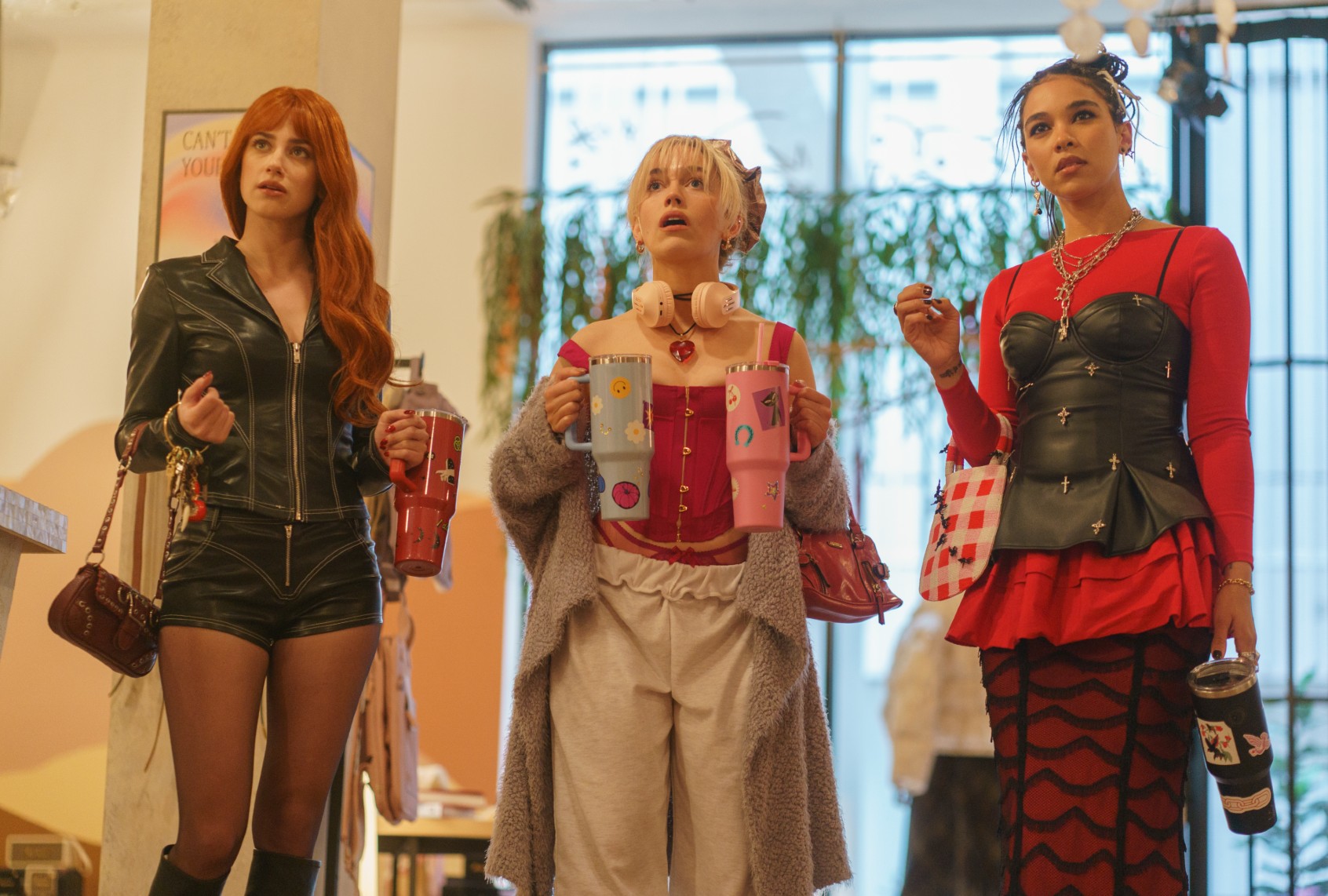
In the flickering glow of a nearly empty theater, the latest horror-comedy 'Forbidden Fruits' arrives as both a tribute and a requiem for a fading American icon: the shopping mall. Directed by Meredith Alloway and released on Shudder, the film unfolds entirely within the confines of a Texas shopping center, where four fruit-named employees at a womenswear store called Free Eden form an amateur coven after hours. Starring Lili Reinhart as Apple, Victoria Pedretti as Cherry, Alexandra Shipp as Fig, and Lola Tung as the newcomer Pumpkin, 'Forbidden Fruits' blends witchcraft with retail drudgery, capturing the eerie limbo of modern malls.
The movie, co-written by Alloway and Lily Houghton—adapting Houghton's off-Broadway stage play—premiered amid growing discussions about the decline of shopping malls and the cinematic genre they once inspired. According to a review in Salon.com published on April 2, 2026, the film serves as 'a functional eulogy to the mall before it croaks,' highlighting how these once-vibrant social hubs have become 'cold, crumbling shells' of their former selves. Filmed largely during off-hours at Toronto's Sherway Gardens mall, 'Forbidden Fruits' evokes the 'transient feeling of walking around a mall in 2026,' where unnerving events lurk in the sterile corridors.
This portrayal draws from a rich history of mall-set films that romanticized the spaces as teenage playgrounds and cultural crossroads. Classics like 'Fast Times at Ridgemont High' (1982) and 'Mallrats' (1995) depicted malls as extensions of high school drama, where 'bullies could co-mingle with their targets in a safer space' and 'note-passing flirtationships culminated in first dates,' the Salon review notes. Earlier still, George A. Romero's 1978 zombie epic 'Dawn of the Dead' used a Pennsylvania mall as a metaphor for unchecked consumerism, with the undead shambling through its stores in search of 'fresh flesh'—a pointed satire on shoppers' mindless pursuits.
But 'Forbidden Fruits' flips the script, transforming the mall into a nightmarish shrine rather than a haven. The Free Eden employees, bound by a 'hollow bond of performed femininity,' practice light magic in the basement using fruit juice, blood, and tears poured into trendy footwear. Their coven, led by the sharp-tongued Apple, enforces a rigid 'girl code' that mirrors the store's capitalist ethos: 'Care for your fellow woman, lift her, don’t let her be defined by men.' As the review observes, this is 'wokeness commodified,' where identity is 'bought, sold and performed' through clothing and archetypes, discouraging individuality under threat of exclusion.
The film's setting underscores a stark reality for America's malls. Depending on the criteria—whether including smaller local centers or only 'mega malls' with multiple levels—estimates of operational U.S. malls vary, but most sources agree there are fewer than 1,000 left. A 2025 report in The New York Times projected 10 to 20 closures annually, driven by declining foot traffic, the COVID-19 pandemic, the rise of e-commerce, and economic uncertainty. Retail vacancies have surged, leaving many centers in a 'dull, gray purgatory,' as one observer described it.
Nostalgia for the malls' golden era fuels much of the film's resonance. In a YouTube video by the channel The Proper People, explorers Bryan and Michael illegally entered the abandoned Knoxville Center Mall in Tennessee and discovered vintage photo albums in a staff office. The albums, organized by date, month, and year, captured daily life from decades past: a D.A.R.E.-sponsored haunted house with a pumpkin patch in the atrium, a September 1990 'Mall Walkers’ Meeting' drawing at least 50 early-morning participants in the food court, fashion shows promoting spring looks, and floor-to-ceiling Christmas decorations.
Commenters on the video shared poignant memories. One recalled their first kiss outside the mall's movie theater; another spoke of bringing children to the play areas. A former patron even spotted themselves in a Halloween photo from years ago, dressed as a train conductor during a kids' costume event. As Bryan exclaimed behind the camera upon the find,
“We’re going to be here a while.”The discovery evoked the malls' past as 'premier places for social gathering,' where families, friends, or solo shoppers could linger for hours, blending shopping with food courts, movies, and events like teen pop star mall tours.
Yet, the Knoxville Center Mall, like many others, faces demolition after a 'slow, painful death.' The Salon review contrasts this with the bustling prime captured in the photos, noting how modern malls have been 'redone with the steely, impersonal decor' of gray brick, stone surfaces, white LED lights, and occasional skylight sunlight. Gone are the 'tacky yet charming fake foliage and carpeted surfaces' infused with the scent of Auntie Anne’s pretzels. In their place, uniformity prevails to cut costs and labor, amplifying the 'antisocial space' the film portrays.
'Forbidden Fruits' nods to '90s influences like 'The Craft' (1996) and 'Jawbreaker' (1999), with its 'uber-b*tchy' dynamics, but lacks their effortless cult appeal due to self-awareness and choppy editing. Still, it amplifies mall movie tropes: the teenage politics of after-school jobs, where high schoolers mingled with slightly older managers, and the mall served as a stage for identity exploration. In the film, Pumpkin's initial rejection by the group—due to her job at the pretzel shop Sister Salty’s—highlights lingering hierarchies, only resolved when her fruit-themed name seals her fate in the coven.
The coven's magic, more about mutual influence than supernatural feats, underscores the film's themes. Without the hair loss, snakes, or levitation of 'The Craft,' their rituals emphasize solidarity amid dead-end retail work. As malls teeter toward extinction—potentially gone within 30 years, per some projections—the women navigate a 'map to nowhere,' filling shifts with interpersonal swipes that escalate dramatically. The review praises this as 'smart, but not cleverly written,' with a 'thin narrative' that feels 'appropriately robotic' for today's mall experience.
Personal anecdotes echo the film's melancholy. The Salon's author, Coleman Spilde, recounted visiting a 'dead mall' in Massachusetts during early spring, where a prom dress store stood empty under fluorescent lights, each garment wrapped in plastic 'like Laura Palmer' from Twin Peaks. No employees or customers were in sight, evoking a 'manufactured memory' of the mall's peak that 'ruined my day.' Such scenes mirror the unease in older night-time mall horrors like 'Chopping Mall' (1986) or 'Night of the Comet' (1984), once thrilling because malls were 'bustling prime' destinations, prepared for like 'heading to war' during Christmas rushes.
Today, even semi-thriving malls carry a 'melancholic liminality,' with massive architectures that once offered filmmakers endless visual opportunities now vanishing. The loss extends beyond structures to a 'visual touchstone of cinematic culture' and the fantasies malls represented. As Spilde reflects, the 'inevitable reality' of their death depresses, but tracking the lifecycle in real time fosters appreciation, turning memories 'rosier through indie film tributes or YouTube exploration videos.'
Broader implications ripple through culture and economy. Malls symbolized America's narrow definitions of trendiness and cool, uniting diverse crowds under capitalism's pull. Their decline, accelerated since the pandemic, has reshaped leisure and retail, pushing consumers online and leaving employees like the Free Eden coven in precarious gigs. Experts predict continued closures unless adaptive repurposing—into mixed-use spaces or entertainment hubs—gains traction.
Looking ahead, 'Forbidden Fruits' may mark the end of an era for mall movies, but it preserves their essence in a strange, charming package. As Alloway's film streams on Shudder, it invites viewers to revisit their own mall memories before they're lost to time. Whether through horror-comedy or viral explorations, the slow fade of these cathedrals of consumerism prompts a collective pause: what spaces will define the next generation's social rituals?
For now, the film's release coincides with renewed interest in dead mall urbex, as channels like The Proper People document the ruins. With fewer than 1,000 malls standing, and projections of steady attrition, the genre's demise feels poignant. Yet, in capturing the bittersweet irony, works like 'Forbidden Fruits' ensure the mall's legacy endures on screen, even as the structures themselves crumble.