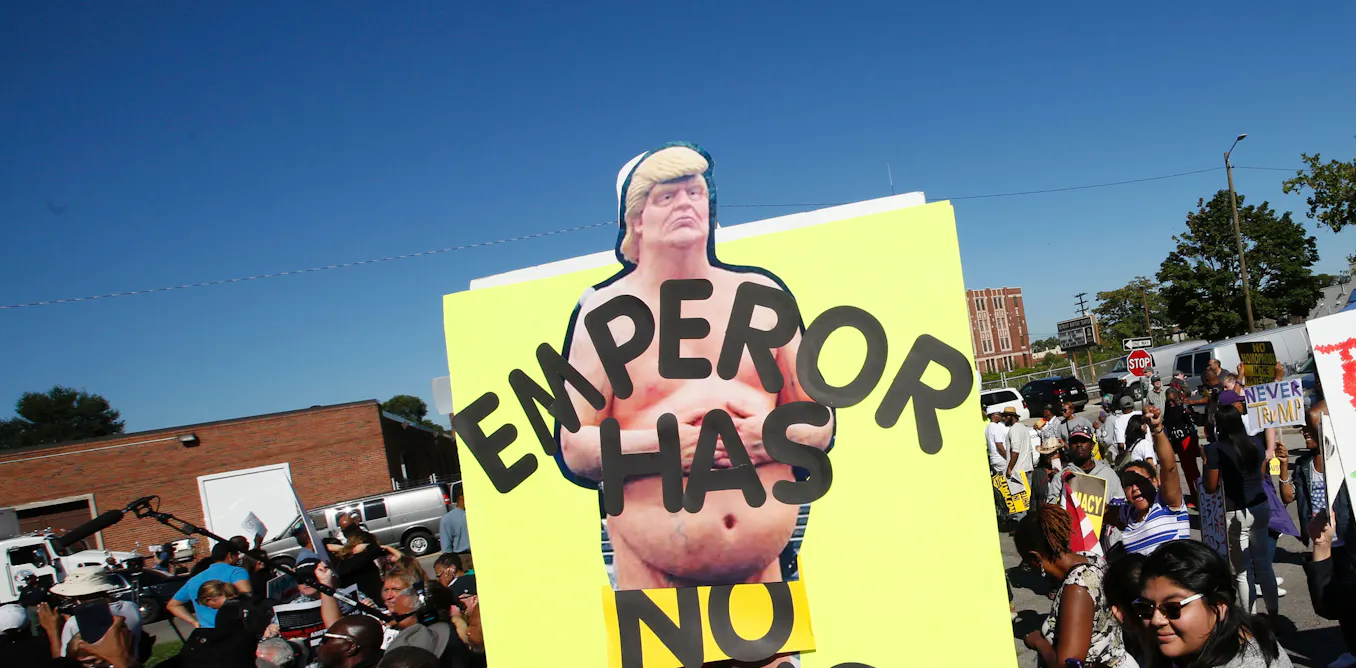
In mid-March, residents of Rutland County, Vermont, gathered for their weekly rally protesting the policies of U.S. President Donald Trump. Among the demonstrators was Marsha Cassel, who led the crowd dressed as a naked version of the president, complete with a crown and staff. Trailing behind her was another protester carrying a sign that boldly declared, “THE EMPEROR HAS NO CLOTHES!” The scene, captured during the rally on a crisp spring day, evoked the classic fairy tale by Hans Christian Andersen, drawing parallels between the story's vain ruler and contemporary political figures.
The protest in Rutland County highlights a growing trend of activists using literary references to critique leadership. Cassel's costume choice was not random; it directly referenced Andersen's 1837 tale The Emperor’s New Clothes, first published in his collection Fairy Tales Told for Children. In the story, a self-absorbed emperor falls for a scam by two conmen posing as weavers, who claim to create a fabric invisible only to those unfit for their positions or too simple-minded. Terrified of appearing incompetent, the emperor's aides pretend to see the nonexistent cloth, and the ruler parades naked through the streets to the adulation of his subjects—until a child cries out the truth.
According to reports from the event, Cassel, a local activist, said the demonstration aimed to remind people of the dangers of unchecked vanity in power. “We’re calling out the illusions,” she told onlookers, as quoted in local coverage. The rally, which typically draws a few dozen participants every Saturday afternoon, has been a staple in Rutland since Trump's inauguration in 2017, focusing on issues like immigration and environmental policy.
This isn't the first time The Emperor’s New Clothes has been invoked in political discourse surrounding Trump. Pundits and scholars have frequently drawn the comparison, noting the tale's critique of leaders who propagate untruths and the complicity of those around them. One such analysis comes from literary academic Naomi Wood, who argued in a post-9/11 context that the story reveals a “terrifying possibility”: adults persisting in their delusions even after the truth is exposed, allowing the farce to continue.
Hans Christian Andersen, the Danish author behind the tale, was born in 1805 in Odense, Denmark, to humble beginnings. His father was a cobbler, and his mother an illiterate washerwoman, despite family lore claiming noble ancestry from his grandfather. After his father's death when Andersen was just nine, the young boy moved to Copenhagen seeking opportunities. There, he caught the attention of theatre director Jonas Collin, who became his patron and funded his education.
Andersen graduated from university and turned to writing, gaining fame in the 1830s with his fairy tales. The Emperor’s New Clothes appeared alongside other enduring stories like The Steadfast Tin Soldier and The Little Mermaid. The tale's roots, however, trace back centuries to medieval folktales, where conmen exploit the vanities of the powerful. Literary scholar Hollis Robbins suggests Andersen's version captured the anxieties of a rising working class, where “professional competence” began eclipsing traditional legitimacy and heritage as markers of status.
Fairy tale expert Jack Zipes, in his book The Enchanted Screen: The Unknown History of Fairy-Tale Films, describes Andersen as someone “embarrassed by his proletarian background” who “rarely mingled with the lower classes” after achieving success. Yet, Zipes argues, this outsider perspective made Andersen adept at sharp social commentary, particularly on the struggles of those escaping poverty. Andersen himself never married and is now understood by historians as bisexual, with documented infatuations toward men like Edvard Collin—Jonas's son—and women such as Swedish opera singer Jenny Lind.
In 1872, Andersen suffered a fall from which he never fully recovered, leading to his death in 1875 at age 70. His personal life infused his works with themes of suffering and resilience. Zipes notes that in one translation of the story, the child who exposes the emperor is dubbed “the voice of innocence” by his father, a declaration that ripples through the crowd. Even as the emperor marches on, his aides futilely lift the imaginary train of his robe higher, a comical yet poignant image of denial.
“Regardless of one’s position in life, this story suggests you cannot escape ‘suffering, humiliation, and torture,’” Zipes writes, highlighting the tale's undercurrent of bleakness common in Andersen's oeuvre. Many of his stories feature fragile protagonists, often young women, enduring immense hardship before noble but tragic ends. The Emperor’s New Clothes, with its child as the harbinger of truth, offers a relatively lighthearted resolution compared to Andersen's darker narratives—though the emperor's parade persists amid laughter.
Fairy tales like this one originated as oral folktales, evolving into written forms in 16th- and 17th-century France, Italy, and Germany as tools for social commentary and moral education. Identifying “original” versions is challenging due to their folkloric nature, but Andersen's adaptations stand out for their notably grim tone, predating the sanitized Disney versions familiar today. The story has been retold countless times in print, film, and music, maintaining its relevance across eras.
In the context of modern politics, the tale's resonance with Trump's tenure is striking. As one pundit put it, the president has a habit of “constructing a narrative, declare it to be true and relentlessly force the world to submit to it.” This approach, critics say, mirrors the emperor's insistence on his finery despite evidence to the contrary. Supporters, however, view such comparisons as partisan overreach, emphasizing Trump's achievements in economic policy and foreign relations without directly addressing the literary analogy.
The Rutland rally underscores how cultural symbols can amplify political messages. Similar protests have occurred nationwide, from Washington, D.C., to smaller towns like Appleton, Wisconsin, where local groups have adapted fairy tale motifs to critique national leadership. In Appleton, for instance, a 2018 event featured protesters in makeshift crowns, echoing the Vermont demonstration but focusing on trade tariffs.
Scholars like Wood caution that the tale's true warning lies not just in the emperor's folly but in the crowd's acquiescence. “The truth of the fairy tale is not its glorification of the voice of innocence, free from corruption and untruth,” she writes. “Rather, it is that adults will continue to believe their own lies, even when they are clearly revealed.” This perspective invites reflection on how societies respond to exposed deceptions, whether in fairy tales or real-world governance.
Looking ahead, as Trump's influence persists beyond his presidency—through media appearances and political endorsements—the fairy tale's lessons may continue to surface in activism. In Rutland County, organizers plan to sustain their weekly rallies, incorporating more literary elements to engage the public. Marsha Cassel indicated future events might draw from other Andersen stories, aiming to foster dialogue on truth and accountability.
Ultimately, The Emperor’s New Clothes endures as a timeless critique of power's illusions. From Andersen's 19th-century Denmark to 21st-century America, it reminds us that a single honest voice can pierce the veil, even if the parade marches on. In places like Rutland, that voice echoes in signs, costumes, and chants, challenging onlookers to see clearly.