MAR-A-LAGO, Fla. — The capture of Venezuelan President Nicolás Maduro on Saturday has thrust President Donald Trump's foreign policy approach into the spotlight, with administration officials framing it as a stark demonstration of what they call the 'Fuck Around and Find Out' doctrine. Secretary of State Marco Rubio, speaking to reporters at Trump's Mar-a-Lago estate just hours after the operation, expressed bewilderment at why global leaders hadn't anticipated the consequences of challenging the U.S. president. 'I don’t understand yet how they haven’t figured this out,' Rubio said, underscoring what he described as the straightforward risks of crossing Trump.
The events unfolded rapidly in Venezuela, where U.S. forces reportedly executed a precision operation to apprehend Maduro and his wife, who face charges in U.S. courts related to drug trafficking and corruption. According to White House statements, the action was not an invasion but a law-enforcement maneuver aimed at neutralizing a regime accused of turning the country into a hub for international adversaries. Trump, addressing the press at Mar-a-Lago on Saturday, vowed that the U.S. would 'run Venezuela for the foreseeable future,' signaling a potential shift toward deeper American involvement in the South American nation.
Pete Hegseth, Trump's nominee for secretary of defense — whom he has styled as 'secretary of war' pending congressional approval — echoed the administration's blunt rhetoric during a CBS News interview. Hegseth described Maduro's downfall by saying the Venezuelan leader 'effed around, and he found out,' encapsulating what critics and supporters alike are dubbing the FAFO doctrine. This approach, Hegseth explained, prioritizes action over diplomacy, citing examples like disruptions to Iran's nuclear program, strikes against Houthi rebels in Yemen, and enforcement along the U.S. southern border.
Trump's comments built on this theme during an interview with The Atlantic's Michael Scherer on Sunday, where he defended the intervention as necessary for rebuilding a nation he said had 'gone to hell' under Maduro's decade-long rule. 'Rebuilding is not a bad thing, in Venezuela’s case,' Trump stated, drawing a contrast with past U.S. engagements like the Iraq War, which he blamed squarely on former President George W. Bush. 'That was Bush. You’ll have to ask Bush that question, because we should have never gone into Iraq. That started the Middle East disaster,' Trump said, highlighting his view that interventions in the Western Hemisphere warrant different considerations.
The administration has leaned into the FAFO messaging, circulating an image on social media of Trump striding purposefully up steps with the caption 'FAFO.' Rubio, during the Mar-a-Lago press conference, warned foreign nations against 'playing games' with the president. 'The 47th president of the United States is not a game player. If you don’t know, now you know,' Rubio declared, a phrase that the White House later amplified in a video set to the Notorious B.I.G. song of similar title, though it's unclear if the reference was intentional given Rubio's admitted interest in rap music.
Experts offered mixed assessments of whether this constitutes a formal doctrine. John Bolton, a former national security adviser to Trump who has since become a vocal critic, dismissed the idea in an interview with The Atlantic. 'There is no Trump Doctrine: No matter what he does, there is no grand conceptual framework; it’s whatever suits him at the moment,' Bolton said. Similarly, Kori Schake, director of foreign- and defense-policy studies at the American Enterprise Institute, cautioned against elevating the policy to doctrinal status. 'We shouldn’t ennoble Trump policy by saying there’s a doctrine,' Schake told reporters.
Historical context underscores the departure from Trump's earlier 'America First' rhetoric, which he revived in 2016 to promise an end to costly post-9/11 wars and a focus on domestic priorities. Yet the Venezuela operation marks a pivot toward adventurism in the Americas, reminiscent of the Monroe Doctrine from the early 19th century, which aimed to prevent European interference in the Western Hemisphere. Trump referenced this legacy at Mar-a-Lago, claiming the U.S. has 'superseded' it 'by a real lot.' A forthcoming National Security Strategy document, according to former U.S. Ambassador to Colombia Kevin Whitaker, includes a 'Trump corollary' to the Monroe Doctrine, asserting U.S. hegemony in the region and the right to take actions of 'questionable legitimacy.'
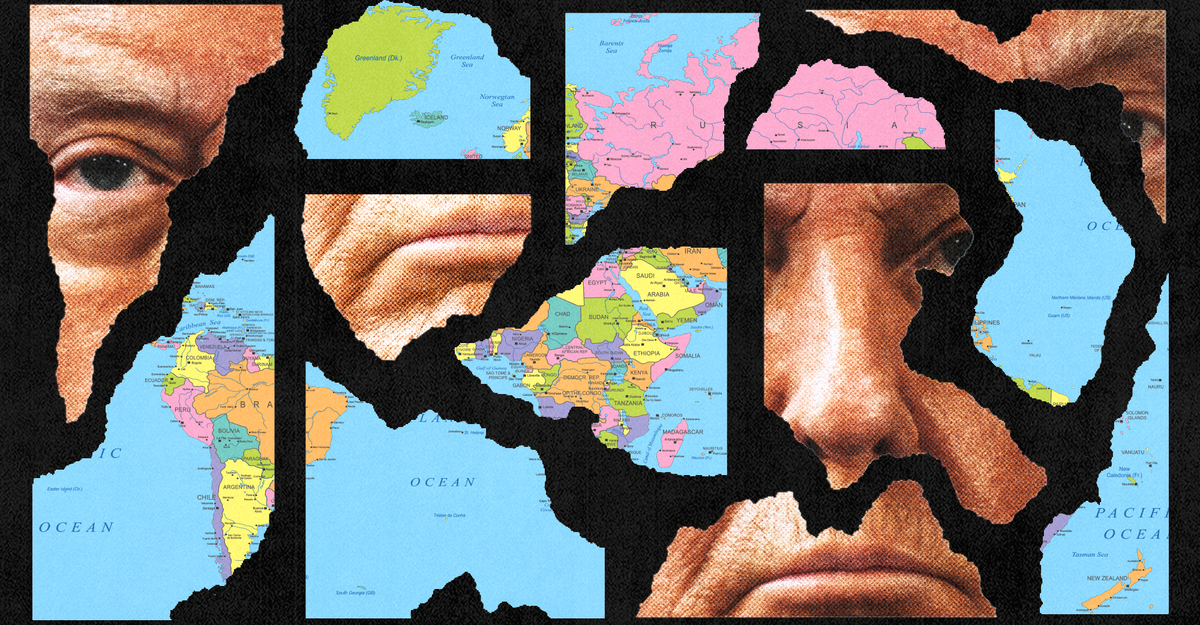
One anonymous source close to Trump told The Atlantic that the president applies a looser standard to hemispheric issues, viewing countries like Venezuela as extensions of U.S. influence. This perspective extends to resources such as Venezuelan oil and strategic sites like the Panama Canal. During his Sunday interview, Trump veered into related musings on Greenland, which he has long coveted for defense purposes. 'You know, I wasn’t referring to Greenland at that time, but we do need Greenland, absolutely. And we need it for defense. You know, it’s surrounded by Russian and Chinese ships,' Trump said. Katie Miller, wife of senior adviser Stephen Miller, posted an image on social media Saturday showing Greenland under an American flag with the caption 'SOON,' prompting Denmark's Prime Minister Mette Frederiksen to urge the U.S. to cease threats, calling them 'absolutely no sense.'
Broadening the scope, Trump used a 37-minute press interaction aboard Air Force One on Sunday evening to issue warnings to multiple nations, including Colombia, Cuba, Iran, Mexico, and Venezuela itself. He accused past presidents of neglecting leftist regimes in the Americas while pursuing distant conflicts, alleging Venezuela's involvement in sending criminals to the U.S., drug trafficking, and oil theft. 'All of these actions were in gross violation of the core principles of American foreign policy dating back more than two centuries—not anymore,' Trump stated.
Venezuelans, both in-country and among the diaspora in the U.S., have largely welcomed Maduro's ouster after years of economic collapse, corruption, and repression. However, details on U.S. oversight remain vague. Trump announced that Rubio, Hegseth, and other officials would form a group to 'run' Venezuela, but on NBC's Meet the Press Sunday, Rubio clarified they were merely 'running policy.' 'We are not going to be able to allow in our hemisphere a country that becomes a crossroads for the activities of all of our adversaries around the world,' Rubio said, portraying the capture as a judicial matter.
Prior to Maduro's apprehension, the Trump administration had already escalated actions across the Americas, threatening strikes on Mexican cartels despite objections from Mexico's government, pardoning a former Honduran president convicted on U.S. drug charges, and extending a $20 billion credit line to Argentina. Ricardo Zuniga, a former Biden administration official for Latin America, described this as a '19th-century view of the world,' noting the U.S.'s history of interventions that often backfired, fostering anti-American nationalism in places like Nicaragua, Cuba, and Chile.
The FAFO approach appears tailored to deter rivals like Russia and China. A U.S. official, speaking anonymously, claimed Russian President Vladimir Putin has been 'scared shitless' by the Venezuela operation, interpreting it as a warning against challenging U.S. military might. Yet limits exist: The source close to Trump indicated no desire for prolonged occupations, preferring threats as leverage. In Venezuela, interim President Delcy Rodríguez — Maduro's second-in-command, sworn in Saturday — faces an 'or else' ultimatum. 'If she doesn’t do what’s right, she is going to pay a very big price, probably bigger than Maduro,' Trump warned Scherer.
As the dust settles, questions linger about the sustainability of this aggressive posture. The person close to Trump suggested it's a calculated risk, with the president willing to court short-term misunderstanding to achieve long-term goals. 'Most presidents would not go out and say, ‘I’m not afraid to put boots on the ground,’ because their base would go, ‘Wait a minute,’' the source said. For now, the operation has reshaped dynamics in the Western Hemisphere, potentially inviting both cooperation and backlash from neighbors wary of renewed U.S. dominance.
Broader implications extend to global alliances, with even close partners questioning the U.S. role in Venezuela. As Trump prepares to outline his vision further, the world watches to see if FAFO will define his second term or provoke unintended escalations.