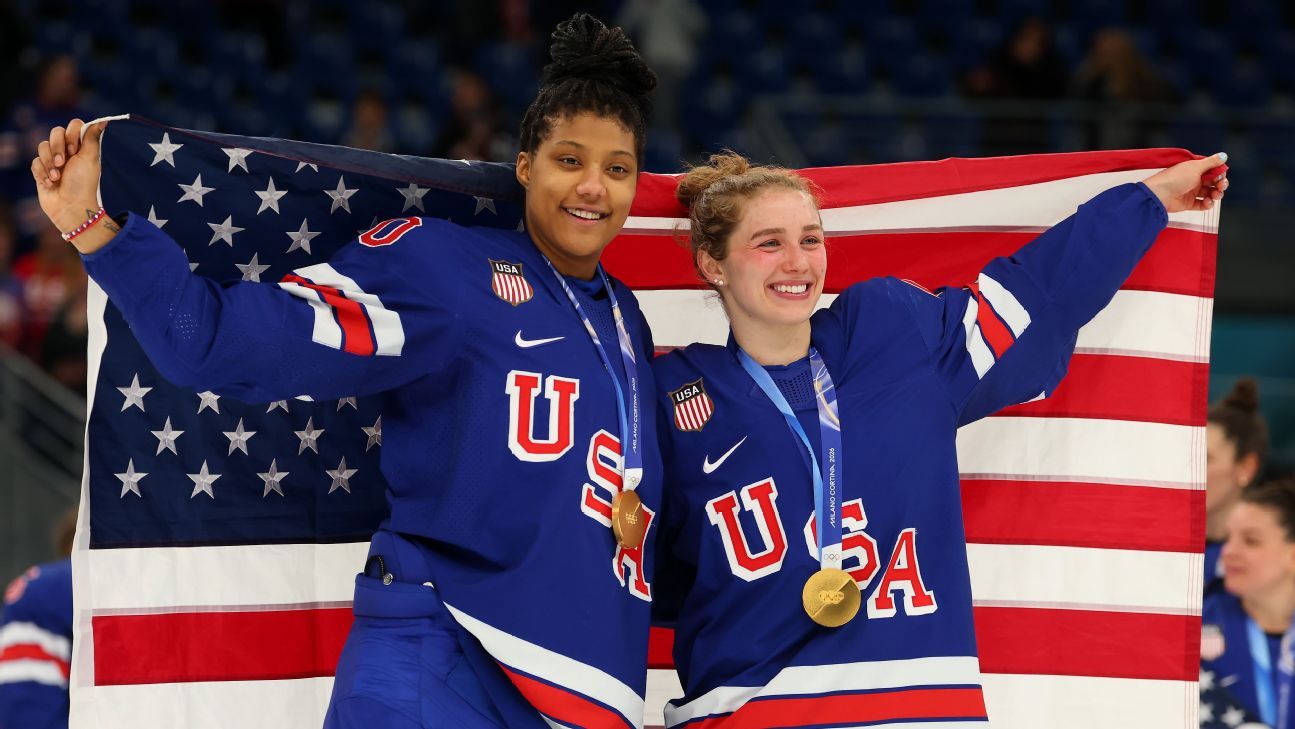
MILAN, Italy -- The U.S. women's hockey team captured Olympic gold at the 2026 Winter Games here, capping a dominant tournament run that has players and observers alike hailing it as one of the most talented squads in the program's storied history. With a perfect 7-0 record and a staggering goal differential of 33-2, the Americans outclassed their competition, including a tense 2-1 overtime victory over rival Canada in the final. The win marks the first Olympic gold for the U.S. women since 2018, breaking a streak of silver medals and reigniting talk of a potential dynasty.
Hayley Scamurra, a 31-year-old forward and two-time Olympian with six world championship medals -- three gold and three silver -- didn't mince words after the victory. "Oh yeah," she said. "100%." Scamurra was referring to her belief that this 2026 team surpasses any she's played on, a sentiment echoed throughout the post-game celebrations.
First-time Olympian Taylor Heise, 25, who wore her new gold medal proudly while navigating the interview area, shared similar enthusiasm. "I didn't want to be the first one to say it. Someone said it before me, so thank goodness," Heise remarked. "But I just think we cemented ourselves as one of the best U.S. teams in history." Heise, the reigning Professional Women's Hockey League playoff MVP, contributed significantly to the team's depth, helping drive their offensive firepower.
Meghan Duggan, a Hockey Hall of Famer and captain of the 2018 gold-winning team, offered even broader perspective from her years in the sport. "This is the most dominant team I've ever seen," Duggan said. "In all my years watching and playing, I've never seen a team like that." Duggan's comments underscore the historical weight of the performance, especially given the U.S. program's legacy of fierce competition.
The gold medal game itself was a thriller, decided in overtime when veterans Hilary Knight, 36, and Megan Keller, 29, stepped up as the heroes. Knight, who announced that Milan would be her fifth and final Olympics, scored the game-winner, while Keller's defensive play anchored the backline. Knight's goal came at 2:47 of the extra period, silencing a pro-Canadian crowd at the Mediolanum Forum.
Yet it was the influx of young talent that truly dazzled, stealing headlines and signaling a bright future. Players like Laila Edwards, Caroline Harvey, Tessa Janecke, and Abbey Murphy -- all 23 or younger -- are set to enter the PWHL draft this spring, forming what many call the most loaded class in the league's short history. Harvey, named tournament MVP, drew comparisons to hockey legend Bobby Orr from NHL star Matthew Tkachuk. "Crazy," Harvey responded, noting she wears the same No. 4 as the Hall of Famer.
Hannah Bilka, 24, who plays for PWHL Seattle, led the U.S. with four goals during the Olympics. Goalie Aerin Frankel, 26, set a new Olympic record with three shutouts in the tournament. The team's depth was evident in its scoring: ten players tallied at least five points, six more than any other nation. "We're confident," Harvey said. "We're going to go back and tear it up."
This dominance comes against a backdrop of North American supremacy in women's hockey. Since the sport's Olympic debut in 1998 at Nagano, Japan, the U.S. and Canada have claimed every gold and silver medal. They've also dominated the IIHF World Championships, winning all but one gold and silver across 24 tournaments -- the exception being a silver for host Finland in 2019.
Early years favored Canada, which captured the first eight world titles from 1990 to 2006, including the initial three from 1990 to 1994 by a combined 19-5 score margin. Over time, the rivalry has intensified into one of sports' most heated. Entering the Milan Games, Canada led the all-time series 25-23 but held only a slim 135-133 edge in total goals, according to the Associated Press.
Duggan highlighted the U.S. pipeline as a key factor. "If you look at the depth charts of both teams, who is even in the pipeline to come? The U.S. has the Harveys, the [Abbey] Murphys, the [Laila] Edwards -- these women are going to play in a couple different Olympics," she said. "And if you look at them now, they're already some of the best players in the world."
Canada's performance sparked internal discussions after the loss. The team returned 16 players from its 2022 Beijing gold squad, opting for familiarity over injecting younger talent. This choice left some ascending prospects at home, a decision that became a point of debate as Canada appeared slower against the faster American attack. "Coming into this [gold medal] game, I think everyone was like wow, U.S. has the edge, and it's not just going to be a coin toss," Duggan noted, pointing to a perceived shift in the balance of power.
Coach John Wroblewski attributed the U.S. success to the players' unparalleled intensity. "The intensity level is something I've never seen," he said. "We as a staff had to adjust almost all the plans that we had. If we had 40 minutes planned, they were demanding an hour and a half. Video sessions you could tell they wanted more. It was like Neo in the 'Matrix.' They were just dialed. And they wanted more information and more motivation." Wroblewski's coaching staff, which included adjustments for the team's drive, guided them through preliminary rounds where they shut out opponents like Sweden 5-0 and Czechia 3-0.
The U.S. women's program has evolved amid growing professional opportunities, including the PWHL's launch in 2023. This has bolstered talent development, with players like Heise and Bilka already established in the league. Edwards, reflecting on the leadership, added, "With this young talent, we've just had incredible leaders. The future of USA Hockey is in really good hands."
While the victory evokes comparisons to the U.S. women's basketball team's eight straight Olympic golds, Duggan cautioned against overconfidence. Canada, with its deep history and pride, remains a formidable foe, as evidenced by pushing the final to overtime. "It's the speed, it's the skill, the hockey sense, the connectivity, the depth, the combination of the youth. That's what makes them the most dominant team," Duggan said. She dismissed notions of broader sporting evolution, noting, "this isn't the best Canadian team we've ever seen. So there goes that argument."
Looking ahead, the U.S. team eyes the 2027 IIHF World Championship in St. Louis, Missouri, as a next test. With many core players returning and the PWHL draft poised to add even more stars, the Americans aim to extend their momentum. For now, Milan has etched this group into Olympic lore, setting the stage for what could be an extended era of excellence on the ice.