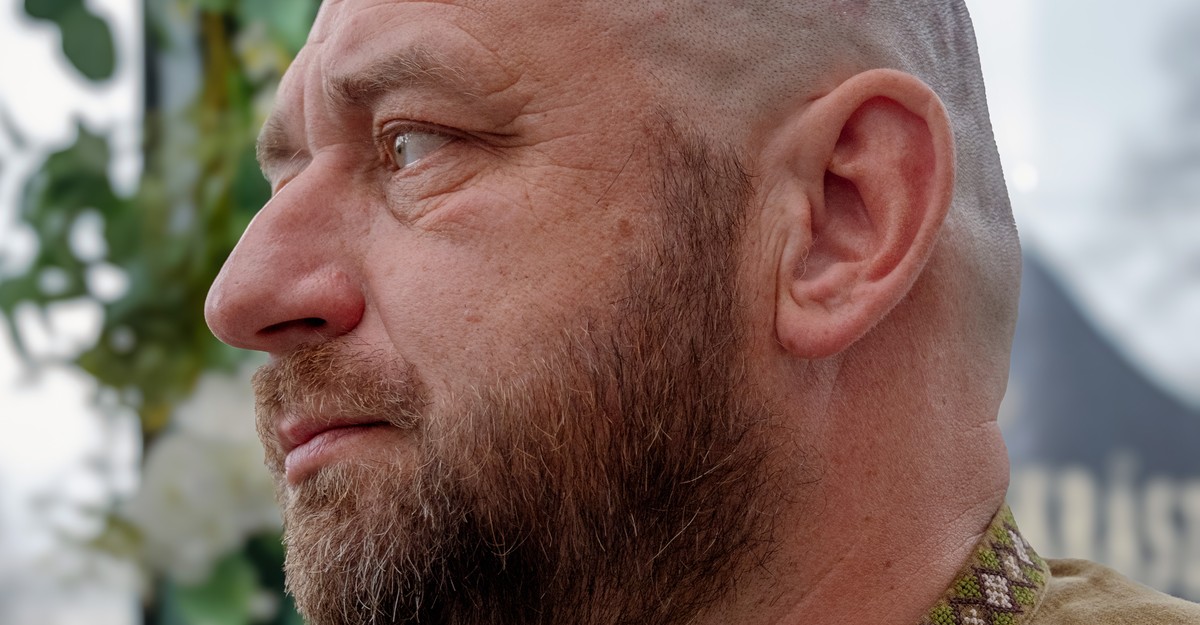
BUDAPEST, Hungary — As Hungary approaches its parliamentary elections on April 7, the role of Ukraine's ambassador to the country has become one of the most precarious diplomatic posts in Europe. Fedir Shandor, a 50-year-old former university professor turned battlefield commander, navigates a landscape where Prime Minister Viktor Orbán has centered his reelection campaign on portraying Ukraine as an existential threat to Hungarian sovereignty. Orbán, who has positioned Hungary as the European Union's most vocal critic of support for Kyiv, warns voters that without his leadership, Hungary could become a 'Ukrainian colony,' with President Volodymyr Zelensky potentially drafting Hungarians into the war against Russia.
Shandor, whose mother is Ukrainian and father Hungarian, embodies the intertwined histories of the two nations, separated by an 85-mile border and sharing a legacy in the Transcarpathia region. In an interview over the weekend at a pastry shop on the outskirts of Budapest, the burly ambassador arrived with the energy of a man undeterred by the hostility. Dressed in a traditional Ukrainian embroidered shirt, he waved his arms animatedly and spoke at a volume that turned heads. 'Do you feel safe here?' he was asked, given his status as a frequent target of pro-government media and repeated summons to the foreign ministry for reprimands. 'Yes!' Shandor replied without hesitation. 'It’s no problem, no problem.' He attributes his resilience to his time as a sergeant on the front lines, where he says information warfare pales in comparison to actual combat.
Shandor's path to diplomacy was forged in the fires of Russia's full-scale invasion of Ukraine in February 2022. At the time, he headed the sociology faculty at Uzhhorod National University in western Ukraine. When Russian forces attempted to seize Kyiv and other key cities, Shandor enlisted at a recruiting center. He helped repel advances in Sloviansk and Kharkiv, continuing to deliver virtual lectures to his students from the battlefield due to his prior experience teaching online during the coronavirus pandemic. 'It’s my country; it’s my family,' he said of his decision to fight. After his company commander was killed, Shandor assumed leadership and served for about two years before being appointed ambassador in 2024.
Now, Shandor describes his primary duty in one word: 'I am a bridge.' Despite Orbán's campaign rhetoric, which includes posters depicting Zelensky as a wanted criminal glaring from billboards, Shandor insists the connection between the peoples of Hungary and Ukraine remains strong. Just outside the pastry shop window during the interview, one such poster loomed large. 'Yeah, it’s my president, very popular,' Shandor quipped, slouching in his chair. 'Maybe next election, he’ll be the president in Hungary.' He quickly added, 'It’s a joke,' with a playful elbow nudge.
The ambassador's efforts focus on grassroots diplomacy. He fosters sister-city relationships, supports ethnic Hungarians in Ukraine, and coordinates humanitarian aid. Hungarian volunteers, for instance, have helped finance the reconstruction of Ukrainian kindergartens damaged by Russian bombs and missiles. While this aid is modest — a 'pittance' compared to the €90 billion EU loan package that Orbán has blocked amid disputes over oil pipeline disruptions through Ukraine — Shandor argues it carries significant symbolic weight. According to him, the government's animosity does not mirror societal views, with about 70 percent of his government contacts remaining intact even during the election period, which he dismisses as a 'stupid period.'
Yet tensions have escalated beyond rhetoric. Earlier this month, Hungarian counterterrorism authorities detained a group of Ukrainians transporting approximately $82 million in cash and gold via armored vehicles from Austria to Ukraine. Budapest's government alleged money laundering, using the incident to reinforce claims of Ukrainian meddling in Hungarian affairs. Ukrainian officials, however, described it as a routine road convoy necessitated by the war's dangers to air travel. Shandor recounted how the detainees were blindfolded and one allegedly injected with a muscle relaxant, which he called a 'truth vaccine.' Acting as a bilingual intermediary, he resolved the standoff by speaking Hungarian on one phone line and Ukrainian on another. 'Election,' he explained succinctly. 'Every week there’s a new idea. Classic Russian methods.'
Hungary's position as Europe's most reliable Russian ally within the EU adds layers of complexity. Orbán's Fidesz party has accused the main opposition, Tisza, led by Péter Magyar, of being a Ukrainian front operation aimed at ousting the prime minister. Magyar, a former insider in Orbán's ruling circle, has surged in popularity after 16 years of Fidesz dominance, with most polls showing him ahead as of late March. Pro-government media has targeted Shandor as a bogeyman, but he remains unfazed, drawing on Hungary's cultural independence — its unique language, music, poets, and gastronomy — as a bulwark against foreign influence. 'Pride in Hungary’s singular culture inoculates the country against foreign propaganda,' he suggested.
Western officials, however, express greater concern about Russian interference. They have endorsed reports that the Kremlin plans to leverage social media to bolster Orbán and undermine Magyar. An independent investigative outlet, VSquare, reported earlier this month that a delegation from Russia's GRU military-intelligence agency arrived at the Russian embassy in Budapest. Separately, The Washington Post revealed a Russian proposal to stage an assassination attempt on Orbán to consolidate support behind him. Shandor predicts that with the election two weeks away, destabilization efforts could intensify, potentially involving 'physical contact' to 'destroy the society' and divide the country into 'two parts.'
Shandor's lighthearted demeanor persists even amid grave topics. Discussing a smear campaign against Magyar, which involved circulating a still image from an alleged consensual intimate encounter rather than a full video, the ambassador chuckled. 'Hungary is a sexual nation,' he said. 'It’s a beautiful, sexual nation.' He clapped approvingly at Magyar's appeal: 'Young leader, easy on the eyes, not impotent.' Such episodes, Shandor believes, have ultimately benefited the opposition candidate.
Beyond Budapest, Shandor engages with local communities. He was set to travel to Debrecen, Hungary's second-largest city, to lecture the Ukrainian diaspora there. During rare vacations, he returns to Ukraine's front lines to deliver aid. 'It’s normal,' he said matter-of-factly. His dual heritage and combat experience position him uniquely to bridge divides, though the election's shadow looms large.
The broader dispute between Hungary and Ukraine extends to economic and security realms. Orbán's blockade of the EU aid package stems partly from disagreements over the Druzhba pipeline, which carries Russian oil through Ukraine and has faced interruptions due to war-related damage. Ukraine maintains that these issues are being addressed bilaterally, while Budapest leverages them to demand exemptions from EU sanctions on Russia. Ethnic Hungarian minorities in Ukraine's Transcarpathia region, numbering around 150,000, also factor into the tensions, with Orbán advocating for their rights amid Kyiv's wartime language policies.
As the campaign intensifies, the international community watches closely. The United States and EU allies have urged Hungary to align more firmly with NATO and EU consensus on Ukraine, but Orbán's veto power in the bloc has prolonged the standoff. Shandor's optimism contrasts with warnings from analysts who see Hungary's drift toward Moscow as a vulnerability for European unity. With polls tightening, the outcome could reshape not only Hungarian politics but also the trajectory of Western support for Ukraine.
Shandor's story underscores the human element in geopolitics. From the trenches of Kharkiv to the pastry shops of Budapest, he carries the weight of his nation's survival. As Hungary votes, his bridge-building may prove more crucial than ever, even if the path ahead remains fraught with 'classic Russian methods' and domestic divisions.
(Word count: 1,078)