Pakistan's unexpected emergence as a mediator in high-stakes talks between the United States and Iran has left Indian leaders grappling with a sense of diplomatic isolation amid an escalating Middle East conflict that is battering the country's economy. In recent weeks, Islamabad has hosted at least one round of negotiations aimed at resolving the U.S.-Israel-Iran war, positioning itself as a key player while New Delhi watches from the sidelines. The April 8 cease-fire announcement in the broader regional tensions only amplified frustrations in Indian political circles, where critics have accused Prime Minister Narendra Modi's government of squandering India's global influence.
Indian Foreign Minister Subrahmanyam Jaishankar initially downplayed Pakistan's involvement, referring to it with a pejorative Hindi term for an unsavory middleman during a recent briefing. However, opposition voices have been sharper in their assessments. Jairam Ramesh, a spokesperson for the Congress Party, posted on X that Pakistan's role represented “a severe setback to both the substance and style of Mr. Modi’s highly personalised diplomacy.” He went on to mock Modi's self-proclaimed title of vishwaguru, or “teacher of the world,” suggesting the prime minister's global ambitions have fallen flat.
Asaduddin Owaisi, India's most prominent Muslim politician and leader of the All India Majlis-e-Ittehadul Muslimeen, echoed this sentiment, stating that India would have been the natural venue for the U.S.-Iran talks “if not for the Modi government’s missteps.” Owaisi's comments highlight a growing chorus of discontent among Modi's domestic rivals, who argue that strained international relationships have diminished India's stature at a critical juncture.
The roots of this diplomatic rift trace back to last spring, when a terrorist attack in Indian-administered Kashmir triggered a four-day conflict between India and Pakistan. President Donald Trump intervened decisively, announcing a cease-fire that halted the fighting but reportedly embarrassed Modi, who prides himself on a strongman image. According to sources familiar with the matter, Modi struggled to publicly acknowledge the U.S. role, straining ties with the Trump administration. This tension escalated when Trump imposed 50 percent tariffs on Indian goods—among the highest levied globally—further souring bilateral relations.
In contrast, Pakistan seized the opportunity to mend fences with Washington. The war on terror had long bred suspicions of Islamabad's double-dealing, but last year, Pakistani Prime Minister Shehbaz Sharif publicly thanked Trump for his cease-fire mediation and even nominated the U.S. president for the Nobel Peace Prize. Embracing Trump's transactional approach, Pakistan inked a deal on rare-earth minerals with the United States and joined the president's informal Board of Peace, moves that have bolstered its standing.
The first round of U.S.-Iran talks in Islamabad concluded without agreement just over a week ago, a development that briefly buoyed Indian elites. Priyanka Chaturvedi, a former member of Parliament from the Shiv Sena party, posted on X: “To all those who were hailing the Pakistan mediation and calling it a diplomatic coup. Hope the cake on your face was tasty.” Yet Pakistan has not stepped back, with reports indicating a second round of talks could occur in Islamabad this week, keeping the pressure on New Delhi.
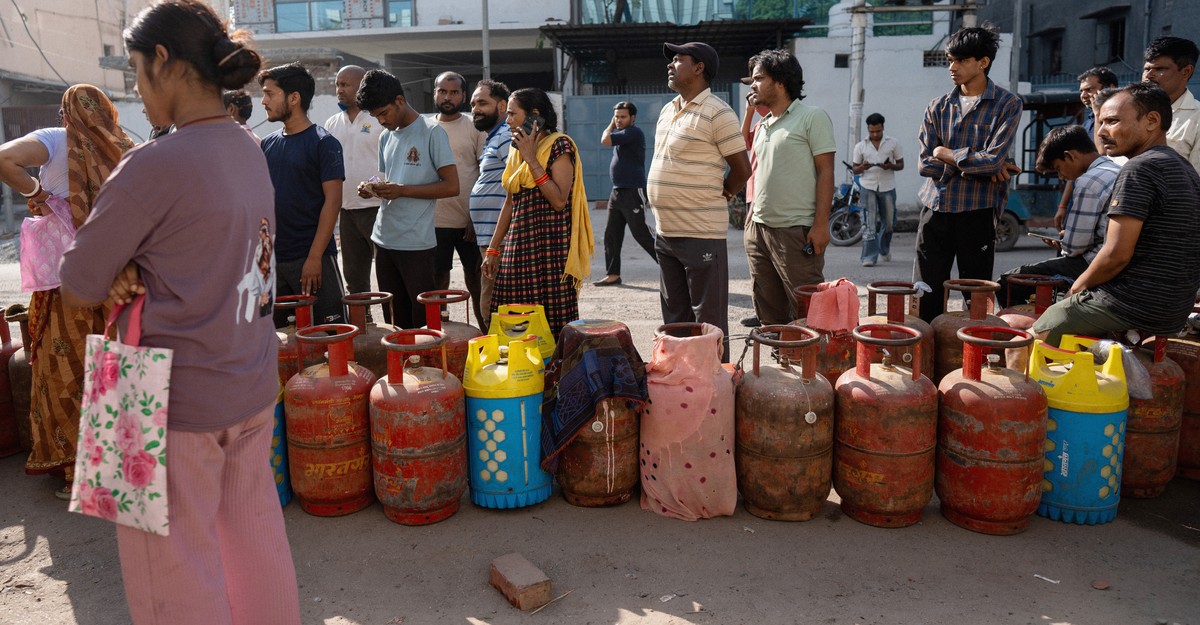
For ordinary Indians, the focus is less on diplomatic slights and more on the tangible fallout from the U.S.-Israel-Iran war, which has disrupted vital energy supplies. India sources half of its oil and 60 percent of its liquid petroleum gas from the Middle East, much of it passing through the Strait of Hormuz. The conflict has triggered an oil shock, leading to widespread economic strain. Restaurants in major cities have shuttered early or closed entirely, while rural migrants are returning to villages en masse, citing farm life and wood fires as preferable to urban starvation.
Factories have halted operations due to energy uncertainties, and fertilizer shortages threaten food security across the nation. The Indian rupee has plummeted, exacerbating inflation. A United Nations report warned that the Iran war could drive up to 2.5 million Indians into poverty, underscoring the human cost of the geopolitical turmoil.
On a humid afternoon earlier this month in central Delhi, 56-year-old electrical worker Irfan Ahmed described the daily grind intensified by the crisis. Emerging from a gas dealership with a bulky red cylinder—standard for most Indian households without piped gas—Ahmed said procuring it had cost him a full day's wages and over five hours. “Before the Iran war, I would have placed a request online, and the cylinder would have been delivered to my home within three days,” he recounted. Now, the online system is defunct, and buyers must queue for hours to verify identity documents, ostensibly to curb black-market sales. Ahmed and his brother then balanced the 50-pound cylinder on a scooter for the ride home, a precarious task mirrored by dozens of others navigating the streets on motorbikes.
The Indian government's initial response to the war's outbreak appeared muted. When a February 28 airstrike killed Iranian Supreme Leader Ali Khamenei, New Delhi maintained silence for several days before a diplomat signed the condolence book at the Iranian embassy. Opposition figures in the Congress Party interpreted this as tacit approval from Modi, who they claim miscalculated the conflict's trajectory. Rather than regime collapse in Iran, the war intensified, culminating in Iran's blockade of the Strait of Hormuz.
India scrambled for workarounds. On March 12, Modi spoke directly with Iranian President Masoud Pezeshkian, securing passage for a few Indian ships through the strait. The U.S. also waived some sanctions, allowing India to receive its first Iranian oil shipment in seven years that April. But tensions flared again on April 18, when Iran fired at two Indian-flagged vessels attempting to cross the strait, forcing them to retreat. India promptly summoned the Iranian ambassador to express “deep concern,” according to a foreign ministry statement.
Historically, India balanced its Middle East policy with deep ties to Iran—spanning over a millennium—and growing relations with Israel. Under Modi, however, this equilibrium has shifted toward closer alignment with Israeli Prime Minister Benjamin Netanyahu. Modi's visit to Israel just before the war's escalation reportedly undermined any chance for New Delhi to mediate, observers say. “India has been pretty irrelevant in the war,” noted Aakar Patel, a prominent writer and columnist, in a recent interview. “Except that we are taking the punishment quietly.”
Modi's domestic policies, including the rise of anti-Muslim Hindu nationalism, have further eroded India's regional clout, particularly in the Muslim-majority Middle East. Coupled with restrictions on media scrutiny, this has stifled public debate on the crisis. On April 18—the same evening as the vessel incident—Modi addressed the nation in prime time, but instead of outlining economic or geopolitical strategies, he focused on attacking political opponents ahead of an upcoming election in West Bengal.
Meanwhile, popular culture reflects a disconnect from reality. The Bollywood film Dhurandhar, depicting an Indian spy inflicting brutal revenge on Pakistani foes, became one of the highest-grossing movies ever shortly after the war began, embodying the hypernationalist escapism prevalent in public discourse.
India's aspirations as a rising global power now appear diminished. Once envisioned as a South Asian hegemon countering China and overshadowing Pakistan, the country fought its neighbor to a draw last summer and struggles to shape events in the Middle East. “The ambition that India would be this global power is gone,” Patel said. “It’s only the pageantry that remains.” As Pakistan potentially hosts further talks, Indian officials face mounting questions about reclaiming relevance in a volatile world.