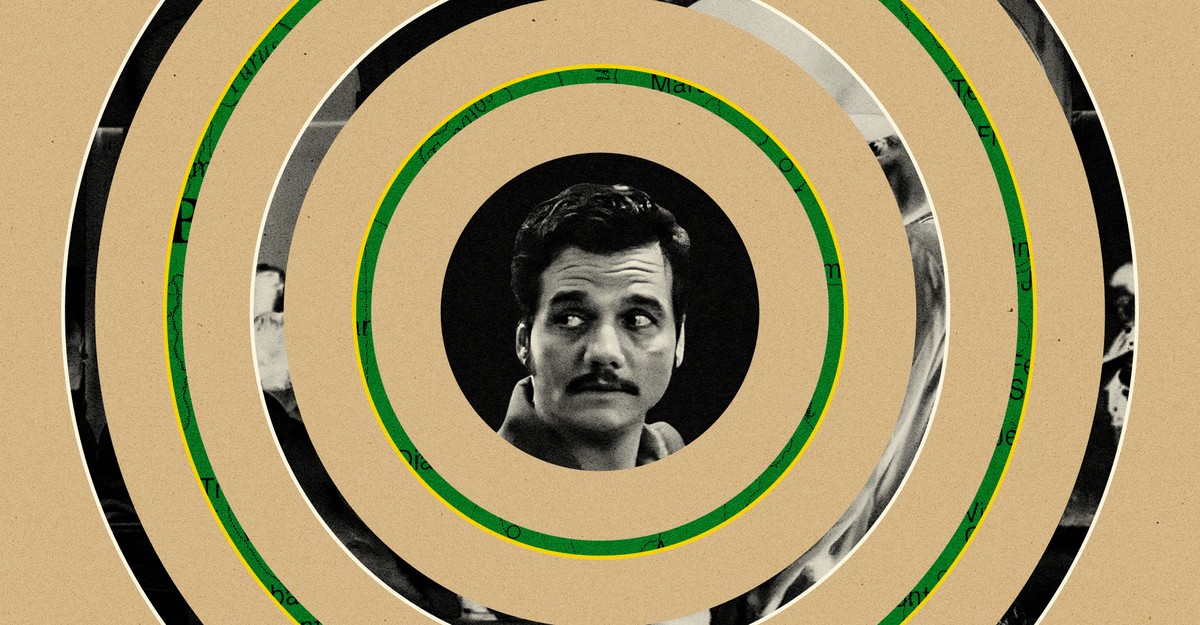
RECIFE, Brazil — As Wagner Moura's portrayal of a hapless scientist on the run garners Oscar buzz, Kleber Mendonça Filho's latest film, The Secret Agent, has emerged as a poignant exploration of Brazil's enduring societal fractures, blending thriller elements with a deep dive into the country's authoritarian past and present-day corruption.
The film, Mendonça Filho's fifth feature, unfolds over 160 minutes and is set against the backdrop of Brazil's military dictatorship from 1964 to 1985. It follows Armando Solimões, played by Moura, who is nominated for Best Actor in a Leading Role at the upcoming Oscars. Armando, a research scientist, finds himself fleeing after crossing a powerful businessman, Ghirotti, from Brazil's wealthy southeast region. The story begins with Armando seeking refuge in a safehouse in Recife, the coastal metropolis where the director grew up, overseen by the no-nonsense Dona Sebastiana.
Shot in amber tones and featuring era-specific details like bell-bottoms and screenings of 1970s blockbusters such as Jaws and The Omen, the movie captures the late 1970s atmosphere of paranoia and repression under the U.S.-backed regime. Yet, as Mendonça Filho explained to the Brazilian news magazine Veja in 2023, while the film was still in production, “The Secret Agent is not a dictatorship film: It’s about the logic of Brazil.” This “logic,” according to the director, encompasses persistent issues of corruption, impunity, and greed that continue to plague the nation.
Mendonça Filho, known for his incisive takes on Brazilian society, has long focused on these themes. His debut feature, Neighboring Sounds (2012), examined class and racial tensions in Recife amid rapid urban development. It was followed by Aquarius (2016), which starred Sonia Braga and critiqued gentrification in the city. In 2019, he co-directed Bacurau with Juliano Dornelles, a satirical western about foreign hunters targeting a rural Brazilian village, highlighting venal politics and exploitation.
More recently, Mendonça Filho's 2023 documentary Pictures of Ghosts wove personal anecdotes with archival footage to chronicle Recife's decaying cinemas and the broader erasure of Brazil's history. In the film, the director's late mother, historian Joselice Jucá, appears in an archival television interview, stating, “Through oral history, we collect the information that’s been left out of history.” This emphasis on overlooked narratives directly inspired The Secret Agent, which incorporates flash-forwards to the present day where young contractors at an unnamed university transcribe tape-recorded testimonies from Armando and other victims of the regime.
The film's structure underscores Brazil's delayed reckoning with its dictatorial past. While neighboring countries like Argentina and Uruguay launched investigations into their regimes soon after they ended, Brazil waited until 2011 to establish its National Truth Commission. Mendonça Filho has argued that this official amnesia contributed to the 2018 election of Jair Bolsonaro, who campaigned on nostalgia for military rule. Bolsonaro, now facing legal repercussions, was sentenced to 27 years in prison for his role in the failed 2023 coup attempt and barred from electoral politics until 2030, according to Brazilian government announcements.
For international audiences, films like Walter Salles's 2024 Oscar-winning I’m Still Here have introduced the brutalities of the Brazilian dictatorship. Based on a memoir by Eunice Paiva's son, the movie depicts Paiva's quest for justice after her husband, an opposition congressman, was disappeared by the state. It ends on a note of familial reconciliation in a hopeful present-day Brazil. The Secret Agent, however, offers a more nuanced view, avoiding a singular heroic narrative in favor of a broader tapestry of human experiences under repression.
In the safehouse, Armando interacts with a diverse group of refugees, including a casual romantic interest, Claudia, whose backstory remains undisclosed. Amid the tension, moments of levity emerge: Carnival celebrations spill into the streets, and fugitives distract themselves with newspaper reports of surreal local events, like a stop-motion severed leg terrorizing cruisers in a city park—a real-life symbol from the era used by Recife reporters to obliquely reference domestic violence and police brutality.
The film humanizes even its antagonists. One assassin, Bobbi, hired by Ghirotti to track Armando, is revealed to have entered his line of work after his stepfather murdered his mother. Bobbi's resentment flares when Recife's crooked police chief mocks his name and masculinity, prompting the chief to scoff, “What’s with ‘Bobbi’ anyway? That a man’s name?” Bobbi, in turn, outsources the hit to a dark-skinned dockworker, snarling, “You work in this shithole carrying sugar like some animal.” The camera captures Bobbi's striking profile, blurring lines between beauty and brutality.
This chain of cruelty illustrates Mendonça Filho's “logic of Brazil,” where personal vendettas and bigotry perpetuate systemic violence, even without direct state involvement. The dictatorship's savagery, the film suggests, is intertwined with societal ills like envy and desperation. Armando's plight stems not from political activism but from refusing to hand over lucrative research, leading to his separation from his young son, Fernando—a separation portrayed as a senseless outrage.
Interwoven personal histories add layers of historical depth. In a flash-forward, an adult Fernando, also played by Moura, speaks to a researcher preserving his father's testimonies. He recounts that Armando was conceived when a 17-year-old white boy impregnated the 14-year-old daughter of the family's Indigenous housemaid, whom he describes haltingly as “a kind of servant. Like … a slave … or an enslaved person.” This revelation ties the film's events to Brazil's legacy of slavery, abolished in 1888 but with echoes persisting in labor exploitation.
A nightmarish sequence transitions into the film's third act, where Armando dreams of a rotting corpse at a rural gas station rising with a moan, followed by a blood-red masked figure at his bedside. Awakening in terror, he is steadied by Claudia, who holds his face and says, “Look at me. I’m here,” pulling him into an embrace without false reassurances.
Dona Sebastiana offers a grounding perspective to the exiles, declaring in a tender moment, “Life has bad things but also has good things”—a simple counter to despair. In a recent interview with The New Yorker, Mendonça Filho noted that Brazilians often prefer to “not talk about unpleasant things,” yet the film posits that confronting these obscenities is essential, as they form part of the nation's long history rather than isolated aberrations.
Unlike the equal amnesty law of 1979, which granted impunity to both regime opponents and perpetrators, The Secret Agent eschews tidy resolutions. It reflects a world without a clear moral arc, where justice remains elusive, much like in contemporary Brazil. The film's release comes at a time of global concerns over authoritarianism, providing a lens on how societies grapple with — or avoid — their pasts.
As The Secret Agent gains traction ahead of the Oscars, it invites viewers to consider the hard work of remembrance. By amplifying forgotten voices through fiction grounded in testimony, Mendonça Filho's work challenges Brazil — and beyond — to build over amnesia rather than history, fostering empathy in place of erasure.