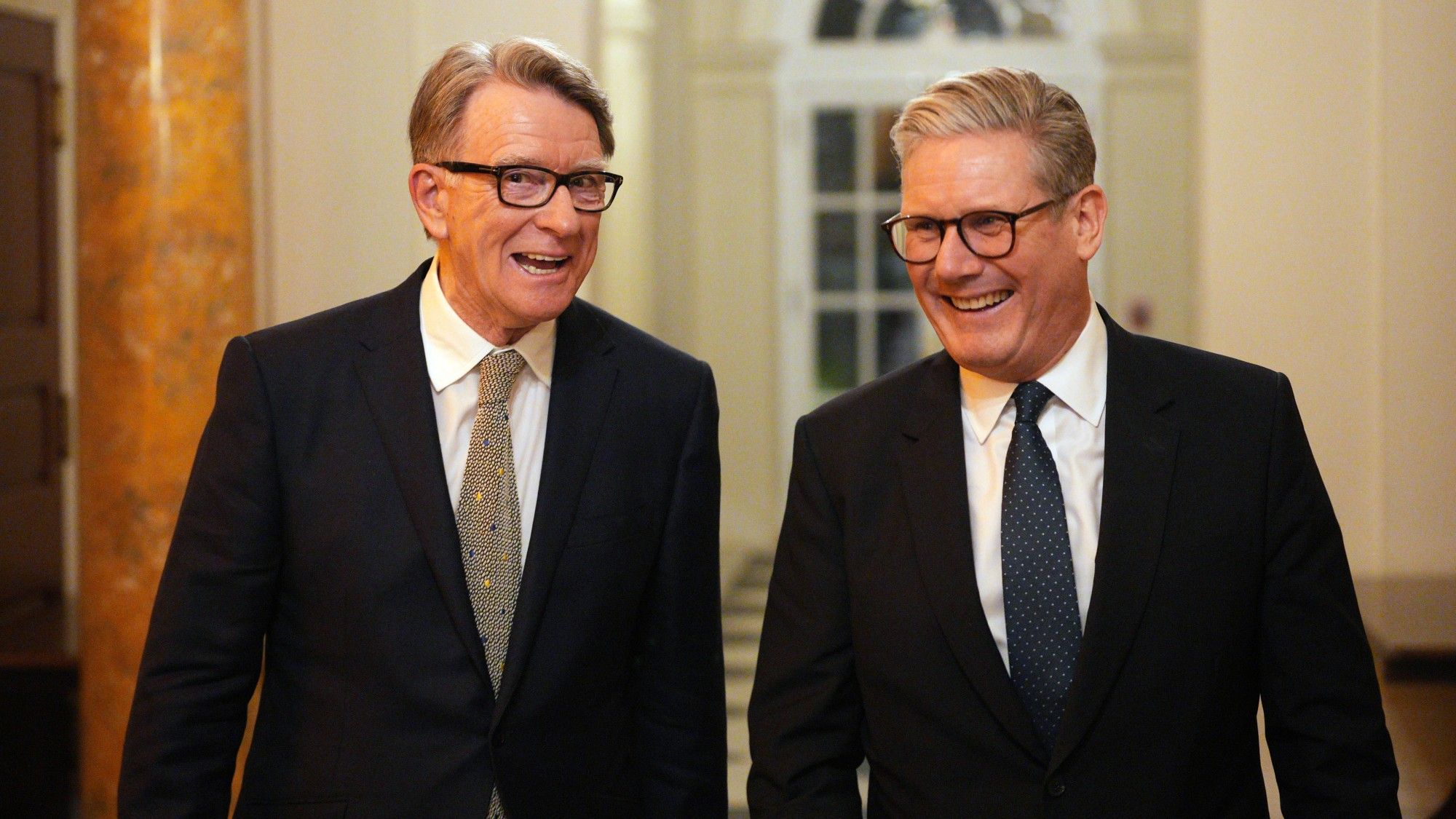
In a move that has intensified the political storm swirling around his government, Prime Minister Keir Starmer has ordered the release of files related to the appointment of Peter Mandelson as Britain's ambassador to the United States. The decision, announced amid mounting pressure from opposition lawmakers, comes as newly disclosed documents from the Jeffrey Epstein case reveal potentially damaging allegations against the former Labour heavyweight. Mandelson, a key architect of Tony Blair's New Labour era and often dubbed the party's 'Svengali,' was abruptly removed from his Washington posting last September after emails surfaced showing his continued ties to Epstein, the disgraced financier facing charges of soliciting a minor at the time.
The latest revelations, drawn from Epstein files unsealed in the United States, allege that in 2009, while serving as business secretary under Gordon Brown, Mandelson leaked sensitive Downing Street emails containing market-sensitive information to Epstein. According to reports from The Week, these documents have prompted the Metropolitan Police to formally launch a criminal investigation into Mandelson's actions. The developments have sent shockwaves through Westminster, with Labour insiders expressing deep dismay over the scandal's implications for Starmer's leadership.
BBC political editor Chris Mason captured the sentiment among party figures, stating that many are “seething with disappointment and boiling with betrayal.” He warned that the “gravity of what is alleged” could escalate into “perhaps one of the biggest” political scandals “for a generation,” raising serious questions about Starmer's judgment in nominating Mandelson to the high-profile diplomatic role just a year ago, in the lead-up to the 2024 general election.
Starmer's order for the files' release preempts a House of Commons debate scheduled for today, where Conservatives planned to push for the mandatory publication of records detailing Mandelson's discussions with the prime minister and his chief of staff, Morgan McSweeney. The documents in question include emails, official papers, and messages exchanged during the appointment process. However, Starmer has stipulated that releases will exclude any materials that could prejudice national security or harm diplomatic relations with the U.S., a caveat that has already sparked concerns about potential selective disclosure.
Politico's coverage highlights the immediate focus shifting to this exemption clause, noting that “attention will turn swiftly” to “which ones aren’t in scope.” There remains uncertainty over whether private communications, such as WhatsApp messages from personal phones, will be included in the batch. Furthermore, it's unclear who will oversee the redaction and release process or which senior officials will have final say, adding layers of complexity to what promises to be a protracted affair.
The government has emphasized its commitment to transparency, according to The Guardian, signaling an “intention to be transparent” without committing to publishing “every single piece of communication.” Any documents slated for release must first undergo review by police investigators to ensure they do not interfere with the ongoing criminal probe. This mirrors the drawn-out process seen with the Epstein files' unsealing in American courts, which has fueled partisan battles and accusations of whitewashing on both sides of the Atlantic.
Background on Mandelson's ties to Epstein dates back years, with the pair's friendship reportedly spanning social and professional circles in the late 2000s. Epstein, who died in 2019 while awaiting trial on sex trafficking charges, was known for cultivating relationships with influential figures in politics and business. Mandelson's 2009 role as business secretary placed him at the heart of economic policy during the global financial crisis, making the alleged leak of market-sensitive Downing Street emails particularly explosive if proven.
The scandal's fallout has largely played out beyond U.S. borders, though it intersects with transatlantic diplomacy at a tense moment. With Donald Trump poised for a potential return to the White House, Mandelson's appointment was seen as a strategic bid to leverage his extensive connections in American elite circles. Critics, however, argue it was a miscalculation, appointing a “tarnished, if well connected, figure” to navigate the complexities of Trump's orbit, as The Guardian's senior political correspondent Peter Walker put it.
Within Labour ranks, frustration is mounting not just at Mandelson but at those who championed his candidacy. McSweeney, Starmer's powerful chief of staff and a former protégé of the veteran strategist, is believed to have been a driving force behind the nomination. Some MPs are directing their ire toward him, viewing the decision as a lapse in due diligence that now threatens the government's early stability.
Yet, not all in the party are pointing fingers at the prime minister. Health Secretary Wes Streeting, often floated as a future leadership contender, came to Starmer's defense during an interview on LBC radio today. “That would let Mandelson off the hook,” Streeting said, rejecting suggestions that the controversy could cost Starmer his job. “This is his misjudgment, his misconduct, his irresponsibility.” Streeting's comments underscore a divide: while some see the scandal as a personal failing of Mandelson's, others worry it reflects broader flaws in Starmer's inner circle.
Starmer himself has maintained distance from the Labour old guard's social networks, avoiding the dinner circuits where figures like Streeting and McSweeney have mingled with Mandelson. Politico suggests this insulation could shield the prime minister somewhat, noting that “the PM has less to lose than others in government if cosy Labour texts to Mandelson end up in the public domain.” Still, the optics of releasing selectively curated files risk amplifying perceptions of opacity, especially as opposition voices demand full accountability.
The broader context of political scandals in Britain often involves a finite lifecycle, where public outrage eventually wanes. But Walker in The Guardian cautions that for Downing Street, Mandelson “risks being a headache that simply will not end.” Unlike past controversies with clear resolutions, this one ties into the enduring Epstein saga, which continues to ensnare high-profile names and provoke international scrutiny. The Metropolitan Police's investigation, now underway, could extend the timeline, potentially leading to charges or further document dumps.
Looking ahead, today's Commons debate may evolve into a forum for Conservatives to press their advantage, though Starmer's proactive release could blunt some attacks. Questions linger about the Epstein connection's full scope: could political pressure compel Mandelson or others to testify on their relationship with the financier? As The Week poses in its analysis, overcoming legal hurdles to force such evidence remains uncertain, but the stakes are high for Labour's credibility.
Amid these domestic tremors, external factors complicate the picture. The European Union is reportedly seeking to lessen dependence on U.S. Big Tech amid Trump's tariff threats, a backdrop that underscores the delicate U.S.-U.K. ties Mandelson was meant to bolster. Starmer's government, still finding its footing post-election, faces the challenge of containing the scandal without alienating allies or emboldening rivals like Kemi Badenoch's Conservatives or Nigel Farage's Reform UK.
Ultimately, the Mandelson files represent more than a personal reckoning; they test the new Labour administration's promise of integrity after years of Conservative turmoil. As documents trickle out, Westminster watches closely, aware that what begins as an internal Labour squabble could reshape the political landscape well into 2025 and beyond. For now, the prime minister's team insists on measured transparency, but the specter of betrayal looms large over 10 Downing Street.