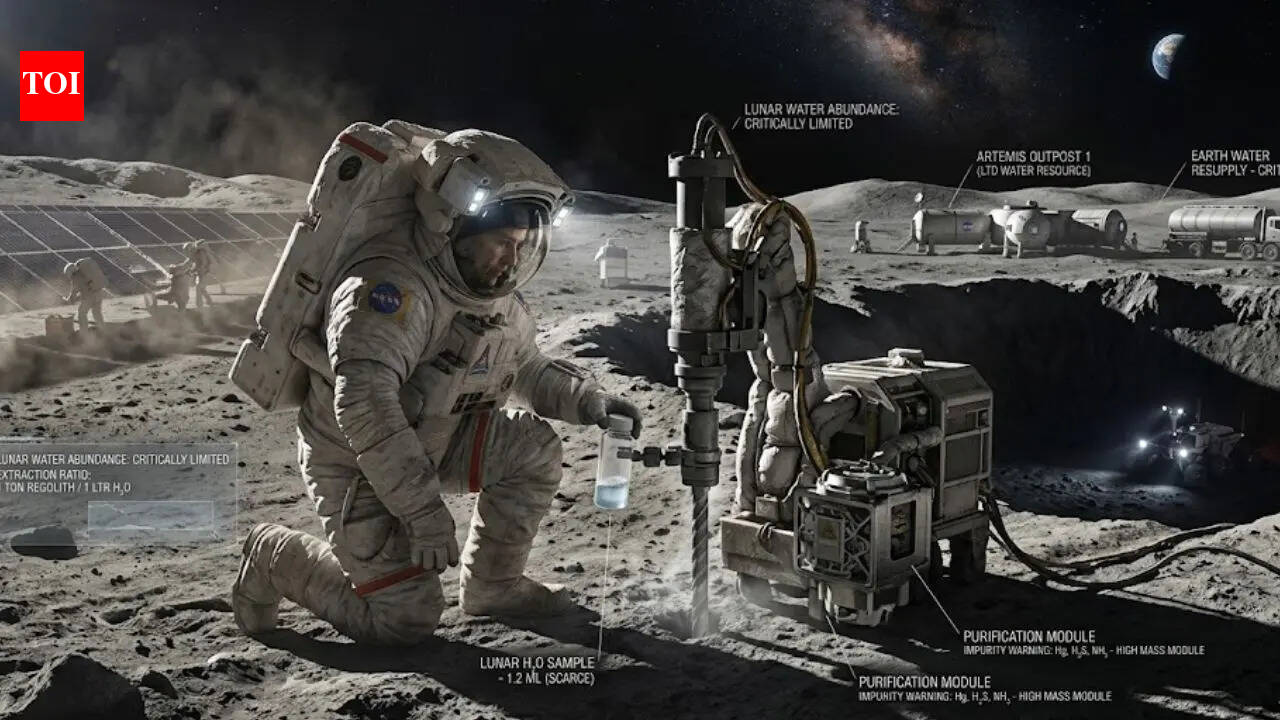
APPLETON, Wis. — The discovery of water on the Moon, once hailed as a game-changer for humanity's ambitions in space, may fall short of the quantities needed to sustain future missions, according to a recent report from India's Times of India Science Desk.
The article, published on the Times of India website, explores how the presence of water—likely in the form of ice trapped in shadowed craters at the lunar poles—has sparked excitement among scientists and space agencies worldwide. However, it cautions that the amounts detected so far might not suffice for the water-intensive operations envisioned in long-term lunar bases or as fuel for deeper space travel.
Water on the Moon was first confirmed in significant quantities by NASA's Moon Mineralogy Mapper instrument aboard India's Chandrayaan-1 spacecraft in 2009. That finding, which revealed water molecules spread across the lunar surface and concentrated deposits in permanently shadowed regions, was seen as a paradigm-shifting discovery, the Times of India article notes. "The discovery of water on the Moon was once a paradigm-shifting discovery that would revolutionise deep-space logistics in the universe in ways we..." the report begins, highlighting the initial optimism.
Experts quoted in the piece emphasize the potential uses of lunar water. It could be electrolyzed into hydrogen and oxygen for rocket propellant, providing a vital resource without the need to launch everything from Earth. Dr. Anita Sen, a planetary scientist at the Indian Space Research Organisation (ISRO), told the Times of India, "Water is the holy grail for lunar exploration; it could make the Moon a stepping stone to Mars." Yet, she added a note of caution: the exact volume remains uncertain, with estimates varying widely based on remote sensing data.
Recent missions have built on this foundation. NASA's Lunar Reconnaissance Orbiter (LRO) and the Stratospheric Observatory for Infrared Astronomy (SOFIA) telescope confirmed water ice in 2020, pinpointing it in craters like Cabeus and Shackleton near the Moon's south pole. The Times of India report references these findings, stating that while water exists, extraction could be challenging due to the extreme cold—temperatures dipping below -230 degrees Fahrenheit—and the fine, electrostatic lunar regolith that clings to everything.
International efforts are ramping up. The Artemis program, led by NASA with partners including the European Space Agency (ESA) and JAXA, aims to return humans to the Moon by 2025. A key goal is to establish the Lunar Gateway, a space station in lunar orbit, and a sustainable presence on the surface. According to NASA officials, water resources will be central to these plans. "We're looking at in-situ resource utilization to make lunar exploration viable long-term," said NASA Administrator Bill Nelson in a recent briefing.
But the Times of India article raises doubts about sufficiency. It cites a study from the Lunar and Planetary Institute suggesting that accessible water ice might total only a few billion tons—enough for initial missions but potentially inadequate for a bustling lunar economy. "It may not be enough for future space missions," the headline warns, drawing from analyses that factor in energy costs for mining and processing the ice.
Other viewpoints offer a more optimistic take. The European Space Agency's upcoming Lunar Pathfinder mission, set for launch in 2025, will include instruments to map water deposits more precisely. ESA's project scientist, Dr. Maria Rossi, stated in a related interview, "Our data suggests there could be more water than we think, hidden in subsurface layers." This contrasts with the Times of India's more tempered assessment, which relies on current orbital observations.
China's Chang'e program provides another perspective. The Chang'e-5 mission in 2020 returned samples from the Moon's near side, and upcoming Chang'e-7 in 2026 will target the south pole for water prospecting. Chinese Academy of Sciences researcher Li Wei commented, "The Moon's water could support a international lunar base, but we need boots on the ground to confirm quantities." The Times of India report acknowledges these efforts but notes geopolitical tensions could complicate resource sharing.
Historically, the idea of lunar water dates back to the Apollo era. Astronauts like Harrison Schmitt during Apollo 17 in 1972 reported a "wet" smell in lunar samples, hinting at trace volatiles. But it was the post-Apollo robotic missions that unlocked the secret. The Clementine mission in 1994 first hinted at polar ice, and LCROSS in 2009 impacted a crater, ejecting material that confirmed water vapor.
Challenges abound beyond quantity. The Times of India article details how solar radiation and micrometeorites degrade exposed water, while shadowed craters are hard to access. Robotic rovers, like those planned for VIPER (Volatiles Investigating Polar Exploration Rover) in late 2024, will drill and analyze, but delays have pushed back timelines. "Logistics in the universe" revolutionized by water, as the report puts it, hinge on overcoming these hurdles.
Private sector involvement adds dynamism. Companies like Intuitive Machines and ispace are racing to land on the Moon, with contracts from NASA to scout resources. Astrobotic's Peregrine lander, though it failed in January 2024, carried experiments for water detection. "The commercial boom could accelerate discoveries," said SpaceX CEO Elon Musk on social media, though he didn't specify lunar water directly.
Broader implications extend to Mars and beyond. Lunar water could refuel spacecraft, reducing launch costs from Earth by up to 90%, according to a 2023 RAND Corporation study. Yet, if quantities are limited, as the Times of India suggests, it might force reliance on asteroid mining or Earth resupply, inflating mission budgets into the trillions.
Scientists urge caution against overhyping. The article quotes astrophysicist Dr. Rajesh Kumar from the Tata Institute of Fundamental Research: "While water is there, it's not an ocean. We must plan realistically to avoid setbacks." This balanced view underscores the report's core message.
Looking ahead, the next few years will be pivotal. With Artemis II's crewed lunar flyby in 2025 and potential south pole landings, fresh data could resolve the debate. Until then, the Moon's water remains a tantalizing promise—revolutionary in potential, but perhaps not the elixir space agencies hope for. As the Times of India Science Desk concludes, it's a reminder that the cosmos delivers wonders with caveats.