Imagine if every American with a prison record were gathered into one vast territory and granted statehood. According to political scientist John J. Lennon, author of the 2024 book "The Jailer's Reckoning," this hypothetical state would rank as the 12th largest in the union, home to at least 7 million to 8 million people and wielding a dozen Electoral College votes. In a razor-thin presidential contest, Lennon argues, this bloc of formerly incarcerated individuals could tip the scales toward one candidate or another—not by casting ballots, but by their absence from the polls.
Lennon's analysis, published recently on The Conversation, underscores a stark reality of American democracy: millions of former felons remain sidelined from voting due to lingering disenfranchisement laws. These policies, varying widely by state, have created what he calls a "vast shadow electorate" that quietly influences election outcomes. With at least 20 million Americans having served time in prison or under felony supervision—based on conservative 2010 estimates—the potential impact is profound, especially in battleground states where margins are slim.
The roots of this issue trace back to felony disenfranchisement practices embedded in state laws across the country. Inmates are legally barred from voting in all but two states, Maine and Vermont. Ten states impose permanent or temporary bans on ex-felons, depending on the crime and without special interventions like gubernatorial pardons. In Idaho, Oklahoma, and Texas, as many as one in 10 citizens are ineligible due to criminal records, a figure that soars to one in five among Black Americans, Lennon writes.
Even when rights are restored, participation remains low. Turnout among eligible ex-convicts hovers around 10%, according to scholarly estimates cited by Lennon. "Contact with the criminal justice system lowers political trust, which in turn reduces the likelihood of political engagement among ex-convicts," he explains. This disengagement stems from a broader erosion of faith in institutions, compounded by the stigma of a felony conviction.
Scholars generally agree that this disenfranchised group leans Democratic, though the exact partisan breakdown is debated. Conservative estimates suggest a majority would support Democrats, while higher-end projections reach 70%. Lennon points to the 2000 presidential election in Florida as a prime example of how this dynamic played out. That year, about 7% of the state's 11.7 million voting-age residents—roughly 800,000 people—were disenfranchised due to past convictions.
"If 10% of them had voted and, say, 55% voted Democratic for president, that would have translated to a 6,000-vote swing for Vice President Al Gore," Lennon writes. "In reality, Texas Gov. George W. Bush won the state—and with it the presidency—by 537 votes."
This narrow victory propelled Bush into the White House, altering the course of American history. Lennon extends the analysis to other races, noting that Florida Republicans Ron DeSantis and Rick Scott may have secured their initial gubernatorial wins thanks to similar disenfranchisement effects. In 2018, Florida voters appeared poised to change this when they approved Amendment 4, a constitutional measure to automatically restore voting rights to most former felons.
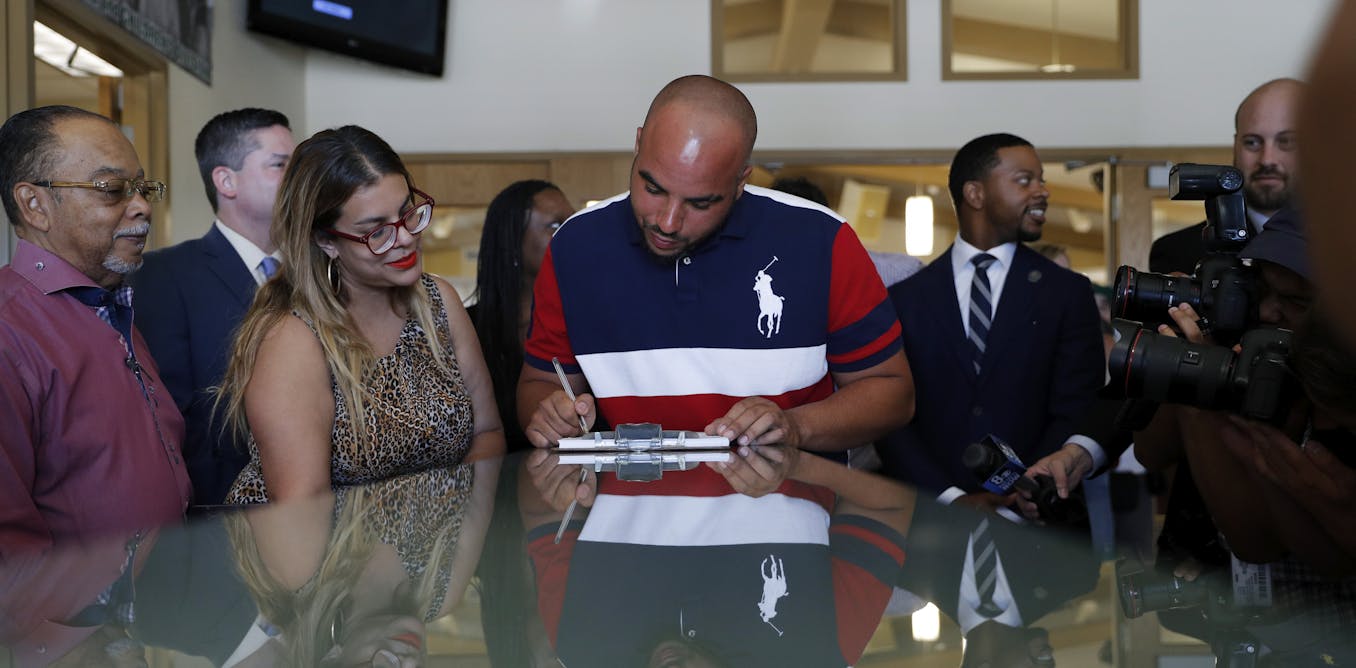
However, the momentum stalled. A follow-up law enacted by state lawmakers required felons to pay off all fines and fees before regaining eligibility. According to the Sentencing Project, a criminal justice reform advocacy group, this provision has blocked nearly 1 million Floridians from voting. "Florida voters did approve a constitutional amendment to restore voting rights automatically to most former felons. But a subsequent law requiring felons to pay off fines and fees has kept nearly 1 million Floridians from being able to vote," Lennon reports, citing the group's data.
The issue extends beyond Florida. Lennon's research, drawn from his book exploring variations in mass incarceration rates across states, highlights how the U.S. has incarcerated more of its citizens than any other liberal democracy—or even most authoritarian regimes—over the past four decades. This "social experiment," as he terms it, has not only swelled prison populations but also reshaped the electorate. The formerly incarcerated now form a normalized feature of American life, with their political exclusion creating ripple effects in close races.
Consider the 2016 presidential election, decided by the slimmest of margins in key Rust Belt states. Donald Trump carried Michigan, Pennsylvania, and Wisconsin by less than 1 percentage point each. "Again, the outcome could easily have been different if voting rights for former felons were a given," Lennon observes. His statistical models indicate that in statewide contests, this shadow electorate could swing results by 1 to 2 percentage points—a negligible difference in safe districts but decisive in competitive ones.
While Lennon's work focuses on the national scale, the disparities are particularly acute in the South and Midwest, where strict disenfranchisement laws persist. In states like Texas and Oklahoma, the high ineligibility rates among Black voters exacerbate racial inequities in political representation. The Sentencing Project has long documented these trends, estimating that nationwide, more than 5 million people remain disenfranchised due to felony convictions, though Lennon's broader tally includes those who are eligible but apathetic.
Advocates for reform argue that restoring rights could reinvigorate democracy. Groups like the Sentencing Project push for automatic restoration upon release, viewing current barriers as modern-day poll taxes. Critics, including some law enforcement officials and conservative policymakers, contend that felons must demonstrate rehabilitation before regaining the franchise, emphasizing public safety and accountability. Lennon acknowledges this debate but stresses the empirical evidence of electoral distortion.
Mass incarceration's legacy continues to unfold. Since the 1980s, policies like mandatory minimum sentences and the war on drugs have driven incarceration rates to historic highs, disproportionately affecting communities of color. By 2010, the footprint of the criminal justice system had touched one in every 33 Americans, per federal data. Lennon's book delves into why rates vary— from lenient approaches in states like Minnesota to harsh ones in Louisiana— and measures the downstream political costs.
Looking ahead, the 2024 election looms as another potential flashpoint. With battlegrounds like Georgia and Arizona featuring significant ex-felon populations, any shifts in voting access could prove pivotal. Efforts to expand rights persist: In 2020, Virginia Governor Ralph Northam issued executive orders restoring rights to thousands, while Iowa's new Democratic governor, Kim Reynolds, has signaled openness to reform. Yet, in many states, legislative hurdles remain.
As Lennon concludes, the millions in this shadow electorate represent a quiet force with the power to reshape American politics. "Under the right circumstances, this slice of the electorate is large enough to tip an election," he writes. Whether through ballot initiatives, court challenges, or policy overhauls, addressing felon disenfranchisement could unlock a more inclusive democracy—or leave the status quo to silently sway the nation's future.