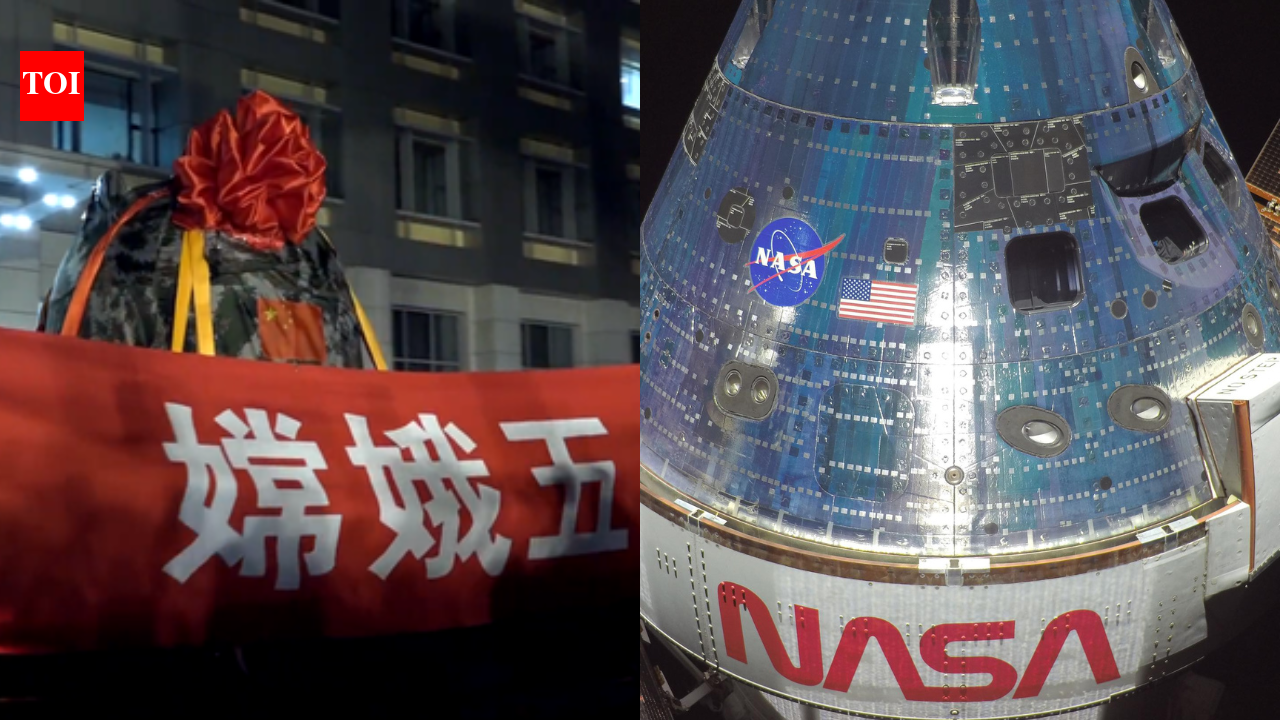
APPLETON, Wis. — NASA's successful Artemis II mission has reignited global interest in lunar exploration, casting a spotlight on China's ambitious plans for a crewed moon landing by 2030. The four-person crew, including NASA astronauts Reid Wiseman, Victor Glover, and Christina Koch, along with Canadian Space Agency astronaut Jeremy Hansen, completed a 10-day orbital test flight around the moon on September 30, 2024, marking the first human spaceflight under the Artemis program since the Apollo era ended in 1972.
Launched from Kennedy Space Center in Florida aboard the Space Launch System rocket and Orion spacecraft, the mission splashed down safely in the Pacific Ocean off the California coast. According to NASA officials, the flight tested critical systems for future lunar landings, including life support, navigation, and re-entry capabilities. "This mission is a giant leap forward in our return to the moon," said NASA Administrator Bill Nelson in a post-mission briefing. "Artemis II proves we can send humans beyond low-Earth orbit safely and sustainably."
The success comes amid a renewed space race, with China positioning itself as a major contender. Beijing has outlined a roadmap through its Chang'e program, aiming to land astronauts on the lunar surface by the end of the decade. According to reports from the China National Space Administration (CNSA), the country plans to establish the International Lunar Research Station in collaboration with Russia and other partners, focusing on the moon's south pole where water ice resources could support long-term habitation.
Experts note that China's progress has accelerated in recent years. In 2020, the Chang'e 5 mission returned the first lunar samples to Earth since 1976, and the uncrewed Chang'e 6 probe is scheduled for launch in 2024 to collect samples from the moon's far side. "China's lunar ambitions are not just exploratory; they're strategic," said Dean Cheng, a senior research fellow at the Heritage Foundation, in an interview with The Appleton Times. "By 2030, they aim to have a sustained presence, which could give them a foothold in space resources."
NASA's Artemis program, conversely, emphasizes international partnerships. The Artemis Accords, signed by 43 countries including the United States, Japan, and the European Space Agency, promote peaceful lunar exploration and data sharing. However, China and Russia have declined to join, opting instead for their own framework. "We're building a coalition for the benefit of all humanity," Nelson stated during a White House address following the Artemis II splashdown. "But competition drives innovation, and we're ready for it."
The Artemis II crew provided live updates from space, capturing the public's imagination with images of Earthrise and the moon's cratered surface. Mission commander Reid Wiseman described the experience as "humbling and exhilarating," according to NASA's mission logs. The flight path took the Orion spacecraft about 250,000 miles from Earth, looping around the moon without landing, to verify the spacecraft's heat shield and propulsion systems after concerns raised during uncrewed Artemis I in 2022.
China's 2030 goal builds on its Tiangong space station, operational since 2021, which serves as a testing ground for long-duration spaceflight. CNSA administrator Zhang Kejian announced in 2023 that the country would conduct crewed lunar flybys as early as 2028, paving the way for landings. "Our space program is driven by scientific curiosity and national development," Zhang said in a state media interview. "The moon holds keys to understanding our solar system and beyond."
Geopolitical tensions underlie the rivalry. U.S. lawmakers have expressed concerns over China's opaque space program and potential military applications. The Wolf Amendment, in place since 2011, prohibits NASA from bilateral cooperation with China without congressional approval. "This is more than science; it's about leadership in the final frontier," said Sen. Ted Cruz (R-Texas) during a Senate hearing on space policy last month.
Despite the competition, some analysts see opportunities for cooperation. The United Nations Office for Outer Space Affairs has called for inclusive lunar governance to avoid conflicts over resources like helium-3, a potential fuel for fusion energy. "The moon is big enough for everyone," said Pam Melroy, NASA's deputy administrator and a former astronaut, at the International Astronautical Congress in Milan earlier this year. "But we need rules of the road to ensure it's a shared domain."
Artemis II's technical achievements included flawless performance of the Orion's service module, powered by the European Space Agency's contributions. The mission cost approximately $4.1 billion, part of the broader Artemis program's $93 billion price tag through 2025, according to Government Accountability Office estimates. Public support remains high, with a recent Pew Research poll showing 65% of Americans favoring increased NASA funding for lunar missions.
Looking ahead, NASA plans Artemis III for mid-2026, targeting the first woman and person of color on the moon at the south pole. Private companies like SpaceX, with its Starship vehicle, will play a key role in landing operations. Elon Musk, CEO of SpaceX, tweeted post-mission: "Congrats to NASA on Artemis II. Starship is next up for the real heavy lifting."
China, meanwhile, is developing its Long March 10 rocket for crewed lunar missions, with test flights expected by 2027. The country's space budget, estimated at $13 billion annually, trails the U.S.'s $25 billion but shows rapid growth. International observers, including those from the European Space Agency, have praised China's engineering feats while urging transparency.
The renewed focus on the moon evokes the Cold War-era Apollo-Soyuz détente, but today's race involves more players, including India, which landed on the lunar south pole with Chandrayaan-3 in 2023, and private entities like Blue Origin. "This is a multi-polar space age," said astrophysicist Neil deGrasse Tyson in a recent podcast. "The U.S. and China are frontrunners, but the innovation will come from collaboration and competition alike."
As nations vie for lunar primacy, questions of sustainability arise. Environmentalists warn that unchecked exploration could scar the moon's surface, while scientists highlight the need to protect potential archaeological sites from ancient impacts. The Artemis Accords address some of these, committing signatories to mitigate space debris and preserve heritage.
In the end, Artemis II's triumph underscores humanity's enduring quest to reach the stars, even as it sharpens the edge of international rivalry. With China's 2030 deadline looming, the coming years promise a lunar landscape transformed—not just by footprints, but by flags and foundations. Officials from both nations express confidence in their paths forward, setting the stage for what could be the most pivotal chapter in space history since Apollo 11.