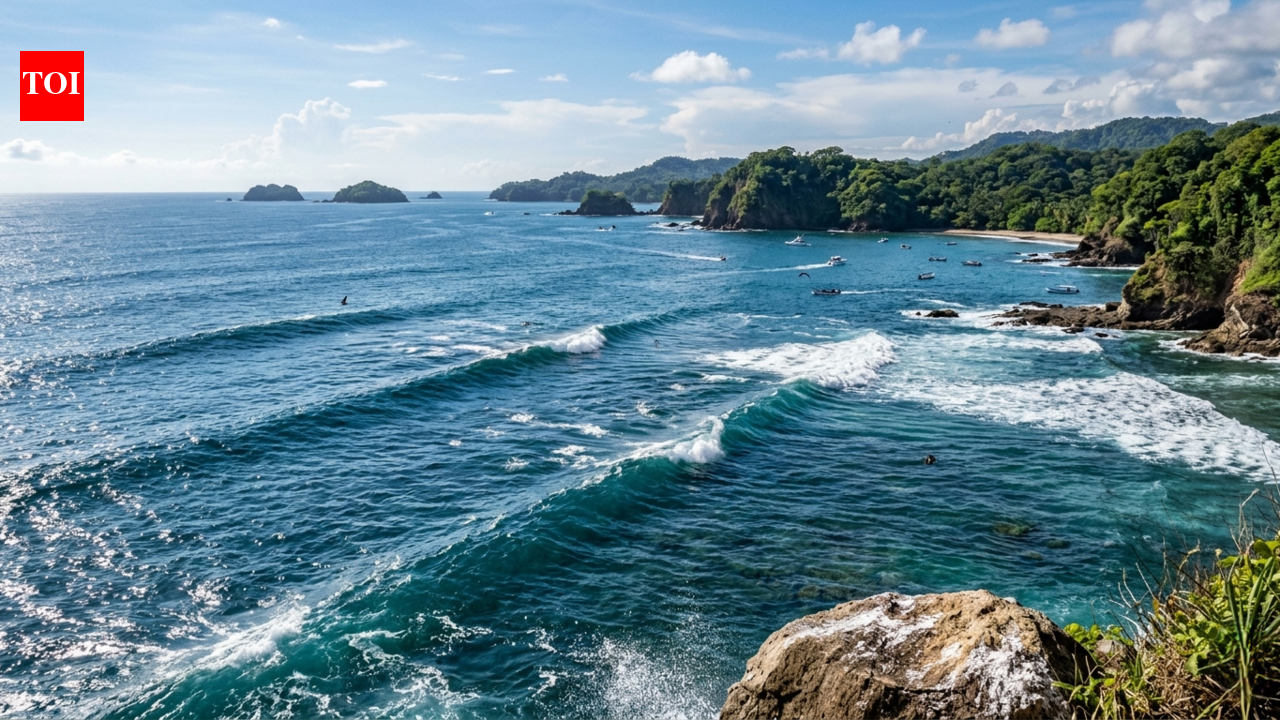
Panama City, Panama — For the first time in over four decades, the waters of the Gulf of Panama have failed to experience the vital ocean upwelling process that sustains one of the region's richest marine ecosystems, leaving scientists and local fishing communities on edge.
According to researchers at the Smithsonian Tropical Research Institute, this unprecedented break in the annual upwelling cycle — which typically brings nutrient-rich deep waters to the surface from January to April — occurred throughout the 2023 season. The event marks the end of a 40-year streak of consistent upwelling, a phenomenon that has supported abundant fish populations and biodiversity in the area since records began in 1983.
"This is a historic failure," said Dr. María García, a marine biologist with the institute who has studied the gulf's currents for 15 years. "We've never seen the upwelling completely shut down like this. It's like the ocean's engine has stalled, and we're only beginning to understand why."
The upwelling process in the Gulf of Panama is driven by seasonal winds that push surface waters away from the coast, allowing colder, nutrient-laden waters from the depths to rise. These nutrients fuel phytoplankton blooms, which form the base of the food chain for commercially important species like sardines, anchovies, and tuna. Without it, the ecosystem unravels quickly.
Local fishermen in ports like Pedregal and Vacamonte report catches down by as much as 70% compared to previous years. Juan Pérez, a 52-year-old fisherman who has plied these waters since he was a teenager, described the situation as dire. "We've been coming out empty-handed for weeks," Pérez said during an interview at the bustling Panama City fish market. "Our families depend on this. If the fish don't come back soon, many of us won't make it through the year."
Scientists attribute the disruption primarily to shifting climate patterns, including the lingering effects of the 2023-2024 El Niño event, which warmed surface waters across the Pacific and weakened the trade winds responsible for upwelling. Warmer waters create a stronger thermocline — the boundary between warm surface layers and cooler depths — making it harder for nutrients to mix upward.
"El Niño played a role, but this could be a sign of longer-term climate change," explained Dr. Carlos Mendoza, an oceanographer at the University of Panama. "Sea surface temperatures in the gulf were 1.5 degrees Celsius above average this year, the highest on record. If this becomes the new normal, we're looking at cascading effects on everything from fish stocks to coastal economies."
The Gulf of Panama, spanning about 2,400 square kilometers along the country's Pacific coast, is a biodiversity hotspot. It supports over 1,000 species of fish and serves as a nursery for migratory birds and marine mammals. The failure of upwelling has already led to visible changes: jellyfish blooms have proliferated in the absence of competing plankton, and reports of hypoxic zones — areas with low oxygen levels — have increased near the shore.
Environmental groups like the Panamanian Association for the Conservation of Nature have raised alarms about the broader implications. "This isn't just a local issue," said association director Ana López. "The gulf's fisheries provide 40% of Panama's seafood catch, worth around $200 million annually. A collapse here could ripple through Central America and affect global tuna markets."
Historical data from the Panama government's fisheries ministry corroborates the severity. Records show that during weaker upwelling years in the past, such as 1998 and 2016 — both El Niño years — catches dropped by 30-50%. But this year's total absence is unprecedented, with monitoring buoys recording wind speeds 20% below the long-term average.
Not all experts agree on the exact causes. While most point to climate variability, some researchers suggest human factors, including overfishing and coastal pollution, may have exacerbated the problem. Dr. Elena Torres, a fisheries expert at the Inter-American Tropical Tuna Commission, noted, "We've removed too many top predators from the system, which might be altering nutrient cycles indirectly. It's a complex interplay, and we need more data."
In response, Panamanian authorities have announced emergency measures. The Ministry of Environment declared a fishing moratorium in affected zones last month, effective until May 2024, to allow stocks to recover. "We're monitoring the situation closely," said ministry spokesperson Roberto Díaz. "If upwelling resumes with the onset of stronger winds in April, we could see improvement. But we're preparing for the worst."
International attention has grown, with scientists from NOAA in the United States collaborating on a joint study. Preliminary findings, shared at a virtual conference last week, predict that similar disruptions could hit other upwelling regions, like Peru's coast, in the coming years as global temperatures rise.
For the communities along Panama's Pacific shore, the stakes are immediate. In the village of San Carlos, where fishing employs 60% of residents, food banks have stepped in to provide aid. "We've never had to rely on handouts before," said local elder Rosa Jiménez. "The sea has always given us what we need. Now, it's taking it away."
Looking ahead, experts call for urgent action on climate mitigation. Dr. García emphasized the need for expanded marine protected areas and reduced greenhouse gas emissions. "This streak breaking is a wake-up call," she said. "If we don't act, the ocean off Panama — and beyond — may never upwell the way it used to."
As the dry season winds down, all eyes are on the gulf. Will the currents rebound, or has a new era of instability begun? Scientists say only time — and continued observation — will tell, but the worry among researchers and residents alike is palpable.