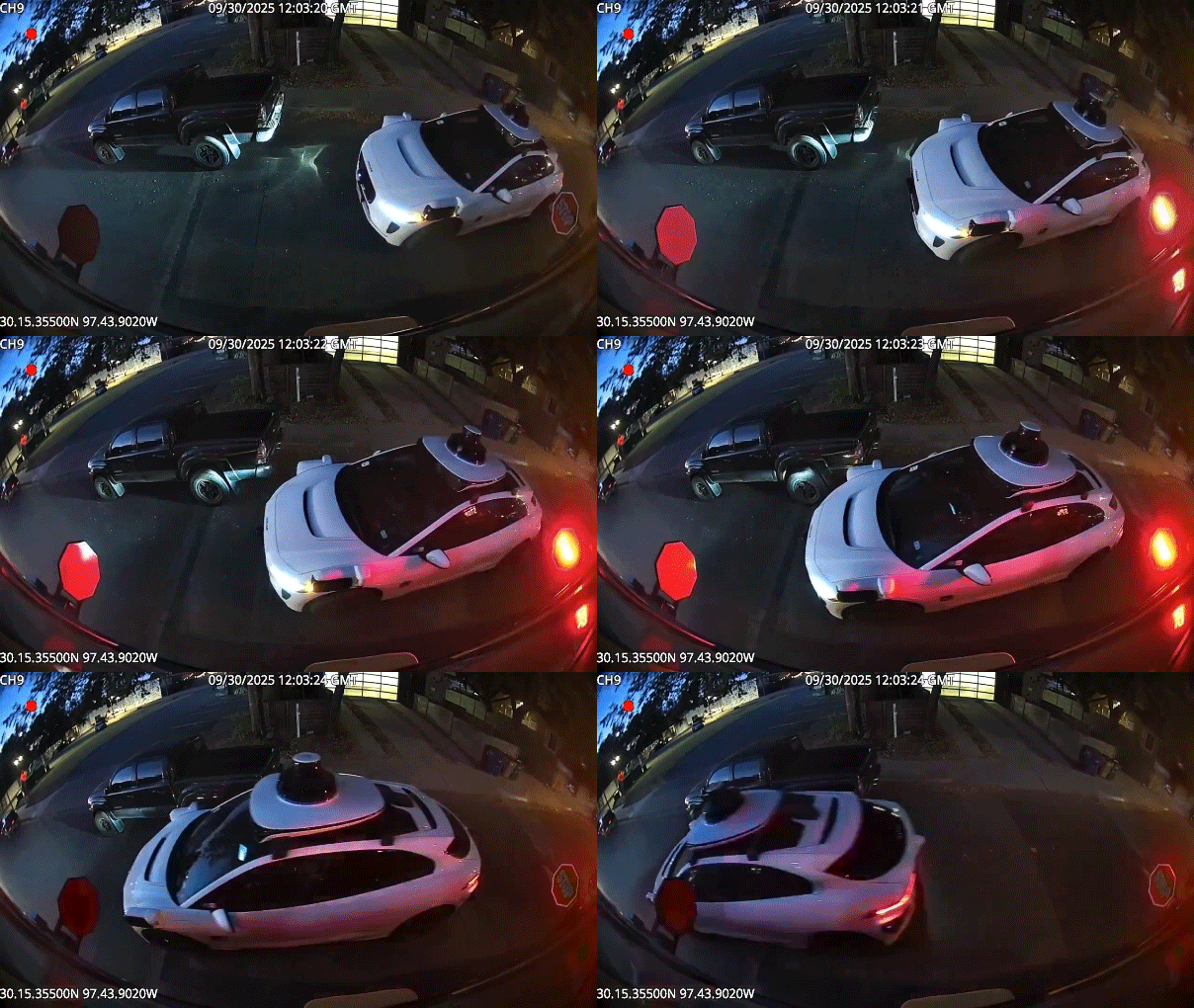
In the bustling streets of San Francisco, a quiet revolution is underway as driverless robotaxis offer rides at nearly half the cost of traditional services, signaling the start of a fierce price war in autonomous transportation. According to data from ride-hailing comparisons, a typical Waymo autonomous ride in the city averages $8.17, while a human-driven Uber trip for the same distance costs $17.25. This disparity has caught the attention of commuters and industry watchers alike, as companies like Waymo, Tesla, and Zoox expand their fleets across major U.S. cities, promising a future where personal car ownership might become obsolete.
The leader in this emerging market is Waymo, a subsidiary of Alphabet, Google's parent company. In 2025, Waymo provided 15 million driverless rides, reaching approximately 400,000 per week by early 2026. Valued at $126 billion, the service operates in Phoenix, the San Francisco Bay Area, Los Angeles, Austin, Atlanta, and Miami. Expansion plans for 2026 include Dallas, Denver, Washington, D.C., London, and Tokyo, according to company announcements. Riders in these areas can summon a vehicle via app, arriving without a driver for seamless, tip-free travel—no small talk or detours required.
While Waymo dominates, competitors are ramping up efforts to challenge its position. Tesla launched its robotaxi service in Austin, Texas, last June 2025, but the rollout has been modest, with roughly 31 vehicles in operation. One tester reported completing 42 trips, each supervised by a safety monitor on board, indicating that full autonomy remains a work in progress for the electric vehicle giant. Tesla's approach relies solely on eight cameras for navigation, eschewing lidar technology to keep costs low, enabling rides at $1.99 per kilometer.
Amazon-owned Zoox represents another contender with its unconventional pod-shaped vehicles, which lack steering wheels and can drive bidirectionally. Currently, Zoox offers free rides in Las Vegas and San Francisco as it awaits regulatory approval to charge fares. This testing phase allows the company to gather data in real-world conditions, positioning it as a wildcard in the market. Meanwhile, Cruise, majority-owned by General Motors, has previously offered free rides to non-employees in San Francisco, as noted in a 2022 Bloomberg report, though its current status in the price war remains less prominent.
Underlying the competition are advanced sensing technologies that allow these vehicles to 'see' their surroundings. Waymo employs a combination of cameras, lidar—which uses lasers to create 3D maps—and traditional radar, enabling operation in total darkness and heavy rain. This multi-sensor setup contrasts with Tesla's vision-only system, which the company argues is sufficient and more cost-effective. Proponents of lidar, however, highlight its precision in complex urban environments.
Safety remains a paramount concern as robotaxis proliferate. Waymo claims its vehicles experience 80% fewer injury-causing crashes compared to human drivers, based on internal data. However, the National Highway Traffic Safety Administration (NHTSA) has recorded 1,429 incidents involving Waymo vehicles since 2021, including 117 injuries and two fatalities. The agency has also documented seven crash incidents for Tesla's robotaxi service since its launch. Waymo has issued three software recalls, one in December 2025 for issues related to passing stopped school buses.
Recent incidents underscore these risks. On an unspecified date in Santa Monica, California, an autonomous vehicle struck a student, though the Santa Monica Police Department reported no injuries. Separately, Waymo is under federal investigation following an incident where a child was struck, according to NHTSA reports. These events have fueled public caution; one rider shared that a Waymo vehicle dropped her off a full mile from her intended destination, with the car's interface simply stating, 'You have arrived,' leaving her unable to intervene without a human driver.
Regulatory scrutiny is intensifying amid these developments. Congress is advancing legislation to establish national rules for self-driving cars, which would override varying state regulations and create a unified framework. At a Senate hearing on Wednesday, February 4, 2026, Waymo executives admitted that some remote operators assisting confused vehicles are based in the Philippines. Senators expressed displeasure at this revelation, questioning the implications for U.S. jobs and oversight in critical safety operations. When a robotaxi encounters uncertainty, human interveners in remote centers view live camera feeds and guide the vehicle, a process Waymo described as essential for reliability.
The price war's economic incentives are clear: robotaxis operate 15 hours or more per day, compared to personal cars that sit idle 95% of the time. This high utilization could make autonomous rides cheaper than owning and maintaining a vehicle, including gas and insurance costs. In Phoenix, where Waymo vehicles are a common sight on freeways and at grocery stores, locals report seeing empty cars idling at red lights, 'just vibing' as one observer put it. Yet, adoption varies; the author of a recent Fox News analysis noted living in Phoenix but hesitating to try a ride, planning to test it within two weeks while joking about survival.
Beyond the U.S., international expansion hints at global implications. Waymo's planned entry into London and Tokyo in 2026 could standardize autonomous travel worldwide, but it also raises questions about adapting to diverse traffic norms and weather. In Austin, a Waymo vehicle was photographed driving past the Capitol Building on January 23, 2026, amid rainy conditions, demonstrating resilience in adverse weather. Tesla's Austin launch on June 22, 2025, featured a Tesla robotaxi on Oltorf Street, marking a tentative step in a city already familiar with autonomous testing.
Critics point to reliability gaps that could hinder widespread trust. The inability to flag down a human during errors, as in the mile-off drop-off, highlights a key limitation. NHTSA's incident logs, while showing fewer injuries overall for Waymo, include serious cases that regulators are probing. Tesla's supervised rides suggest the technology isn't fully ready for unsupervised operation at scale, despite aggressive pricing.
As the market heats up, the shift toward 'nobody driving' promises to reshape urban mobility. Personal car ownership, often likened to an unused gym membership, may decline as affordable, efficient alternatives gain traction. Forward-thinking cities like San Francisco and Phoenix are at the forefront, but national rules could accelerate or standardize this transition. For now, the price war incentivizes innovation, drawing riders into a new era of transportation where steering is optional—and increasingly rare.
Looking ahead, experts anticipate further competition and regulatory evolution. With Zoox's free rides building user data and Tesla's cost advantages pressuring incumbents, the landscape will evolve rapidly. Congress's override of state laws aims to foster innovation while ensuring safety, potentially unlocking billions in economic value. As one analyst noted, those who still view self-driving cars as science fiction are in for a ride—quite literally, as apps make summoning one as easy as ordering takeout.