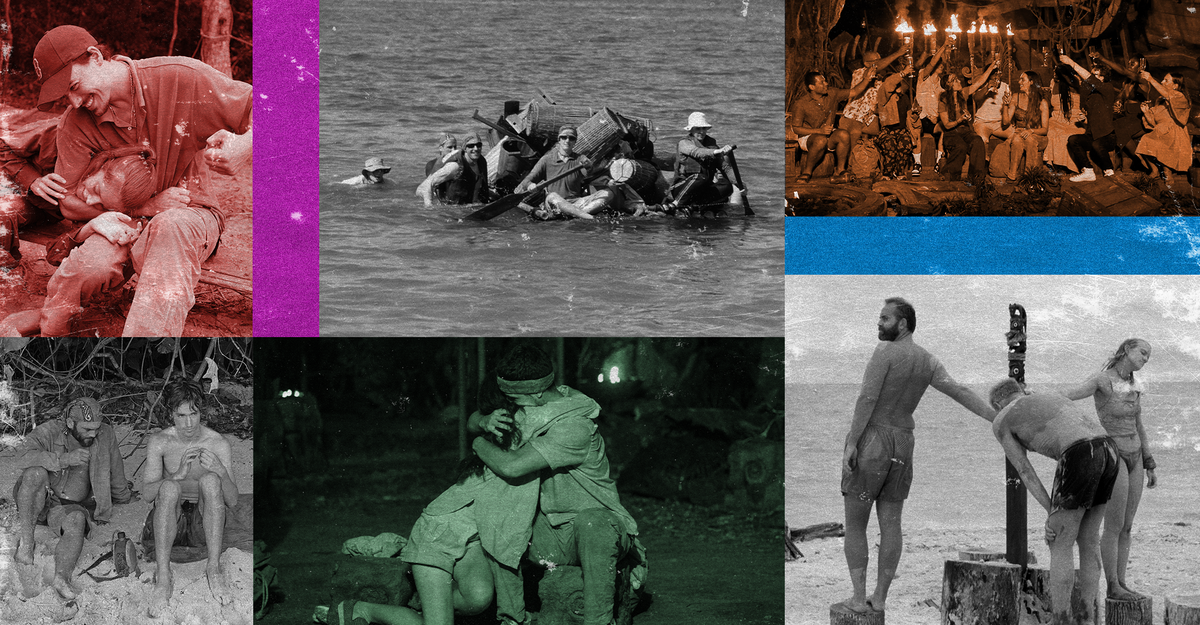
As Survivor kicks off its milestone 50th season on CBS, the long-running reality competition is once again thrusting a diverse cast of players into the Fijian wilderness, where the stakes of $1 million and the clash between personal ambition and group dynamics promise to captivate audiences just as they did more than 25 years ago. Airing since its debut in May 2000, the show has evolved from a novel experiment in survival and strategy to a cultural phenomenon that has influenced the reality TV genre, with this latest installment featuring celebrity cameos and a roster of all-star former contestants. The season, which premiered earlier this month, highlights the enduring tension at the heart of the series: the delicate balance between individualism and community, a theme that mirrors broader American societal preoccupations.
The origins of this dynamic trace back to the very first episode, filmed on a remote beach in Malaysia. Less than 10 minutes in, contestants Richard Hatch, a corporate trainer from Rhode Island, and Sue Hawk, a truck driver from Wisconsin, shared a tense exchange amid the chaos of setting up camp. As tribe members scrambled to build shelters and organize tasks, Hatch expressed frustration, asking Hawk, “Why are we here? And what’s the point?” Hawk, unfazed, replied, “Oh, I figured that out before I come here. And you haven’t?” Hatch clarified, “I have, for me. But we haven’t, for us.” This moment, as detailed in a recent analysis by The Atlantic, encapsulated the show's foundational uncertainty: Was Survivor about forging a new society among strangers, or was it a ruthless individual contest where players vote each other out at tribal council until one victor claims the prize?
In those early days, voting was haphazard. Contestants often targeted those they disliked or who underperformed in physical challenges, with one player even casting votes alphabetically. But as the season progressed, strategy sharpened. Hatch, along with Sue Hawk, Kelly Wiglesworth, a yoga instructor from Texas, and Rudy Boesch, a retired Navy SEAL from Massachusetts, formed the series' first alliance. They coordinated votes to eliminate others, reaching the final four together. This tactic, now a staple of the game, was revolutionary and controversial at the time, shifting focus from communal survival to calculated social maneuvering.
The season one finale in August 2000 crystallized the debate. At the final tribal council in the Malaysian jungle, Hatch and Wiglesworth faced a jury of eliminated players. Wiglesworth adopted a relational approach, apologizing for betrayals and emphasizing her character and connections formed on the island. “I hope you judge me not for the betrayals I’ve committed but for the person I was and the connections I’d formed,” she said, according to accounts from the episode. Hatch, conversely, defended a strategic mindset: “For me, it’s not about you deciding who the best person is. It is about who played the game better.” The jury sided with Hatch, awarding him the $1 million and setting a precedent for the 49 seasons that followed.
Over the years, Survivor has adapted significantly. After globe-trotting to locations from Kenya to Guatemala, the production settled on the Mamanuca Islands in Fiji starting with season 16 in 2008. Gameplay grew more complex with the introduction of hidden immunity idols in season 11 and various advantages that empower individuals to disrupt group votes. Casting diversified, reflecting broader societal shifts, while the show's quality, as fans often quip, remains reliably engaging—like pizza, even subpar episodes satisfy. The current 50th season, which began airing on February 28, 2024, brings back veterans like Cirie Fields, a four-time player and nurse from New Jersey, alongside newcomers and surprise celebrity guests, amplifying the all-star spectacle.
This evolution mirrors changes in American culture, where individualism has long been a cornerstone. In his 1840 book Democracy in America, French observer Alexis de Tocqueville noted Americans' tendency to “consider themselves in isolation, and they willingly fancy that their whole destiny is in their hands.” Contemporary measures reinforce this: The U.S. scores high on indices valuing self-expression and personal effort over external factors, a trend intensifying since the mid-20th century's shift from 1950s conformity to movements championing individual rights and self-help. Television, too, has amplified this focus; as sociologist Todd Gitlin observed in 1983 about prime-time shows of the late 1970s and early 1980s, “with few exceptions, prime time gives us people preoccupied with personal ambition.” On Survivor, this manifests in host Jeff Probst's exhortations during challenges: “You gotta dig!” he shouts to laggards, later praising comebacks with, “That’s why you never give up on Survivor!”
Early seasons emphasized loyalty within alliances, where betraying a close ally was taboo. In the 2004 finale of season 8, Survivor: All-Stars, filmed in the Pearl Islands of Panama, “Boston Rob” Mariano from Massachusetts pleaded with Lex van den Berghe, a mountain guide from Utah, not to vote out his romantic interest, Amber Brkich. Mariano promised protection in return but later voted out van den Berghe. At tribal council, van den Berghe lambasted him: “As good as your game was, you sold out your values, you sold out your character, and you sold out your friends for a stack of greenbacks.” This betrayal cost Mariano the win by one vote; Brkich took the prize, and the pair got engaged at the reunion show.
By contrast, modern play rewards strategic betrayal. Cirie Fields, competing in season 50, described the shift from “old era” to “new era” strategy in a recent episode. “The new-era mindset is ‘I can vote with my archenemy for one vote, for two votes, and then I can get them out. I just want to advance in this game,’” she explained. “The old-era style is ‘I stick with the people I said I was gonna stick with, and that’s it.’” This change solidified around season 41 in 2022, the first post-COVID edition filmed in Fiji amid pandemic protocols. Now, blindsiding allies bolsters a player's “Survivor résumé,” the narrative they pitch to the jury at final tribal council, where questions often probe, “What moves did you make on your own? How did you take control of the game?”
In recent seasons, even losers frame their experience as personal growth. “They’ve learned so much; they’re so grateful; they’ve evolved into a better version of themselves,” as one analysis notes, highlighting the show's dual appeal of competition and self-discovery.
Yet Survivor never fully abandons community. Tocqueville also praised Americans' propensity for associations—political, civic, and social—which tempered individualism. Historian Jennifer Ratner-Rosenhagen, in her 2019 book The Ideas That Made America, traces this ongoing wrestle, from 19th-century transcendentalism's self-reliance to the Progressive era's collective reforms. Today, amid rising individualism globally, community persists in mutual-aid networks. On the show, relationships remain crucial; players stress “authentic relationships” to advance, even as they manipulate them. Tribal councils have softened: Exits now often end in hugs and “Good game,” with betrayed players claiming understanding to maintain potential alliances.
Host Jeff Probst has leaned into this duality. At the start of season 47 in 2024, filmed in Fiji's Waruvu Lagoon, he stated, “The reason community has always been the foundation of this social experiment we’ve been doing for 24 years is because humans have always craved community.” This comes despite the game's backstabbing core, underscoring Survivor's appeal as a microcosm of human interaction.
Extremes rarely win. In season 19, Survivor: Samoa, aired in 2009 from the Samoan islands, villain Russell Hantz from Texas bragged, “When I’m finished with them, I just throw them in the trash,” treating allies like “puppets.” Despite reaching final tribal, jurors denied him the prize for his callousness. Similarly, overly loyal players, like those in season 20's Heroes vs. Villains in 2010, have lost to bolder strategists.
In season 50's recent tribal council, this tension boiled over. Cirie Fields vented, “We don’t work for anybody but ourselves,” resisting group directives. Fellow player Rizo Velovic countered, “If it’s about ‘I, I, I, I,’ then it’s not gonna be about ‘We, we, we’ when you want me to vote with you.” Top players blend both, as Hatch intuited early: To win alone, one needs alliances.
Looking ahead, Survivor's future seems secure, with CBS renewing it through at least season 52. As it navigates streaming competition and cultural shifts, the show's gamified exploration of me versus us continues to resonate, offering endless variations on ambition and connection. For fans tuning in weekly, the question remains: In a world increasingly polarized between self and society, who will master the balance and claim the million?