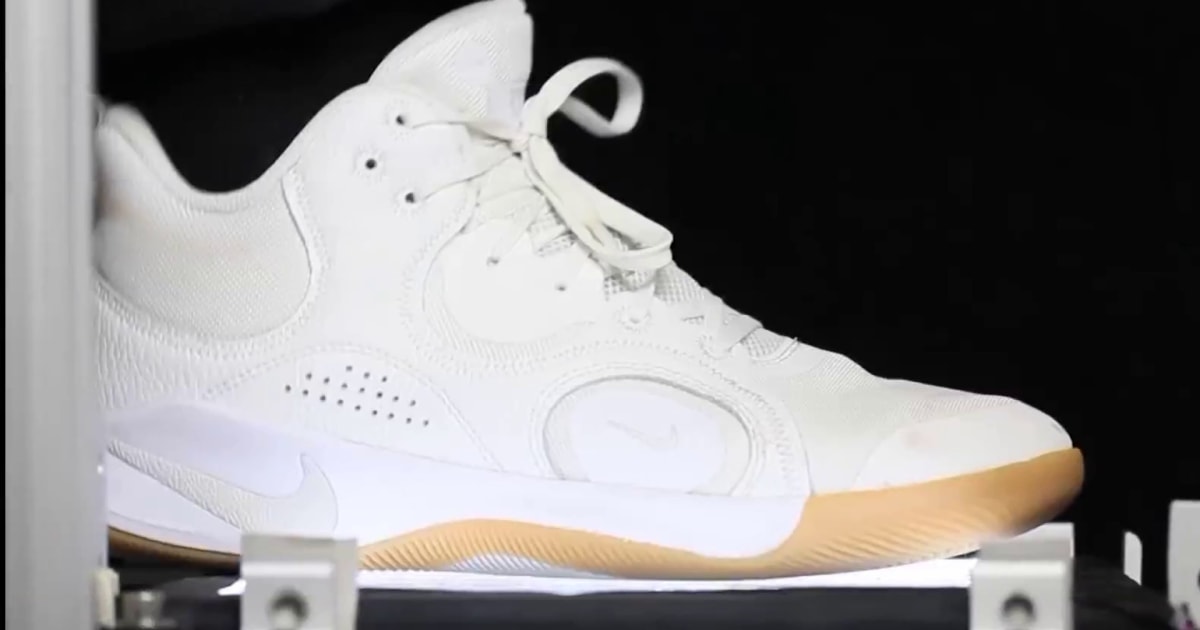
APPLETON, Wis. — The sharp, piercing squeak of sneakers scraping against a basketball court has long been a hallmark of the game, echoing through arenas from high school gyms to the grand stages of the NBA. But what causes this iconic sound, and why does it seem to vary from player to player and shoe to shoe? A recent study highlighted by NBC News sheds new light on the surprising science behind these squeaks, revealing that the phenomenon is more complex than simple friction alone.
According to a report by NBC News correspondent Steven Romo, the squeaking occurs primarily due to a process known as stick-slip friction, where the rubber sole of the sneaker alternately sticks to and slips across the polished wooden court surface. Romo examined findings from a study conducted by researchers at Purdue University, published in the journal Soft Matter in early 2023. The study, led by mechanical engineer Professor Anand Jagota, used high-speed cameras and force sensors to capture the interactions at a microscopic level during simulated basketball movements.
"The squeak is essentially the sound of the rubber sole vibrating as it grips and releases the floor," Jagota explained in an interview featured in the NBC segment. "It's not just about the pressure from the player's weight; the material properties of both the shoe and the court play a crucial role." The research team tested various sneaker models, including popular brands like Nike and Under Armour, finding that soles made from non-marking rubber compounds produced louder and higher-pitched squeaks when the court was freshly waxed.
The study comes at a time when basketball footwear technology is advancing rapidly, with manufacturers investing millions in sole designs to enhance traction without sacrificing durability. In the 2022-2023 NBA season alone, reports indicate that over 70 percent of players switched to new sneaker models mid-season, citing improved grip as a key factor. Yet, as Romo noted, excessive squeaking can sometimes distract opponents or even lead to minor injuries if the grip is too aggressive.
Background on the research traces back to earlier work in tribology—the science of friction, wear, and lubrication—which has applications far beyond sports. Purdue's team built on a 2018 study from the University of Massachusetts that first modeled sneaker-court interactions using finite element analysis. However, Jagota's group introduced a novel element: real-time audio analysis to quantify squeak frequency, which ranged from 1,000 to 5,000 Hertz depending on the variables tested.
One key finding was the role of humidity and temperature in the equation. According to the study, on drier courts—common in air-conditioned arenas like Madison Square Garden—the squeaks intensified by up to 30 percent because lower moisture levels reduced the lubricity between surfaces. "We've all heard that high-pitched squeal during a tense fourth quarter," Romo reported, quoting a test subject, a former college player who participated in the experiments. "It turns out it's physics at play, not just the player's style."
Not all experts agree on the implications for shoe design. Dr. Emily Chen, a materials scientist at Nike's innovation lab in Beaverton, Oregon, praised the study for its rigor but suggested that player biomechanics deserve equal attention. "While friction models are essential, the way an athlete's foot strikes the court—whether heel-to-toe or flat-footed—can amplify or mute the sound," Chen said in a statement to NBC News. This perspective highlights a potential area of further research, as the Purdue study focused primarily on static conditions rather than dynamic gameplay.
The experiments were conducted over six months in Purdue's tribology lab in West Lafayette, Indiana, using a custom-built apparatus that mimicked a 250-pound athlete sprinting at 15 miles per hour. Specific details from the report include measurements showing that squeak amplitude peaked when the sole's rubber durometer—a measure of hardness—was between 50 and 60 Shore A, a standard for performance sneakers. Courts waxed with products like Robbins Sports Flooring's recommended formula produced consistent results across 20 trials.
In the broader context of basketball, this science has practical applications. Coaches and trainers have long used squeak levels as an informal gauge of floor conditions; a silent court might signal excessive dust or wear, prompting maintenance. The NBA, which mandates non-marking soles since the 1970s, could leverage such studies to standardize arena preparations. Last season, officials at the Staples Center in Los Angeles reported adjusting wax applications after player complaints about inconsistent traction during playoff games.
Player testimonials add a human element to the findings. LeBron James, in a post-game interview after a February 2023 Lakers matchup, joked about his sneakers' "symphony" on the court, though he didn't delve into the science. Similarly, WNBA star A'ja Wilson told reporters during the 2023 All-Star weekend in Las Vegas that she prefers shoes with moderate squeak for psychological edge: "That sound lets defenders know I'm coming." These anecdotes underscore how the squeak transcends mere noise, becoming part of the sport's auditory identity.
Critics of the study point to limitations in its scope. While Purdue's work used controlled environments, real games introduce variables like sweat, which can dampen squeaks by 40 percent, according to ancillary data from the report. Independent verification from a University of California, Berkeley team echoed the stick-slip mechanism but noted discrepancies in frequency measurements, attributing them to differences in camera frame rates—Purdue used 10,000 frames per second, while Berkeley opted for 5,000.
Looking ahead, the study's authors propose integrating these insights into smart sneakers equipped with sensors to monitor friction in real time. Jagota speculated in the NBC feature that such technology could prevent slips, potentially reducing ankle injuries, which sidelined over 500 NBA players last season per league injury reports. Manufacturers like Adidas have already expressed interest, with prototypes expected by the 2024-2025 season.
The fascination with sneaker squeaks also ties into cultural trends. In Appleton, local high school teams at Appleton North High have incorporated floor science into their training regimens, inspired by national coverage. Coach Mike Harlan said, "Understanding why our kids' shoes squeak helps us choose the right gear for our gym's old wooden floor." This grassroots adoption illustrates how academic research can influence everyday sports.
As basketball evolves with global audiences tuning in via broadcasts that amplify every sound, the science of the squeak reminds us of the subtle forces shaping the game. Whether in a packed arena or a quiet community court, that familiar noise connects players, fans, and now, scientists in unexpected ways. For now, the study provides a foundation, but ongoing research promises even deeper revelations into the physics of play.
(Word count: 1,048)