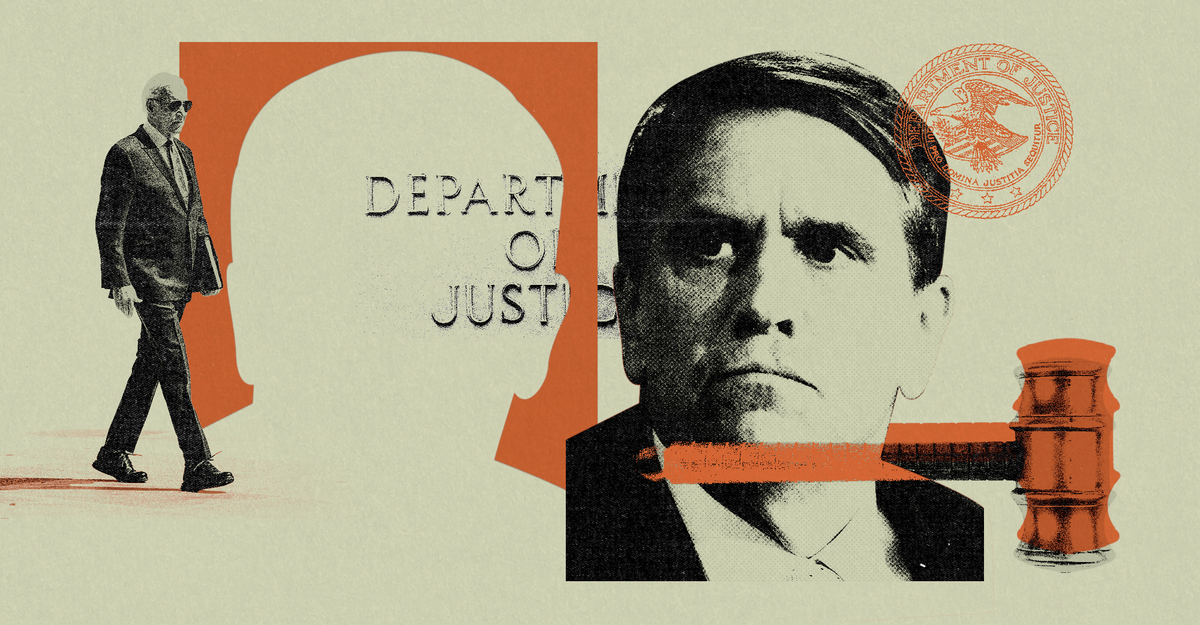
WASHINGTON — The Department of Justice's newly formed Weaponization Working Group has issued its first report, accusing the previous administration of biased prosecutions against anti-abortion activists under a federal law protecting access to reproductive health clinics. Released last week, the 800-page document claims that the Biden-era Justice Department unfairly targeted "pro-life Americans" through selective enforcement of the Freedom of Access to Clinic Entrances Act, or FACE Act. Acting Attorney General Todd Blanche, who assumed the role after President Donald Trump's recent dismissal of Attorney General Pam Bondi, described the findings as evidence of "shameful" abuses.
The report comes amid Trump's second term, which began with an executive order on Inauguration Day demanding accountability for what he called the prior administration's "weaponization of the Federal Government against the American people." Established shortly after by Bondi, the working group aimed to investigate alleged abuses of the criminal justice system. According to the report, the Biden Justice Department brought an unusually high number of FACE Act charges against anti-abortion demonstrators, particularly in the lead-up to the Supreme Court's 2022 decision in Dobbs v. Jackson Women's Health Organization, which overturned Roe v. Wade.
"No Department should conduct selective prosecution based on beliefs," Blanche said in a statement accompanying the report's release. He emphasized the need to "restore integrity to our prosecutorial system." CBS News reported that the Justice Department has since fired at least four prosecutors involved in pursuing those FACE Act cases from the Biden era.
The FACE Act, enacted by Congress in 1994, was a response to a surge in anti-abortion violence and clinic blockades during the 1980s and early 1990s. The law prohibits obstructing access to facilities providing reproductive health services, as well as to anti-abortion crisis pregnancy centers and places of worship, following a Senate compromise. Enforcement ramped up under President Joe Biden in 2022 as demonstrations at abortion clinics intensified ahead of the Dobbs ruling. The Biden administration also launched investigations into vandalism against crisis pregnancy centers by pro-abortion-rights groups after the decision.
Conservative critics, including the Heritage Foundation's Project 2025 initiative, had long argued that FACE Act prosecutions against anti-abortion activists demonstrated an "absurd double standard" and anti-Christian bias at the Justice Department. Just days into his second presidency, Trump pardoned 23 individuals convicted under the law during Biden's term. Bondi then flagged those prosecutions as examples of weaponization warranting review by the working group.
The report largely echoes Project 2025's conclusions, devoting much of its length to emails among career Justice Department attorneys—nonpartisan lawyers who serve across administrations. It portrays routine communications, such as outreach to reproductive-rights organizations, as undue influence by pro-abortion advocates on federal prosecutions. For instance, the document highlights exchanges between DOJ lawyers and advocacy groups as evidence of coordinated bias, without exploring whether the interactions were standard law enforcement procedure.
One key claim is that the Biden Justice Department pursued harsher sentences for anti-abortion defendants compared to pro-abortion-rights ones. The report describes the anti-abortion activists as "peaceful" and points to cases where sentences were elevated. However, former Justice Department attorneys Regan Rush and Megan Marks, in a rebuttal, noted that harsher penalties often stemmed from aggravating factors, such as physical aggression. In one instance, a nurse's hand was crushed in a clinic door by demonstrators, and a pregnant patient was forced to climb through a window after being grabbed and shouted at. By contrast, pro-abortion vandalism typically targeted empty buildings at night, posing no immediate risk to individuals, which influenced sentencing guidelines.
The report also questions why fewer charges were brought for attacks on crisis pregnancy centers. Attorney General Merrick Garland told a Senate committee in 2023 that such incidents were challenging to investigate due to their occurrence in isolated settings, often without witnesses. To address this, the FBI under Biden offered $25,000 rewards for tips on the vandalism cases—a detail omitted from the working group report. Rush and Marks pointed out that many of those episodes fall within the five-year statute of limitations, leaving the current administration opportunity to pursue prosecutions, though none have been filed to date.
Further scrutiny of the report reveals inconsistencies in its timeline. Several emails cited as examples of "Biden DOJ" bias were actually sent during Trump's first term from 2017 to 2020. One appendix lists five FACE Act cases involving threats or attacks on abortion clinics prosecuted by the Trump-era Justice Department, with statements from appointees underscoring the cases' importance at the time.
The document criticizes the lack of FACE Act prosecutions for disruptions at houses of worship under Biden, claiming not a single such case was pursued. However, the Biden administration did charge individuals for attacks on religious centers, albeit under other statutes like those for civil rights violations. No prior administration had invoked the FACE Act's worship provision, partly due to constitutional concerns tied to the Commerce Clause, which underpins the law's authority over interstate commerce more clearly in clinic settings than churches. An earlier draft of the report reportedly acknowledged a 2018 DOJ memo on these issues, but the final version does not.
The working group also takes issue with the Biden DOJ's use of 18 U.S.C. § 241, a civil-rights statute, alongside FACE Act charges, which turned some misdemeanors into felonies. While this approach was novel, it applied to cases involving conspiracy and obstruction that endangered others. The report frames it as abusive, though legal experts have debated its merits without consensus.
Under the current administration, the Justice Department's response to these alleged abuses has included policy shifts that mirror some of the practices it condemns. Prosecutions of "abortion-related" FACE Act cases now require "extraordinary conditions," potentially raising the bar for anti-abortion demonstrators despite the law's neutral language. Anti-abortion groups, including Americans United for Life, received advance access to the report, with its CEO meeting DOJ officials the day after publication. Meanwhile, the Civil Rights Division, led by Assistant Attorney General Harmeet Dhillon, is pursuing both FACE Act and Section 241 charges against protesters who disrupted a church service during an anti-ICE demonstration in St. Paul, Minnesota, last year.
Dhillon recently argued in court to uphold a Section 241 charge against a pro-abortion activist accused of conspiring to vandalize crisis pregnancy centers. This comes as the working group accuses the prior administration of disparate treatment. Blanche, during his first press conference as acting attorney general on April 7, promised more results from the group "very soon," signaling accelerated efforts following Bondi's ouster, which Trump attributed to insufficient action against perceived enemies.
The report's release highlights ongoing tensions over the politicization of federal law enforcement. While it documents internal DOJ emails that some, like one referring to the anti-abortion Thomas More Society as "quite the racket," might view as unprofessional, critics argue such instances warrant internal review rather than firings or broad policy overhauls. This echoes findings from the DOJ inspector general's probe into the 2016 Russia investigation during Trump's first term, which flagged careless language but found no substantive wrongdoing.
Looking ahead, additional reports from the Weaponization Working Group are expected, potentially expanding scrutiny to other areas of Biden-era prosecutions. As the Trump administration pushes forward, questions persist about whether these efforts will uncover genuine abuses or serve to reshape the Justice Department in line with political priorities. Legal observers will watch closely for how forthcoming investigations balance accountability with the principles of impartial justice.