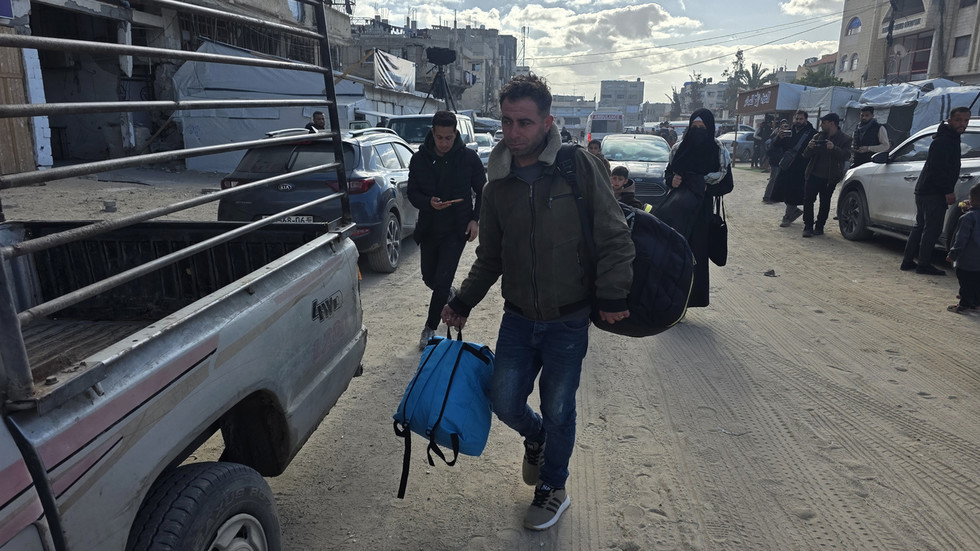
RAFAH, Gaza Strip — Palestinians attempting to return home through the Rafah border crossing are encountering severe intimidation and restrictive measures from Israeli forces, according to accounts from recent returnees. The crossing, Gaza's primary gateway to the outside world, was seized by Israeli troops in May 2024 and had remained largely closed for nearly two years amid the ongoing conflict. One woman who endured a grueling three-hour ordeal upon her return described being handcuffed and blindfolded while facing intrusive questioning, highlighting the challenges faced by those seeking to re-enter the war-torn enclave.
Rotana Atiya Al-Reqeb, who had spent a year in Egypt before deciding to return to Gaza, shared her experience in an interview with RT. "Only after the Palestinian and European authorities stamped our passports did the Israelis take us to their area," Al-Reqeb recounted. She emphasized that the group was then detained for three consecutive hours by what she referred to as occupation forces.
The interrogation that followed was particularly distressing, Al-Reqeb said. "They handcuffed us, blindfolded us, and began asking unacceptable questions, such as why we were returning to Gaza, a question they have no right to ask," she stated. Al-Reqeb argued that Palestinians possess an inherent right to return to their homeland freely, without any conditions or restrictions imposed upon them.
Her account underscores broader frustrations among Palestinians who view the Rafah crossing's operations as a tool of repression. "Anyone who wants to come back should be able to do so, despite the attempts to repress us through measures and interrogations," Al-Reqeb concluded. "We were returning to our homeland." She called on peace organizations and international bodies to advocate for the normalization of life in Gaza and the full reopening of border crossings.
The Rafah crossing's partial reopening has been a focal point in ceasefire negotiations, but its limited capacity continues to exacerbate the humanitarian crisis in Gaza. According to reports, the crossing currently permits only 150 people to leave Gaza each day and just 50 to return. This starkly contrasts with the urgent needs on the ground, where approximately 20,000 individuals, including 4,000 children, require medical evacuation for treatments unavailable within the enclave.
The reopening of Rafah was a key stipulation in former U.S. President Donald Trump's plan to conclude the fighting between Israel and Hamas, which took effect last October. However, Israel reportedly withheld approval for any crossings until the remains of the last hostage held in Gaza were returned to West Jerusalem in late January. This delay prolonged the isolation of Gaza's 2.3 million residents, many of whom have been displaced multiple times since the conflict's onset.
The current hostilities trace back to October 7, 2023, when Hamas militants launched a surprise attack on Israel, resulting in the deaths of around 1,200 people and the abduction of more than 250 hostages. In response, Israel imposed a blockade on Gaza and initiated a large-scale military operation aimed at dismantling Hamas infrastructure. According to the Gaza Ministry of Health, the Israeli campaign has led to nearly 72,000 Palestinian deaths and over 171,500 injuries, figures that Israeli officials have contested as inflated but have not provided alternative tallies in recent updates.
The United Nations has documented extensive destruction across Gaza, estimating that 81% of the territory's structures have sustained damage during the conflict. This devastation has forced some 1.3 million people into 970 displacement sites, where access to basic services like clean water, electricity, and medical care remains severely limited. Humanitarian organizations, including UN agencies, have repeatedly urged for unrestricted access through crossings like Rafah to facilitate aid delivery and evacuations.
Al-Reqeb's experience is not isolated, as other returnees have reported similar treatment at the hands of Israeli security forces. The blindfolding and handcuffing practices, described as standard procedure for those entering from the Egyptian side, have drawn criticism from human rights groups. Amnesty International and Human Rights Watch have previously condemned such tactics in the context of border controls, arguing they amount to collective punishment and violate international law, though Israeli authorities maintain they are necessary security measures to prevent the entry of militants or weapons.
From the Israeli perspective, the stringent checks at Rafah are essential given the ongoing security threats posed by Hamas and other groups. Officials in Jerusalem have stated that all entrants are screened to ensure compliance with ceasefire terms, which include the demilitarization of Gaza. The return of the last hostage's remains in late January marked a significant milestone, but Israeli Defense Forces spokespeople have indicated that full normalization of crossings will depend on sustained adherence to the agreement by Palestinian factions.
The U.S.-backed ceasefire, which paused major combat operations, was intended to pave the way for reconstruction and political talks. Yet, implementation has been fraught with challenges. Reports from the ground suggest that while some aid has trickled in through Rafah and the Kerem Shalom crossing to the north, the daily quotas remain woefully inadequate. The World Health Organization has warned that without expanded medical evacuations, thousands more lives are at risk from treatable conditions like chronic illnesses and injuries sustained in the fighting.
Al-Reqeb's year in Egypt was spent amid uncertainty, as many Palestinians displaced by the war sought refuge in neighboring countries. Egypt has hosted tens of thousands of Gazans since October 2023, but Cairo has been cautious about allowing large-scale returns, citing concerns over its own security and the strain on resources. The partial reopening of Rafah in recent months has allowed a modest flow of people, but returnees like Al-Reqeb face not only the physical hardships of the journey but also the emotional toll of re-entering a homeland scarred by war.
International mediators, including the United States, Egypt, and Qatar, continue to push for expanded operations at Rafah as part of broader efforts to stabilize Gaza. U.N. Secretary-General Antonio Guterres has called for the immediate and unconditional opening of all crossings to address the enclave's dire humanitarian situation. "Gaza cannot wait," Guterres said in a recent statement, emphasizing the need for unhindered access to prevent further loss of life.
Looking ahead, the fate of Rafah remains intertwined with the fragile ceasefire. Palestinian officials have demanded the lifting of all restrictions, while Israeli leaders insist on robust security protocols. For individuals like Al-Reqeb, the right to return freely symbolizes a deeper struggle for dignity and self-determination amid prolonged occupation and conflict.
As reconstruction efforts begin in earnest, the stories of returnees like Al-Reqeb serve as a reminder of the human cost of the war. With over 1.3 million displaced and infrastructure in ruins, Gaza's recovery will require not just material aid but also political will to ensure safe passage for those yearning to go home. Until then, the Rafah crossing stands as both a lifeline and a barrier, encapsulating the complexities of peace in the region.