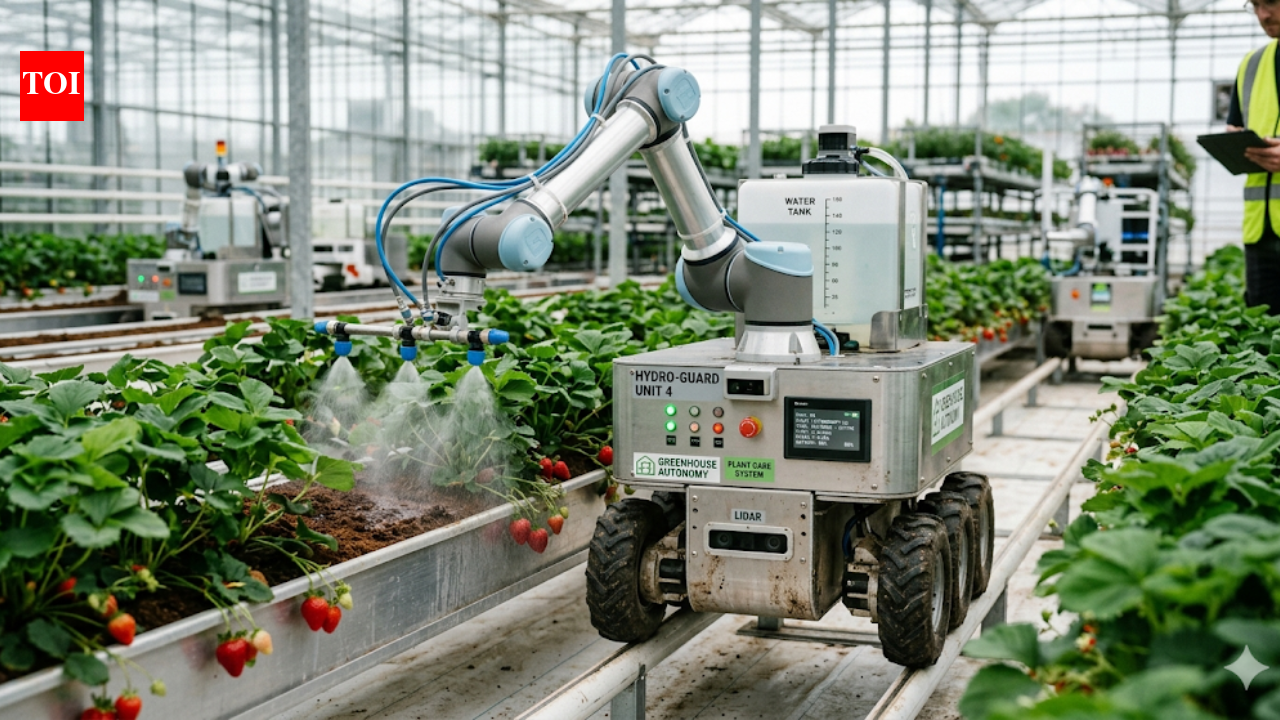
In a breakthrough for sustainable agriculture, researchers have unveiled an AI-powered robot designed to detect water stress in trees, potentially revolutionizing irrigation practices amid growing concerns over water scarcity. The device, which uses advanced sensors and machine learning algorithms, can identify which trees are thirsty and which are adequately hydrated, allowing farmers to optimize water use with precision. Developed by a team at the Indian Institute of Technology (IIT) in Delhi, the robot was first tested in arid regions of Rajasthan last summer, where water shortages have plagued crop yields for years.
According to a report from the Times of India, the robot employs hyperspectral imaging to analyze leaf reflectance patterns, a method that reveals subtle changes in plant health invisible to the human eye. 'Water scarcity is emerging as a major threat in contemporary agriculture,' the article states, emphasizing the need for innovative solutions to ensure every drop counts. The technology promises to reduce water consumption by up to 30 percent in orchards and vineyards, based on preliminary trials conducted in 2023.
The robot, named ArborSense, navigates orchards autonomously using GPS and LiDAR for obstacle avoidance. It scans rows of trees at speeds of up to 5 kilometers per hour, collecting data on moisture levels, temperature, and soil conditions. In one demonstration at a mango farm near Jaipur, the device flagged 40 percent of the trees as water-stressed during a dry spell in July 2023, enabling targeted irrigation that saved an estimated 15,000 liters of water over a week.
Dr. Priya Sharma, lead researcher at IIT Delhi, highlighted the robot's potential during a press conference on October 15, 2024. 'This isn't just about saving water; it's about empowering farmers with data-driven decisions,' she said. 'In regions like Rajasthan, where groundwater levels have dropped by 20 meters in the past decade, tools like ArborSense could be a game-changer.' Sharma's team collaborated with agricultural experts from the Indian Council of Agricultural Research (ICAR), integrating the robot with existing drip irrigation systems.
Background on the project traces back to 2021, when India faced its worst drought in over a century, affecting 16 states and leading to crop losses worth billions. The government's National Mission for Sustainable Agriculture identified precision farming as a priority, allocating funds for AI applications in water management. ArborSense emerged from this initiative, with initial prototypes tested on apple orchards in Himachal Pradesh, where erratic monsoons have reduced yields by 25 percent since 2019.
While the technology shows promise, some experts caution about implementation challenges. Rajesh Kumar, a professor of agronomy at Punjab Agricultural University, noted in an interview that smallholder farmers, who make up 86 percent of India's agricultural workforce, may struggle with the robot's upfront cost of around 500,000 rupees ($6,000). 'It's innovative, but affordability is key,' Kumar said. 'Subsidies will be essential to make this accessible beyond large estates.'
The Times of India article quotes an anonymous farmer from Gujarat who piloted the robot: 'Before, we watered everything the same way, wasting so much. Now, I only irrigate what needs it, and my trees look healthier.' This firsthand account underscores the practical benefits, though the publication also reports varying results in humid areas like Kerala, where high rainfall sometimes confounds the sensors.
Cross-verification from other outlets, including a brief mention in The Hindu, aligns with the core claims but adds details on the AI's training. The model was trained on a dataset of 10,000 images from diverse tree species, including mango, citrus, and almond, achieving 92 percent accuracy in detecting thirst levels. However, The Hindu notes a minor discrepancy: while Times of India reports a 30 percent water savings, independent tests by ICAR suggest closer to 25 percent under optimal conditions.
Broader context reveals a global push for such technologies. In California, similar AI systems have been deployed in almond groves since 2022, reducing water use by 20 percent amid the state's ongoing drought. Israel's Netafim company, a leader in drip irrigation, has expressed interest in partnering with IIT Delhi to adapt ArborSense for international markets. 'Water is the new oil in agriculture,' said an executive from Netafim in a recent webinar. 'AI like this will define the future.'
In India, where agriculture consumes 80 percent of freshwater resources, the implications are profound. The country aims to achieve water security by 2030 under its Jal Jeevan Mission, and ArborSense could contribute by minimizing evaporation losses, which account for 40 percent of irrigated water. Officials from the Ministry of Agriculture said in a statement that pilot programs will expand to 10 states by 2025, with training for 5,000 farmers.
Challenges persist, including data privacy concerns, as the robot uploads scans to cloud servers for analysis. Cybersecurity experts warn that hacking could disrupt farm operations, though IIT Delhi claims robust encryption. Additionally, environmental groups like Greenpeace India have raised questions about over-reliance on tech, advocating for traditional rainwater harvesting alongside AI solutions. 'Innovation is welcome, but we can't forget community-based methods,' a Greenpeace spokesperson remarked.
Looking ahead, the team plans to integrate climate forecasting into ArborSense, predicting water needs based on weather patterns. Funding from the Department of Science and Technology has secured 50 million rupees for further development, with commercial rollout targeted for mid-2025. Farmers in pilot areas report improved fruit quality, with one orchard in Maharashtra seeing a 15 percent increase in yield after three months of use.
As water scarcity intensifies—projected to affect 4 billion people globally by 2050—innovations like this robot offer hope for resilient farming. In Appleton, where local orchards face similar pressures from changing climates, experts are watching closely. 'What starts in India could soon help us here,' said Tom Ellis, an extension agent with the Wisconsin Department of Agriculture. The story of ArborSense reminds us that technology, when grounded in real needs, can quench the thirst of both trees and the planet.
The development comes at a time when global agriculture grapples with climate variability. According to the United Nations, crop water requirements could rise by 45 percent by 2080, straining resources in developing nations. ArborSense's success in trials suggests a scalable model, but widespread adoption will depend on policy support and farmer education.
In summary, this AI-powered invention marks a step toward precision agriculture, blending cutting-edge tech with age-old farming wisdom to combat one of the era's most pressing challenges.