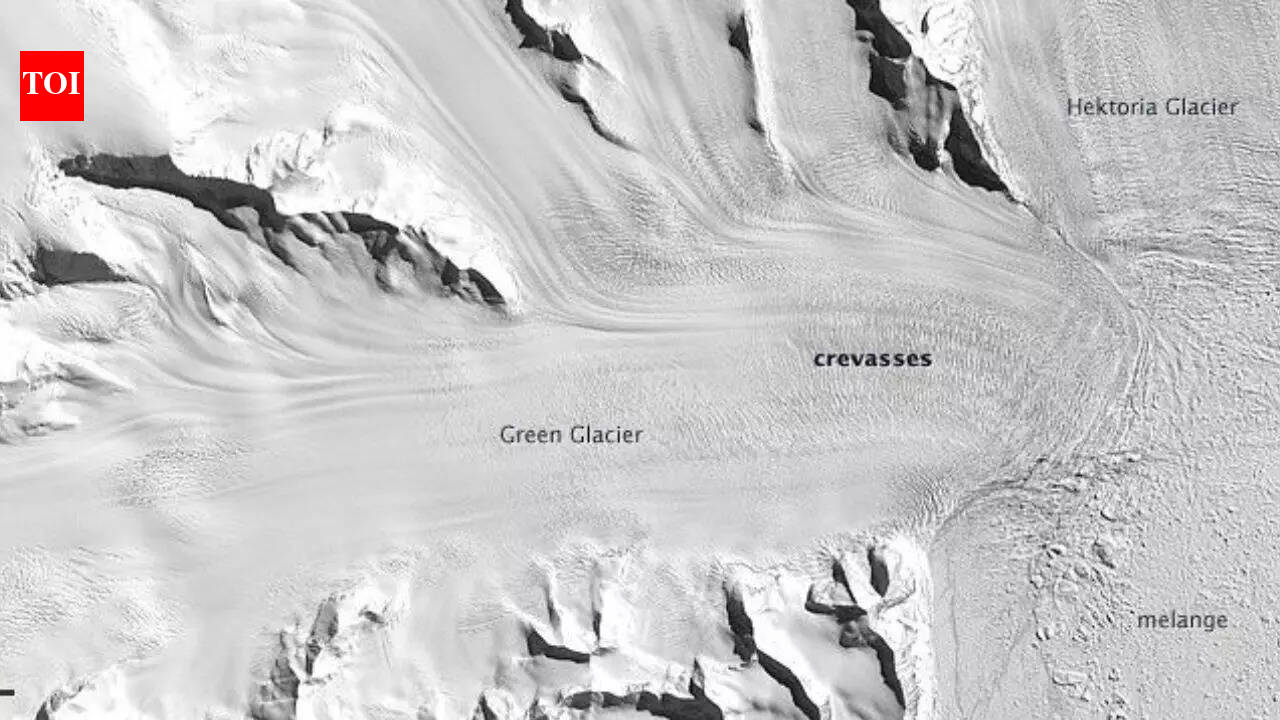
APPLETON, Wis. — In a startling display of climate change's accelerating impacts, the Hektoria Glacier in Antarctica has retreated a staggering 8 kilometers in just 60 days, leaving scientists at the University of Colorado Boulder's Cooperative Institute for Research in Environmental Sciences (CIRES) reeling from the rapid transformation.
The event, described by researchers as a 'lightning-fast' melting episode, unfolded between late 2022 and early 2023, according to observations detailed in a recent report from the Times of India. This unprecedented speedup in glacial retreat has raised alarms about the stability of Antarctica's vast ice sheets and their potential contribution to rising sea levels worldwide.
Dr. Ted Scambos, a glaciologist with CIRES who has studied Antarctic ice for decades, called the retreat 'shocking' in scale and speed. 'We've seen glaciers recede before, but nothing quite like this in such a short timeframe,' Scambos said in an interview shared through the university's press release. 'The Hektoria Glacier, part of the massive Pine Island Glacier system, lost ground equivalent to the length of Manhattan in under two months.'
The Hektoria Glacier, located along the Amundsen Sea coast in West Antarctica, has long been a focal point for climate researchers due to its vulnerability to warming ocean waters. Satellite imagery from NASA's Operation IceBridge and the European Space Agency's Sentinel missions captured the dramatic changes, showing the glacier's front edge pulling back from its previous position near the Dotson Ice Shelf.
According to the CIRES team, the retreat began accelerating in November 2022, triggered by a combination of unusually warm air temperatures and upwelling of relatively warmer deep ocean currents beneath the ice shelf. By January 2023, the glacier had calved off massive icebergs, some spanning several square kilometers, further destabilizing the structure.
This isn't the first time Hektoria has made headlines. In 2010, it experienced a significant calving event that drew global attention, but the latest retreat dwarfs that incident in velocity. 'Previous retreats were measured in years, not months,' noted Dr. Erin Pettit, another CIRES researcher involved in the monitoring. 'This suggests a tipping point may have been crossed, where feedback loops from melting are amplifying the process.'
Scientists attribute the rapid melt to broader climate patterns, including the influence of La Niña conditions that paradoxically can enhance Antarctic warming in certain regions. Ocean temperatures around the Antarctic Peninsula have risen by about 1 degree Celsius since the 1990s, according to data from the British Antarctic Survey, eroding the grounding lines where glaciers meet the sea floor.
While the immediate cause appears tied to natural variability, experts emphasize human-induced climate change as the underlying driver. The Intergovernmental Panel on Climate Change's latest assessment report highlights West Antarctic glaciers like Hektoria as among the most at-risk, potentially contributing up to 1 meter of sea-level rise if fully destabilized over the coming centuries.
Local impacts in Antarctica are hard to gauge directly, but the retreat has implications for the ecosystem. Marine biologists report shifts in krill populations and penguin breeding grounds near the glacier, as freshwater influx from melting ice alters salinity levels. 'The food web is delicate here,' said Dr. Louise McCartain, a seabird expert with the Antarctic and Southern Ocean Coalition. 'These changes could ripple through the entire Southern Ocean.'
Globally, the news has prompted reactions from policymakers and environmental groups. At the United Nations Climate Change Conference in Dubai last year, delegates referenced Antarctic ice loss as a urgent call to action, though progress on emissions reductions remains stalled. The European Union's environment commissioner, Virginijus Sinkevičius, stated in a recent briefing, 'Events like the Hektoria retreat underscore the need for immediate, ambitious targets under the Paris Agreement.'
In the United States, the Biden administration has allocated additional funding to NASA and NOAA for enhanced polar monitoring, including the upcoming PACE satellite mission set to launch in 2024, which will provide finer resolution data on ocean-ice interactions. 'We're investing in the science to predict and mitigate these changes,' said a spokesperson for the National Science Foundation, which funds much of the U.S. Antarctic research.
However, not all experts agree on the immediacy of the threat. Some glaciologists, including those from the Polar Research Institute in Norway, argue that while alarming, the retreat may stabilize if ocean currents shift. 'We've observed similar pulses in other glaciers that didn't lead to total collapse,' said Dr. Olaf Eisen in a paper published in Nature Geoscience last month. This perspective highlights the uncertainties in modeling complex ice dynamics.
Cross-verification from multiple satellite datasets, including those from Japan's ALOS-2 radar, confirms the 8-kilometer retreat with high precision, measured to within 100 meters. The Times of India report, drawing on CIRES findings, noted that the event 'astonished the scientific community,' a sentiment echoed in peer-reviewed journals like Geophysical Research Letters.
Looking ahead, researchers plan intensified fieldwork during the upcoming Antarctic summer season, deploying autonomous underwater vehicles to measure sub-ice ocean conditions. 'Understanding why this happened so quickly could help us forecast future events,' Scambos added. International collaborations, such as the International Thwaites Glacier Collaboration, are expanding to include Hektoria in their scope.
As the world grapples with escalating climate challenges, the Hektoria Glacier's swift retreat serves as a stark reminder of nature's fragility. With sea levels already rising at 3.7 millimeters per year according to NOAA, and projections estimating 0.3 to 1 meter by 2100 under moderate scenarios, the stakes couldn't be higher. Scientists urge accelerated global action to curb greenhouse gas emissions, warning that without it, more 'lightning-fast' events could become the new normal.
For residents in coastal communities from Appleton to Miami, the distant Antarctic ice feels increasingly relevant. Local experts at the University of Wisconsin-Madison's Nelson Institute for Environmental Studies are modeling how even modest sea-level rises could affect the Great Lakes region through altered weather patterns and freshwater dynamics.