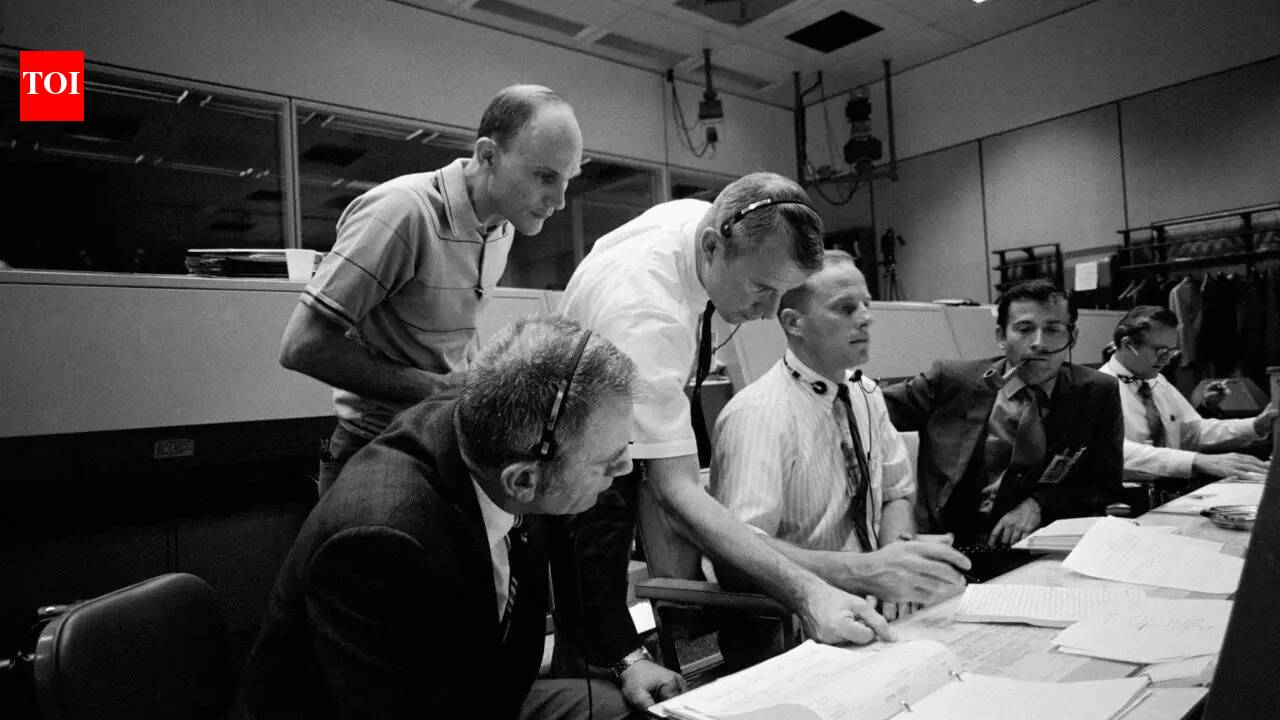
APPLETON, Wis. — On April 13, 1970, the words "Houston, we've had a problem" crackled over the radio from NASA's Mission Control, marking the beginning of one of the most harrowing chapters in space exploration history. The Apollo 13 mission, intended as NASA's third lunar landing, transformed into a desperate fight for survival after an explosion crippled the spacecraft more than 200,000 miles from Earth. Astronauts James A. Lovell Jr., John L. Swigert Jr., and Fred W. Haise Jr. became instant symbols of human resilience, their ordeal captivating the world and ultimately saving their lives through ingenuity on the ground and in space.
The mission launched from Kennedy Space Center in Florida on April 11, 1970, at 2:13 p.m. EDT, aboard the Saturn V rocket. Lovell, the mission commander and veteran of Apollo 8, was making his fourth spaceflight. Swigert, a last-minute replacement for Thomas K. Mattingly Jr., who was grounded due to a measles exposure, served as command module pilot. Haise, a rookie astronaut, was the lunar module pilot. Their objective was to land in the Fra Mauro highlands on the Moon, a site rich with scientific promise for studying lunar geology.
According to NASA records, the first two days of the mission proceeded smoothly. The crew conducted a television broadcast from space, showcasing the Earth and Moon, and performed routine checks. But at 55 hours and 55 minutes into the flight, disaster struck. Swigert flipped a switch to stir the oxygen tanks in the service module, a routine procedure. An electrical fault ignited a spark inside oxygen tank No. 2, which had been damaged during pre-launch tests in 1969 when it was accidentally overheated to 1,000 degrees Fahrenheit.
The resulting explosion ruptured the tank, venting precious oxygen into space and damaging the spacecraft's power and life support systems. Alarms blared as the crew felt a jolt. Lovell later recounted in his memoir, Lost Moon, co-authored with Jeffrey Kluger, "It was as if someone had taken a sledgehammer and hit the side of the spacecraft." The command module, Odyssey, began losing power rapidly, forcing the astronauts to retreat to the lunar module, Aquarius, as a lifeboat.
Mission Control in Houston erupted into controlled chaos. Flight Director Gene Kranz, known for his steely resolve, rallied his team with the now-iconic directive: "Failure is not an option." Engineers on the ground, working around the clock, devised solutions to conserve the limited resources in Aquarius. The lunar module's systems were designed for two men on the Moon for a few days, not three men in deep space for four.
One critical challenge was carbon dioxide buildup. The square lithium hydroxide canisters from the command module didn't fit the round slots in the lunar module. According to NASA engineer Ed Smylie, who led the fix, the team improvised using plastic bags, cardboard, and duct tape — materials available on board. "We put our heads together and came up with a way to make it work," Smylie said in a post-mission debrief. The astronauts jury-rigged the device, averting a toxic atmosphere that could have suffocated them.
Power management was another hurdle. With Odyssey's fuel cells offline, the crew shut down non-essential systems, enduring near-freezing temperatures — as low as 38 degrees Fahrenheit in the cabin. Haise developed a urinary tract infection from dehydration, adding to the physical toll. Lovell reported to Houston, "It's cold in here, but we're hanging in there." Ground crews calculated a trajectory correction using the lunar module's descent engine, slingshotting the spacecraft around the Moon to head back to Earth.
The explosion's cause was later pinpointed in NASA's investigation. The oxygen tank's Teflon-coated wiring had degraded from the earlier heating incident, and a missing thermal indicator during ground tests allowed the damage to go unnoticed. "The tank was a bomb waiting to go off," said Apollo 13 program manager George Low in congressional testimony. This revelation led to sweeping safety reforms, including redesigned oxygen tanks and enhanced spacecraft testing protocols.
Public reaction was one of awe and anxiety. President Richard Nixon monitored the situation from the White House, later praising the crew upon their splashdown: "You have won the hearts of millions." Newspapers worldwide ran front-page stories, with The New York Times headlining "Apollo 13 Averts Disaster." The mission's drama inspired the 1995 film Apollo 13, directed by Ron Howard, which earned nine Oscar nominations and featured actors Tom Hanks as Lovell, Kevin Bacon as Swigert, and Bill Paxton as Haise.
From a scientific standpoint, the aborted landing meant missing out on Fra Mauro samples that could have revealed the Moon's volcanic history. However, the crew did conduct some observations, including ultraviolet photography of stars and Earth resources experiments. Haise noted in a NASA oral history, "We didn't get to walk on the Moon, but we learned more about survival than any lunar stroll could teach."
Comparisons to other missions highlight Apollo 13's uniqueness. Apollo 11 had achieved the first landing just nine months earlier, while Apollo 12 followed with precision. But Apollo 13's near-tragedy shifted NASA's focus toward safety. "It was a wake-up call," according to space historian Roger Launius of the Smithsonian National Air and Space Museum. Subsequent missions, like Apollo 14, incorporated the lessons, landing successfully in the same region in 1971.
Today, as NASA prepares for the Artemis program — aiming to return humans to the Moon by 2025 — Apollo 13 remains a cornerstone of space lore. The partial summary from a recent Times of India article notes, "For the first time in more than 50 years, humans are once again venturing to the Moon. NASA’s Artemis program had sent four astronauts aboard..." underscoring the enduring legacy. Artemis I, an uncrewed test flight, splashed down in December 2022, echoing Apollo's triumphs and trials.
The astronauts' post-mission lives reflected their heroism. Lovell retired from NASA in 1973 and ran for Congress as a Republican in 1984, though unsuccessfully. Swigert served in Congress briefly before his death from cancer in 1982. Haise contributed to the Space Shuttle program and later worked in the private sector. All three received the Presidential Medal of Freedom from Nixon.
Experts debate the mission's long-term impact. Some, like aerospace engineer Sy Liebergot, who was a capsule communicator during the crisis, argue it prevented worse disasters: "Apollo 13 showed us how to bring them back alive, and that saved lives in future programs." Others, including critics of the era's rushed schedule, point to it as evidence of cutting corners in the space race against the Soviet Union.
Looking ahead, Apollo 13's story inspires current endeavors. As private companies like SpaceX and Blue Origin push boundaries, the emphasis on redundancy and quick thinking persists. Lovell, now 95, reflected in a 2020 interview, "We were lucky, but mostly it was the teamwork that got us home." The mission, far from a failure, redefined success in space exploration — not just reaching new worlds, but returning safely from the brink.