By Jessica Williams, The Appleton Times
On March 10, 1942, as World War II raged across the globe, the Canadian federal government imposed strict regulations on men's clothing, aiming to curb the use of fabric and labor amid wartime shortages. The order, announced by the Wartime Prices and Trade Board in Ottawa, targeted what officials described as unnecessary frills in suits, sportswear, and waterproof garments, effectively banning elements like pleats, trouser cuffs, patch pockets, and double-breasted coats. According to a Canadian Press story reported in the Vancouver Sun that day, these "sharp restrictions which will eliminate frills in men’s and boys’ clothing" were designed to "conserve materials and labor" during the conflict.
The regulations were remarkably detailed, reflecting the urgency of the war effort. For men's sack coats in size 38, the length was capped at 29½ inches, with similar proportions for other sizes. Designs had to forgo belting, bi-swings, pleated backs, patch pockets, inside bellows, side or back vents, cash pockets, arm shields, real or imitation buttonholes, chain stitching on sleeves, sleeve cuffs, double-breasted styles, tuxedo coats, and even buttons on the sleeves. Vests faced similar scrutiny: no back straps, inside breast pockets, pencil pockets, double-breasted fronts, or collars. Trousers for a size 32 waist could not exceed 19½ inches at the bottom, with limits on leg width and length overall.
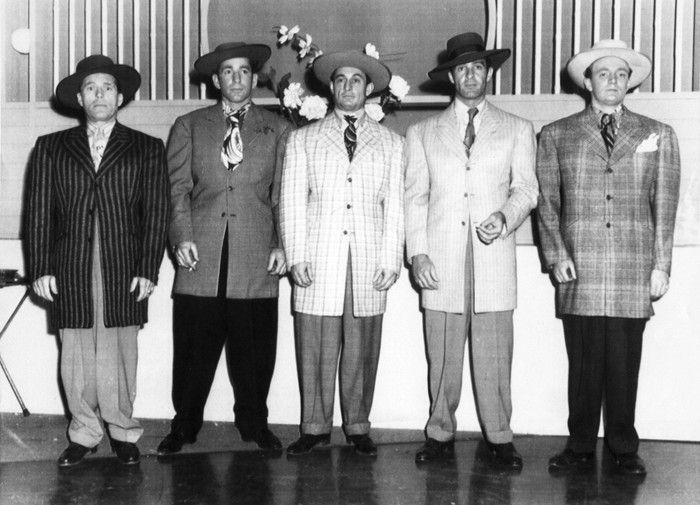
While the order did not explicitly name it, historians and contemporary observers suggest the rules were partly inspired by the rising popularity of the zoot suit, a flamboyant style that consumed excessive fabric at a time when every yard was needed for uniforms and parachutes. Originating in the 1930s among African American communities in New York's Harlem, the zoot suit featured high-waisted, pegged trousers with "reet pleats," tight cuffs known as "stuff cuffs," a long coat with padded shoulders and huge lapels, a vest, and often an exaggerated watch chain dangling to the knee—dubbed a "dog chain." A Vancouver Sun editorial from June 21, 1943, captured the slang of its wearers: "For the uninformed, the zoot suit... is one with ‘reet pleats, stuff cuffs, a zest vest, svelte belt and ‘won my wings’ tie.’" Translated, it meant elaborate pleats, tight cuffs, a beltline under the armpits, and a knee-length coat completed with oversized accessories.
The style spread rapidly across North America in the early 1940s, particularly among young music enthusiasts drawn to jazz and swing. A 1942 recording of "A Zoot Suit (with A Reet Pleat)" by Dorothy Dandridge and Paul White exemplified its cultural allure, blending fashion with the era's vibrant Harlem Renaissance echoes. Yet, as the war intensified, the zoot suit became a flashpoint. To many young wearers—often from minority communities—it symbolized style, rebellion, and cultural pride. But to servicemen on the home front, it represented wastefulness and unpatriotism, clashing with the austerity demanded by the fight against fascism.
Tensions boiled over in the United States, culminating in the Zoot Suit Riots of June 1943 in Los Angeles. From June 3 to 8, white servicemen, sailors, and Marines, joined by civilians, targeted Mexican American, Latino, and Black youths wearing zoot suits in a wave of violence that gripped the city. A June 8, 1943, report in the Los Angeles Times described the chaos: "In the heaviest street fighting on downtown city streets in many years, thousands of servicemen, joined by additional thousands of civilians, last night surged along Main St. and Broadway hunting down zoot suiters." The article continued, "More than 50 zoot suiters had their clothing torn from their bodies as servicemen and civilians converged on bars, restaurants, penny arcades and stores in the downtown area searching for the youths wearing the reet pleats."
The riots left dozens injured, with zoot suiters beaten and stripped in the streets, while military police eventually intervened to restore order. Authorities arrested over 600 people, mostly Latinos, though servicemen faced minimal repercussions. First Lady Eleanor Roosevelt weighed in on the unrest, attributing it to deeper societal issues. In comments reported widely, she said the violence stemmed from "long-standing discrimination against Mexicans" in California and warned that "race problems are growing in the United States." Her perspective highlighted how the clashes were not just about fashion but intertwined with racial prejudices and wartime anxieties.
Canada, though not immune to the zoot suit craze, experienced its own eruption of similar conflicts. On August 5, 1944, a skirmish broke out in Vancouver between zoot suit-wearing youths and merchant seamen, spilling across downtown at the intersection of Richards and Dunsmuir streets, as well as at Princess and Hastings in the Downtown Eastside. The brawl involved punches, broken bottles, and chaotic pursuits, echoing the Los Angeles violence but on a smaller scale. Police intervened, arresting several participants from both sides.
Court outcomes reflected the era's biases. Two zoot suiters received six-month jail sentences for their roles in the fray. In contrast, the servicemen involved faced lighter penalties. Soldier R.J. Brooks was fined $25 or 13 days in jail after being caught kicking a police officer in the groin during the melee. Seaman Peter Evans, arrested on Hastings Street while carrying an axe, was also fined $25 or given one month in jail. These disparities underscored the uneven application of justice, with authorities seemingly more lenient toward military personnel.
The broader context of these events was the home front's mobilization during World War II. Canada's entry into the war in 1939 had transformed daily life, with rationing of food, fuel, and fabrics becoming commonplace. The clothing restrictions of 1942 were part of a larger effort by the Wartime Prices and Trade Board to standardize production and prevent hoarding. Similar measures existed in the U.S., where the War Production Board limited suit lengths and banned wool vests to save materials for the military. Yet, the zoot suit's defiance persisted underground, as young people adapted styles to skirt the rules while expressing identity.
That same March 10, 1942, edition of the Vancouver Sun carried graver news on its front page, underscoring the war's human cost. British Foreign Secretary Anthony Eden accused the Japanese army of "wholesale atrocities" after the fall of Hong Kong on December 25, 1941. A Canadian Press dispatch from London detailed the horrors: "Fifty British officers and men were bound hand and foot and then bayonetted to death following the capture of Hong Kong." These reports fueled anti-Japanese sentiment and justified the stringent home-front policies, including the clothing bans, as symbols of national resolve.
Looking back, the zoot suit phenomenon and its attendant riots reveal the intersections of fashion, race, and wartime patriotism. While the 1942 regulations succeeded in streamlining production—helping Canada supply Allied forces with essential goods—they could not extinguish the cultural spark of the zoot suit. The style waned after the war, but its legacy endures in jazz history, civil rights narratives, and even modern fashion revivals. In Vancouver and beyond, the events of 1943 and 1944 serve as a reminder of how seemingly trivial matters like clothing can ignite deeper social fissures during times of crisis.
Today, as historians revisit these stories, they emphasize the resilience of marginalized communities who used style as resistance. The Vancouver Sun's archival pieces, like the 1943 editorial, provide a window into an era when youthful exuberance clashed with martial discipline. Whether viewed as a conservation triumph or a stifling of expression, the frilly clothes ban marked a pivotal moment in Canada's wartime narrative, one that rippled into street-level confrontations years later.
Scholars note that while the riots were localized, they contributed to national conversations on race and equity. Eleanor Roosevelt's comments, for instance, prompted federal inquiries into discrimination in the U.S., influencing post-war policies. In Canada, the 1944 Vancouver clash, though less documented, highlighted similar undercurrents among immigrant and Indigenous youth who adopted the zoot look. No major legislative changes followed immediately, but the incidents fed into broader anti-racism efforts in the decades ahead.
As the 80th anniversary of these events approaches, interest in zoot suit culture has surged, with documentaries, exhibits, and online clips like Dandridge's performance bringing the era to life. For Appleton readers, this slice of history connects to our own region's wartime stories, where factories shifted to war production and communities rallied under rationing. The tale of banned frills and riotous reets pleats endures as a testament to how war reshapes not just battlefields, but wardrobes and streets alike.