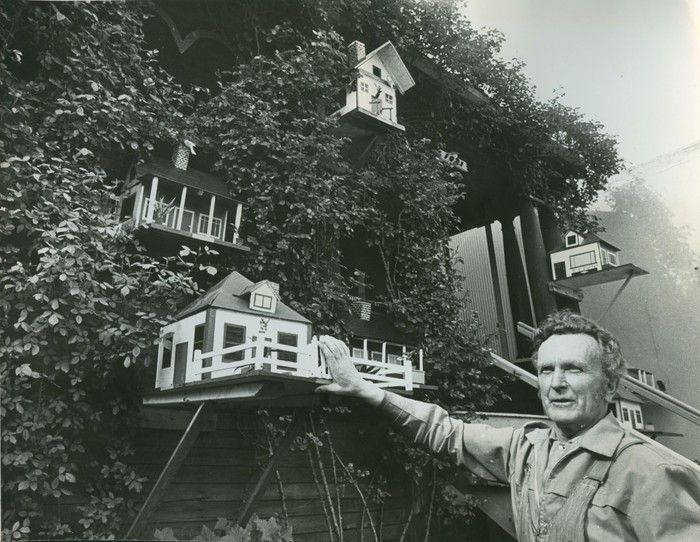
VANCOUVER, B.C. — In the heart of downtown Vancouver during the 1970s, 1980s, and 1990s, a modest three-storey house at 1021 Richards Street stood out not for its architecture, but for the whimsical array of birdhouses adorning its exterior and yard. Percy Linden, a former truck driver from Alberta, earned the affectionate nickname the Birdman of Richards Street for transforming his property into a vibrant spectacle that drew passersby, tourists, and even international postcards. On April 8, 1991, Linden shared with the Vancouver Sun's Nicole Parton that he had built about 100 birdhouses over the years, many of which he sold to intrigued visitors right from his doorstep.
Linden's story began far from the urban buzz of Vancouver. Born and raised on a farm outside Huxley, Alberta, about 160 kilometres northeast of Calgary, he left school at age 13 and first arrived in Vancouver in 1947. By 1954, he purchased the house on Richards Street, built around 1908 when the neighborhood was still primarily residential. However, Linden soon returned to Alberta to drive trucks in the oilpatch, renting out the property for over two decades while he worked there.
It wasn't until the early 1970s that Linden reclaimed his Vancouver home from tenants, finding the garden in disarray. As he set about cleaning it up, his unexpected foray into carpentry and gardening took off. According to Parton's 1991 report, Linden hammered together his first flower box in his workshop, and upon experimenting with a few boards, he exclaimed, “I thought, Migawd, it looks like a birdhouse!” He admitted to Parton that he had “never driven a nail in my life. I’d never carpentered. I’d never gardened.”
The birdhouses themselves were a diverse collection, reflecting Linden's creative whimsy. Aileen Campbell of The Province described them on June 18, 1977, as including “colonial and Swiss, farmhouse and ranch styles. Pillared and plain, from the Coo Coo Inn and Kum Inn to the Bar X ranch, whatever strikes the fancy of the one-time Alberta farm boy who drove a truck all his life.” Despite their charm, the structures served more as decorative art than functional homes for birds. Linden explained to the Sun’s Neal Hall on March 28, 1995, “I put openings for the birds in the first two, but the birds have all been driven out of here.” As a result, he stopped adding entrances, turning the birdhouses into purely ornamental features.
To compensate for the absent avian residents, Linden adorned his yard with plastic birds, along with about 50 miniature wheelbarrows he had also crafted. In the spring, he would erect 10 to 15 birdhouses, some miniature flower boxes, a big heart, and a couple of miniature windmills. His front garden bloomed with a climbing rose bush spilling over the porch, though Linden confessed to Campbell in 1977 that he couldn’t identify half the plants. “That blue stuff — I don’t know what that is, but over there is a snowball tree,” he said. “And that’s a red currant bush.”
The garden's allure caught the eye of professionals as well. In 1981, landscape designer Barbara Patterson helped appraise it for Bruce McLean of The Province. McLean reported that on the south side, it featured “blue hydrangeas, a spirea shrub, gladiolus, stalks of wild fireweed, yellow chrysanthemums, peonies and shasta daisies.” Primulas bloomed in February, and snow-white alyssum bordered the sidewalk, even cascading from tubs on the stairs and growing in cracks in the pavement. Patterson's assessment highlighted the careful nurturing that made the space a pedestrian's delight, encouraging visitors to tread lightly amid the blooms.
Linden's unpainted house exterior provided a stark canvas that made the colorful birdhouses and garden pop against the gray urban backdrop. Located across from the bustling Richard’s on Richards nightclub, the property became a quirky counterpoint to the neighborhood's evolving nightlife scene. Tourists and locals alike snapped photos, mailing them back to Linden from as far away as Europe, Asia, and South America. One note left by a visitor read, “The love you give to your garden is reflected on all of us and carried with us wherever we go.”
The Birdman's fame extended beyond his own yard. His apparent green thumb, possibly rooted in his Alberta farm upbringing, led neighbors to seek his help. Linden told reporters, “They come by here. They swear I’m a gardener, and I swear I’m not. But there will be a note with a sickly house plant on the veranda, and they want me to do something. So I dump out all the dirt, put fresh in and the silly thing grows and they really think I’m a plant doctor.” This informal gardening service turned him into a local celebrity, blending his self-taught skills with the community's appreciation for his efforts.
Yet, as Vancouver's downtown transformed from residential to commercial, pressures mounted on Linden's slice of eccentricity. By 1995, he listed the house for sale at $450,000, a figure reflecting the area's rising real estate values. The site, once a haven of handmade charm, gave way to a highrise and townhouses, erasing the physical remnants of the Birdman's legacy. Linden passed away on February 1, 2002, at the age of 84, leaving behind memories of a man who turned urban decay into a blooming attraction.
Reflections on Linden's impact persist in Vancouver's cultural lore. His story exemplifies the city's quirky underbelly, where individual creativity could briefly hold its own against rapid development. Historians and urban enthusiasts often cite the Richards Street house as a snapshot of pre-gentrification Vancouver, when personal expressions like birdhouses and wildflower gardens dotted the streets amid emerging nightlife hubs.
While no conflicting accounts emerge from contemporary reports, the consistency across Vancouver Sun and Province articles underscores Linden's genuine surprise at his own talents. His journey from oilpatch trucker to downtown folk artist highlights how ordinary lives can intersect with a city's evolving identity, offering moments of delight in an otherwise changing landscape.
Today, as Vancouver grapples with housing affordability and neighborhood preservation, Linden's tale serves as a reminder of lost idiosyncrasies. The absence of birds in his houses, much like the displacement of unique characters in urban renewal, adds a poignant layer to his narrative. Though the physical site is gone, the Birdman of Richards Street endures in archival photos and stories, a testament to one man's unexpected bloom in the concrete jungle.
Efforts to commemorate such figures have grown in recent years, with local history groups occasionally referencing Linden in walking tours of old downtown. While no official markers exist at the former site, his influence lingers in discussions about balancing development with cultural heritage. As one former neighbor recalled in a 2002 obituary note, Linden's garden wasn't just plants and houses—it was a beacon of simple joy for a city in flux.