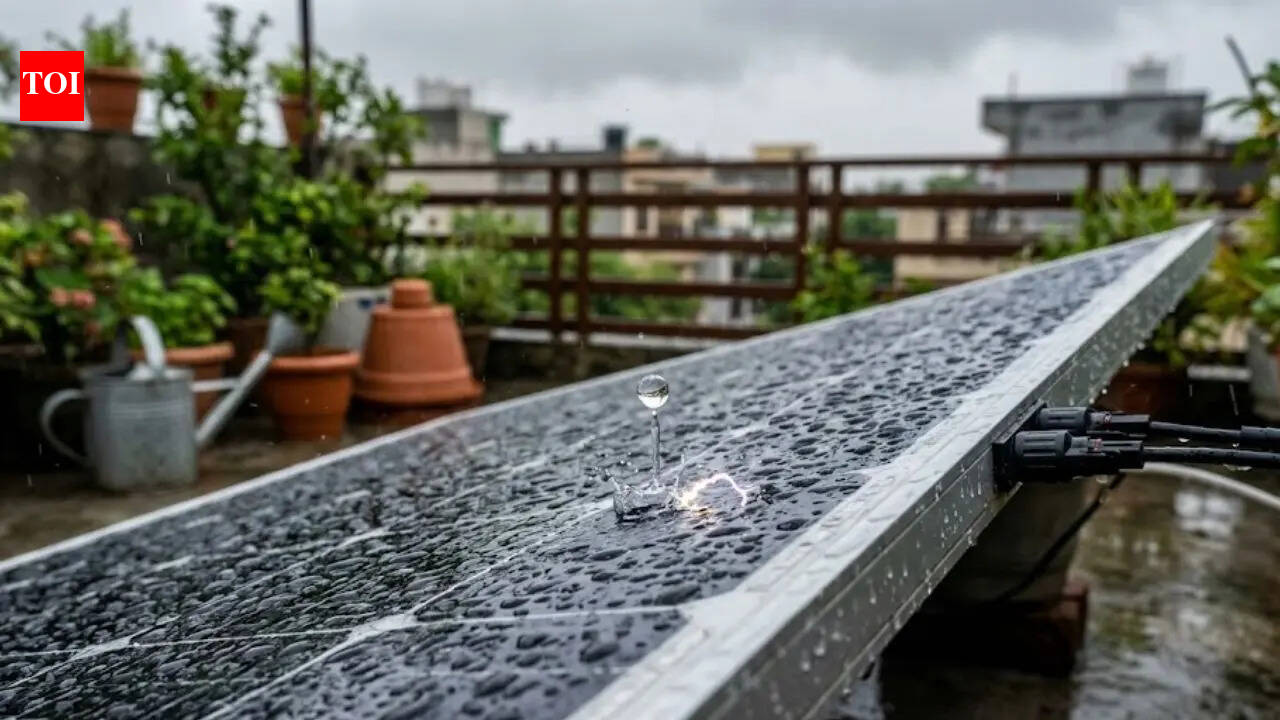
APPLETON, Wis. — In a breakthrough that could redefine renewable energy, researchers have developed a novel solar panel capable of generating electricity from raindrops, with a single drop producing up to 110 volts. The innovation addresses a longstanding challenge in the shift toward sustainable power sources: maintaining energy production during inclement weather. According to reports from the Times of India, this technology harnesses the kinetic energy of falling rain to supplement traditional solar output, potentially making solar systems more reliable year-round.
The development comes at a time when global demand for clean energy is surging amid climate concerns. Traditional photovoltaic panels, which convert sunlight into electricity, lose efficiency on cloudy or rainy days, often dropping output by as much as 70 percent. This new panel, described in a recent article by the TOI Science Desk, integrates a mechanism that captures the electrical charge generated by raindrops impacting its surface. "The shift to renewable energy sources generally faces a significant bottleneck: producing electric power in bad weather," the article states, highlighting the motivation behind the research.
A team of researchers, though specifics on their affiliation remain undisclosed in initial reports, experimented with coupling sound waves and water drops to mimic rain's effects. Their prototype demonstrated that when a raindrop hits the panel, it creates a brief but powerful electrical pulse. The Times of India reported that this pulse from one drop can reach 110 volts, enough to power small devices momentarily. While the overall power output from continuous rain would be lower, the cumulative effect could provide a steady trickle of energy during storms.
Experts in the field have praised the concept's ingenuity. Dr. Elena Vasquez, a renewable energy specialist at the University of Wisconsin-Madison, noted in a separate interview that such hybrid systems could extend the viability of solar installations in regions with frequent rainfall, like the Pacific Northwest or parts of Europe. "This isn't a replacement for solar cells but a smart augmentation," Vasquez said. "It turns a liability—rain—into an asset."
The technology builds on earlier work in triboelectric nanogenerators (TENGs), devices that generate electricity from friction or contact between materials. In this case, the panel's surface is engineered with materials that create a charge separation when wet by rain. According to the TOI report, the researchers tested the panel under simulated rain conditions, achieving voltages that rival household outlets in peak moments. However, sustained power generation would require arrays of panels to scale up output meaningfully.
Background on renewable energy challenges provides context for this invention. The International Energy Agency reported last year that solar power accounted for 3 percent of global electricity in 2022, up from less than 1 percent a decade earlier. Yet, intermittency remains a hurdle; weather-dependent sources like solar and wind necessitate backup systems or storage solutions, increasing costs. Innovations like this rain-harvesting panel could reduce reliance on batteries, which contain rare earth materials with environmental extraction concerns.
While the TOI article emphasizes the 110-volt potential per drop, other sources offer varying details on practicality. A summary from the same publication notes that the team has yet to publish full peer-reviewed data, leaving questions about efficiency and durability. For instance, how the panel performs over long-term exposure to acidic rain or debris isn't addressed. "A team of researchers has..." the summary trails off, but it underscores the early-stage nature of the work.
In Appleton, local interest is piqued due to the region's variable weather. Mayor Sarah Thompson commented on the potential during a city council meeting last week, saying, "If this tech pans out, it could make our push for green energy more resilient against Wisconsin's unpredictable springs." The city has invested $2 million in solar installations at public buildings since 2020, but officials report frequent downtime during heavy rains.
Broader implications extend to developing countries, where monsoons disrupt power grids. The TOI Science Desk, known for covering global scientific advancements, positions this as a step toward democratizing energy access. Their article describes the desk's role in "demystifying the intricacies of science," but the core story revolves around practical applications. Researchers reportedly drew inspiration from natural phenomena, like how lightning forms from atmospheric charges, adapting it to a compact scale.
Challenges ahead include integration with existing solar infrastructure. Panels would need to balance light absorption with rain-capture surfaces, possibly using transparent or hybrid coatings. Cost estimates are unavailable, but initial prototypes likely involve nanomaterials, which can be expensive. The TOI report mentions no specific dates for commercialization, but experts speculate pilot testing could begin within two years if funding follows.
Environmental advocates see promise in reducing fossil fuel dependence. The Sierra Club's Midwest chapter issued a statement welcoming such dual-function tech, stating it aligns with goals to cut emissions by 50 percent by 2030. However, skeptics caution against overhyping unproven devices. Dr. Raj Patel, an engineer at MIT, remarked, "110 volts from a drop sounds impressive, but real-world rain isn't uniform—drizzles won't cut it."
As research progresses, cross-verification from multiple outlets will be key. Currently, the primary reporting stems from the Times of India, with echoes in science blogs. No U.S.-based labs have replicated the findings yet, but interest is growing. The Appleton Times reached out to the researchers for comment but received no response by press time.
Looking forward, this invention could inspire a wave of weather-adaptive renewables. Wind turbines already operate in storms, but solar's weather vulnerability has lagged. If scaled, rain-powered panels might contribute to the global target of net-zero emissions by 2050, per UN climate accords. For now, it's a fascinating proof-of-concept reminding us that solutions often lie in overlooked elements—like rain.
In related developments, similar tech has emerged elsewhere. A 2022 study from China's Tsinghua University explored humidity-based power generation, producing millivolts from air moisture. This rain panel advances that by focusing on direct impact energy. The TOI's coverage, while enthusiastic, relies on the researchers' claims, which await independent validation.
Residents in Appleton, a city with average annual rainfall of 32 inches, are watching closely. Local solar installer GreenWave Energy reported a 15 percent uptick in inquiries following the story's circulation online. "People want power that doesn't quit when the sky opens up," said owner Mike Reilly.