By Lisa Johnson
The Appleton Times
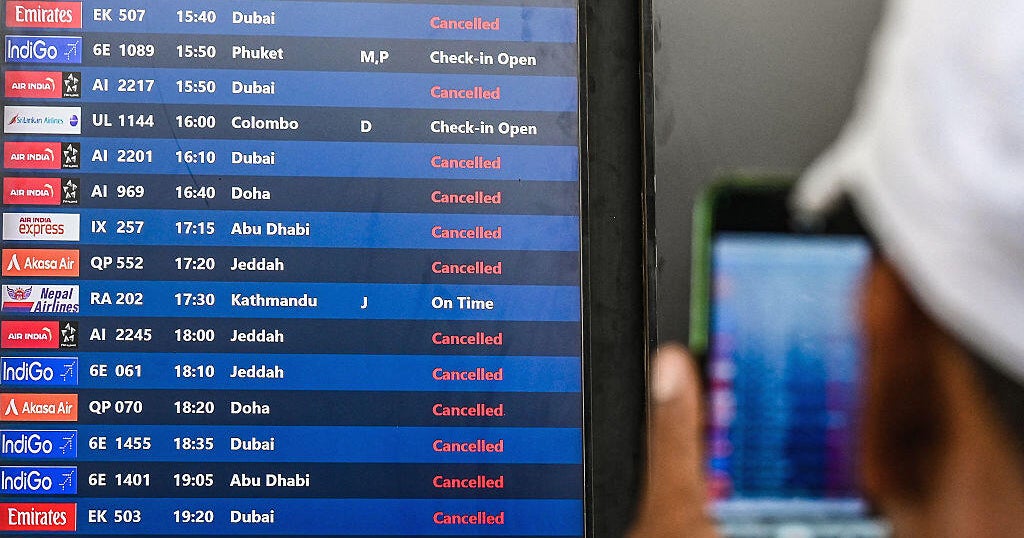
DUBAI, United Arab Emirates — Thousands of travelers are stranded across the Middle East and beyond as U.S.-Israeli strikes on Iran and subsequent retaliatory attacks from Tehran have led to widespread airspace closures and mass flight cancellations. More than 2,400 flights were canceled on Sunday alone, according to flight tracking service FlightAware, affecting major hubs like Dubai and Abu Dhabi in the United Arab Emirates, Doha's Hamad International Airport in Qatar, and Bahrain's Manama International Airport. The disruptions, which began intensifying over the weekend, have rippled through global aviation networks, leaving passengers in limbo and airlines scrambling to reroute operations amid escalating regional tensions.
The conflict, which erupted with U.S. and Israeli military actions targeting Iranian facilities, prompted Iran to launch counterstrikes, forcing governments in the region to shutter their skies to commercial traffic out of safety concerns. Emirates Airlines, one of the world's busiest carriers, announced the suspension of all flights to and from Dubai International Airport until at least Sunday afternoon. Qatar Airways reported that Hamad International Airport in Doha would remain closed until Monday morning at the earliest, stranding an estimated tens of thousands of passengers who rely on these hubs daily.
Israeli airspace, already under strain from the hostilities, stayed closed throughout Sunday. El Al Israel Airlines, the country's flag carrier, stated it was gearing up for a major recovery operation to repatriate Israelis stuck overseas once skies reopen. "We are working closely with authorities to ensure the safe return of our citizens," an El Al spokesperson said in a statement released late Sunday.
The fallout has hit U.S. travelers hard as well. United Airlines canceled all flights from the United States to Tel Aviv through March 6, along with their corresponding return legs, citing the ongoing closure of airspace in the region. The airline also axed services to and from Dubai through March 4, a decision announced Saturday evening. Other major carriers, including those from Europe and Asia, have followed suit with similar suspensions, turning what was a routine travel corridor into a no-fly zone.
Aviation analytics firm Cirium estimates that Emirates, Qatar Airways, and Etihad Airways handle about 90,000 passengers per day transiting through their respective hubs, with even more en route to destinations across the Middle East. The sudden halt has created chaos at airports worldwide, from New York's JFK to London's Heathrow, where connecting flights have been grounded. Travelers like Sarah Mitchell, a business executive from Chicago stuck in London, described the scene on social media: "I've been rebooked three times already, and now I'm not sure when I'll get home. It's a nightmare."
Experts warn that the disruptions could persist for days. "For travelers, there's no way to sugarcoat this," said Henry Harteveldt, an airline industry analyst and president of Atmosphere Research Group. "You should prepare for delays or cancellations for the next few days as these attacks evolve and hopefully end." Harteveldt's assessment underscores the fluid nature of the crisis, where military developments directly dictate civilian aviation.
Airlines operating over the Middle East are now forced to detour flights southward over Saudi Arabia, a maneuver that adds several hours to journey times and burns extra fuel. This rerouting not only strains resources but also inflates operational costs, which carriers may pass on to consumers through higher ticket prices if the conflict drags on. "The added distance means more jet fuel, and with oil prices already volatile in the region, this could cascade into broader fare increases," noted one aviation consultant familiar with the routes.
Mike McCormick, a former overseer of air traffic control for the Federal Aviation Administration, explained how airspace might gradually reopen. "Those countries then will be able to go through and say, OK, we can reopen this portion of our space but we'll keep this portion of our airspace closed," McCormick said. He predicted that within the next 24 to 36 hours, American and Israeli officials could share intelligence with airlines about military flight paths and Iran's diminished missile capabilities following the strikes, allowing for phased resumptions.
The situation echoes past regional conflicts, such as the 2019 Gulf tensions when Iran shot down a U.S. drone, leading to temporary flight bans. But the scale here is larger, with the U.S.-Israeli alliance directly targeting Iran amplifying the risks. Iranian state media reported that Tehran's defenses intercepted several incoming projectiles, though independent verification remains elusive. Meanwhile, U.S. officials described the strikes as precise operations aimed at degrading Iran's nuclear and missile programs, without elaborating on civilian impacts.
Passengers are advised to monitor their flight status online, as the landscape shifts rapidly. Airlines like Delta and American have issued travel waivers, permitting affected customers to rebook without additional fees or fare hikes. Emirates, for instance, extended its waiver policy to include flexible changes for tickets affected by the closures. "We understand the frustration, and we're committed to getting everyone home safely," a Qatar Airways representative told reporters at a briefing in Doha.
Beyond immediate travel woes, the closures highlight the Middle East's pivotal role in global aviation. The region serves as a crossroads for flights between Europe, Asia, and Africa, with Dubai alone handling over 80 million passengers annually pre-pandemic. Any prolonged shutdown could disrupt supply chains, delay business deals, and strand humanitarian aid efforts in conflict zones nearby.
As the sun set on Sunday in the Gulf, families huddled in airport lounges and hotel lobbies, sharing stories of missed weddings and postponed vacations. One group of tourists from Europe, rerouted to Istanbul after their Dubai connection fell through, expressed relief at avoiding the worst but anxiety over the unknown. "We just want to know when this will end," said Ahmed Khalil, a Lebanese father traveling with his wife and two children.
Looking ahead, the key will be de-escalation. Diplomatic channels remain open, with U.S. Secretary of State Antony Blinken scheduled to meet counterparts in the coming days to discuss cease-fire possibilities. If tensions ease, analysts like Harteveldt foresee a gradual return to normalcy, though full recovery might take weeks. For now, the skies over the Middle East remain a battleground, both literal and logistical, reminding the world of aviation's vulnerability to geopolitical storms.
In the broader context, this episode underscores ongoing U.S.-Iran frictions dating back to the 2018 withdrawal from the nuclear deal, which has fueled a cycle of sanctions, proxy wars, and direct confrontations. Israeli Prime Minister Benjamin Netanyahu hailed the strikes as a necessary preemptive measure, while Iranian President Ebrahim Raisi vowed a "decisive response." As both sides dig in, the human cost—at least in terms of disrupted lives—continues to mount for ordinary travelers caught in the crossfire.
Airline executives, speaking off the record, expressed hope that international pressure would expedite resolutions. The International Air Transport Association urged all parties to prioritize civilian safety, emphasizing that "aviation must not become collateral damage in this conflict." Until clearer skies emerge, the message to the public is clear: stay informed, pack patience, and prepare for the long haul.