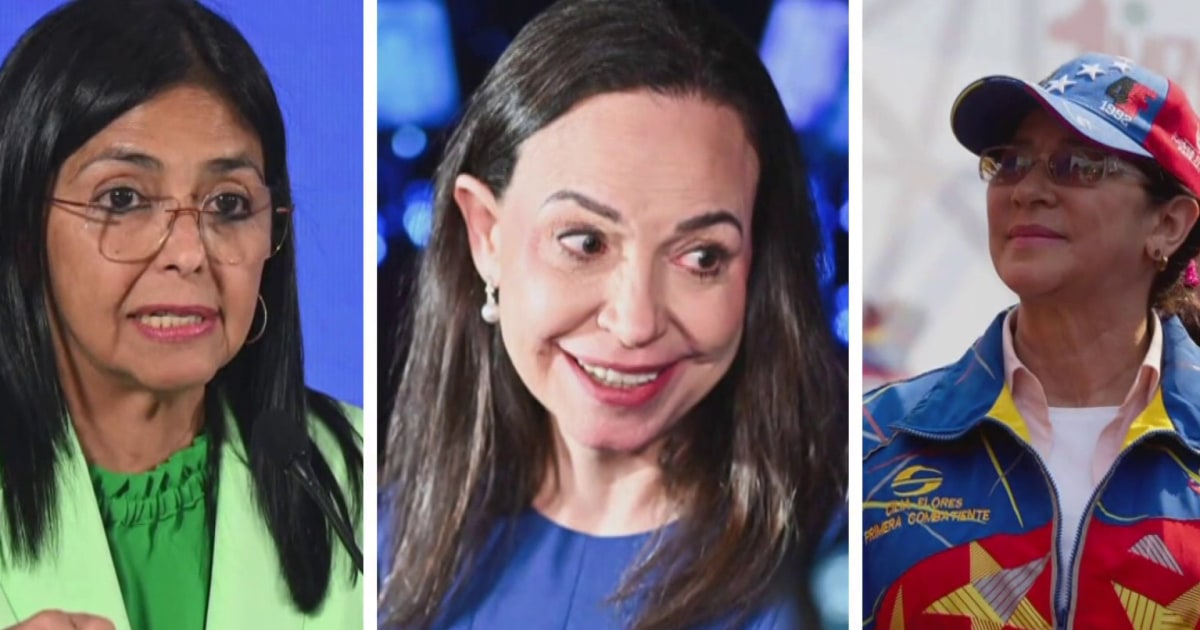
In a dramatic turn of events that has reshaped Venezuela's political landscape, three prominent women—Delcy Rodríguez, Cilia Flores, and María Corina Machado—are emerging as key figures following the capture of President Nicolás Maduro in a U.S. military operation. The operation, which took place on October 15, 2023, in Caracas, marked a significant intervention by U.S. forces aimed at addressing years of political turmoil and human rights abuses in the South American nation. According to reports from NBC News, Maduro's detention has created a power vacuum, propelling these women into pivotal roles as they navigate the country's uncertain future.
Delcy Rodríguez, Venezuela's vice president and a longtime ally of the late Hugo Chávez, has been vocal in the immediate aftermath of Maduro's capture. Speaking from the presidential palace in Miraflores on October 16, Rodríguez declared, 'The revolution will not be silenced; we will fight for the sovereignty of our people.' Her statement, broadcast on state television, underscores the Chavista faction's determination to maintain control amid the chaos. Rodríguez, 55, has served as foreign minister and is known for her hardline stance against U.S. sanctions, which she has repeatedly called 'economic warfare.'
Cilia Flores, another Chavista stalwart and president of the National Assembly, has been coordinating legislative responses to the crisis. Flores, 59, who was instrumental in Chávez's rise to power in the early 2000s, addressed lawmakers in Caracas on October 17, saying, 'This foreign aggression will not break our unity; the assembly stands firm.' Her role has become even more critical as interim governance structures are debated, with Flores reportedly pushing for emergency powers to stabilize the economy, which has been plagued by hyperinflation and shortages for years.
On the opposition side, María Corina Machado, a fierce critic of the Maduro regime, has seized the moment to rally supporters. Machado, 55, whose political ambitions were thwarted when she was barred from running for president in 2024, spoke to a crowd of thousands in Plaza Altamira in eastern Caracas on October 18. 'Today marks the end of tyranny and the beginning of true democracy,' she proclaimed, according to eyewitness accounts reported by international outlets. Machado's party, Vente Venezuela, has long accused the government of electoral fraud and corruption, and her emergence now positions her as a potential transitional leader.
The U.S. military operation that led to Maduro's capture was executed by special forces under the direction of the Pentagon, sources familiar with the matter told NBC News. Details remain sparse, but officials confirmed that the raid occurred around 2 a.m. local time, involving helicopter insertions near Maduro's residence in La Casona. Maduro, 60, was taken into custody without resistance and is currently held at an undisclosed location in Colombia, pending extradition to the United States on charges including narco-terrorism and human rights violations, as outlined in indictments from the Southern District of New York dating back to 2020.
Background to the crisis traces back to the 2018 presidential election, widely criticized as fraudulent by the international community. Maduro's re-election sparked mass protests, economic collapse, and a humanitarian crisis that displaced over 7 million Venezuelans. The U.S., under both Trump and Biden administrations, imposed escalating sanctions, freezing assets and targeting regime officials. The capture, described by U.S. Secretary of State Antony Blinken as 'a necessary step for regional stability' in a statement on October 16, has drawn mixed reactions globally.
Supporters of the Maduro government, aligned with Rodríguez and Flores, view the operation as an imperialistic overreach. Venezuelan Foreign Ministry spokesperson, speaking anonymously due to the sensitivity, said, 'This is a violation of international law that will unite Latin America against U.S. aggression.' In contrast, opposition figures like Machado hail it as liberation. Julio Borges, a former opposition leader in exile, tweeted on October 15, 'Justice has arrived; now the people must rebuild.'
International observers are closely watching the interplay among these three women, whose ideologies clash sharply. Rodríguez and Flores represent the socialist PSUV party, which has dominated Venezuelan politics since 1999, while Machado embodies the liberal, pro-market opposition. Analysts note that their ability to negotiate could determine whether Venezuela avoids further violence. 'The next few weeks will be crucial,' said Michael Shifter, president of the Inter-American Dialogue, in an interview with NBC News. 'These women hold the keys to either reconciliation or deeper division.'
Economic implications are profound. Venezuela's oil-rich economy, once the envy of Latin America, has crumbled under mismanagement and sanctions, with GDP contracting by over 75% since 2013, according to the International Monetary Fund. Post-capture, oil prices spiked 5% on global markets, reflecting uncertainty. Rodríguez has called for immediate lifting of sanctions, while Machado advocates for privatization of PDVSA, the state oil company, to attract foreign investment.
Human rights groups report heightened tensions on the streets of Caracas and other cities like Maracaibo and Valencia. Amnesty International documented at least 12 deaths in clashes between security forces and protesters on October 17 alone. 'The capture has unleashed pent-up frustrations, but it also offers a chance for accountability,' said Erika Guevara-Rosas, Amnesty's Americas director, in a press release.
Regionally, neighbors like Colombia and Brazil have bolstered border security amid fears of refugee surges. Colombian President Gustavo Petro, in a televised address on October 19, urged dialogue: 'We support a peaceful transition that respects Venezuelan sovereignty.' Brazil's government, under Lula da Silva, has remained neutral, with Foreign Minister Mauro Vieira stating, 'Any solution must come from Venezuelans themselves.'
As transitional mechanisms take shape, the United Nations has offered to mediate. A special envoy is expected in Caracas by October 25 to facilitate talks involving all factions. Rodríguez has agreed to participate conditionally, while Machado insists on free elections within six months. The European Union, which recognized opposition leader Juan Guaidó in 2019 before his influence waned, has called for 'inclusive governance.'
The capture of Maduro also revives questions about his inner circle. Diosdado Cabello, a powerful PSUV figure, remains at large and has vowed retaliation through loyalist militias. Reports indicate skirmishes in rural areas like the Orinoco region, where armed groups control gold mines funding the regime.
Looking ahead, the roles of Rodríguez, Flores, and Machado could redefine Venezuelan politics for generations. If they forge a coalition, it might stabilize the nation and pave the way for elections in 2025. However, persistent divisions risk civil war, echoing the instability in neighboring countries. As one Caracas resident, interviewed by NBC News, put it, 'We've suffered enough; these women must lead us to peace.'
For now, the world watches as Venezuela stands at a crossroads, with these three women at the helm of its political future. The coming days will reveal whether unity prevails or fragmentation deepens the crisis that has gripped the nation for over two decades.