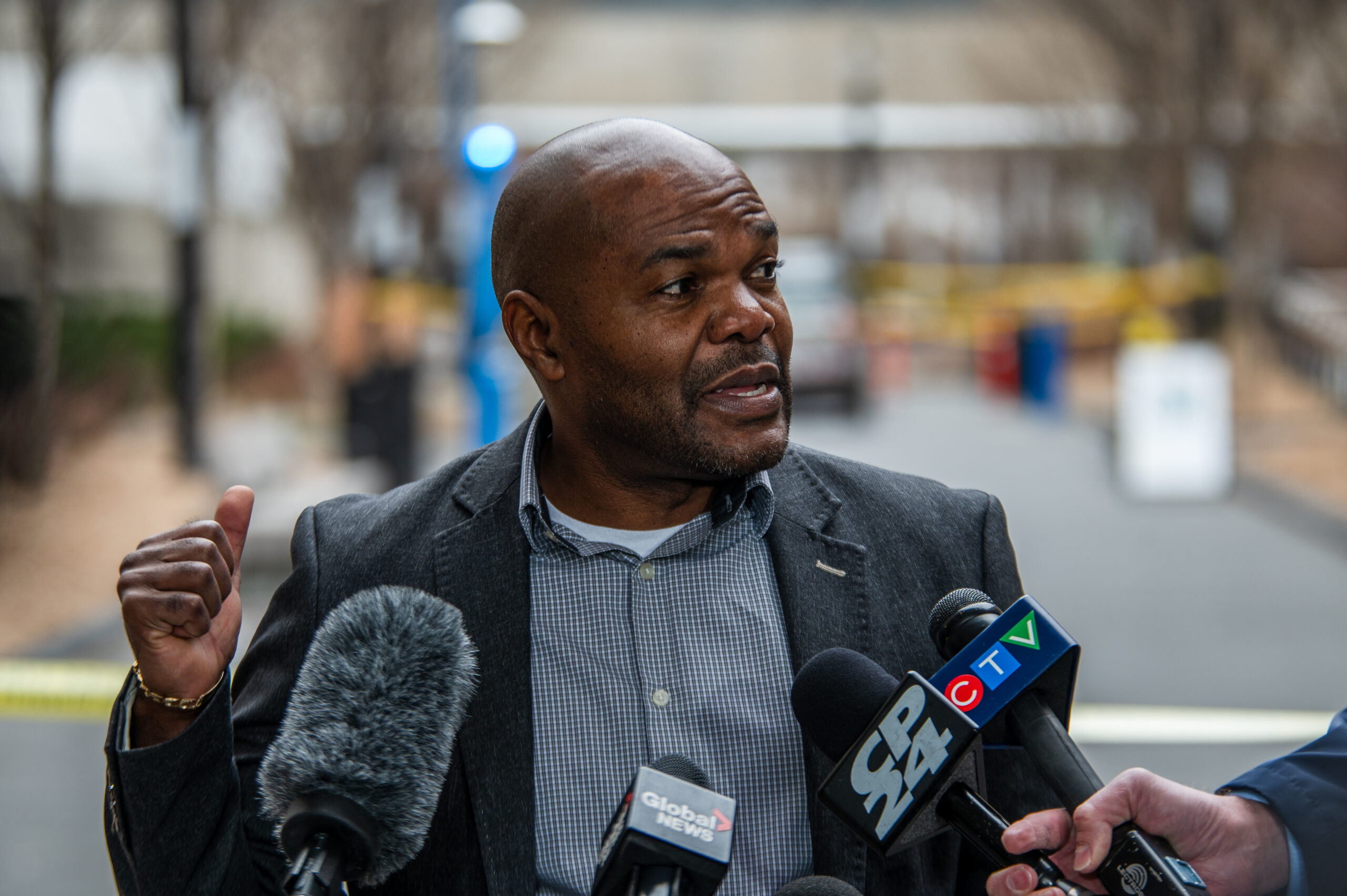
TORONTO — Toronto's Integrity Commissioner has ruled that Ward 13 Councillor Chris Moise violated the city's code of conduct during a heated exchange with a constituent at a town hall meeting last year, though no penalties were recommended due to the circumstances surrounding the confrontation.
The incident unfolded on January 16, 2025, at a public meeting in Toronto Centre, where Moise, who represents the ward, was approached by Daniel Tate, a member of the advocacy group Integrity TO. Tate, known for his opposition to the city's decision to rename Yonge-Dundas Square to Sankofa Square—a change spearheaded by Moise—confronted the councillor as he attempted to leave the event. The exchange, captured on video by Tate and later shared with media outlets, quickly escalated into a personal dispute.
According to the video footage, Tate pressed Moise on his plans for further renamings, asking, “So what are you doing this year, in [20]25, relating to renaming things that hurt your feelings for whatever reason? What else is on your list?” Moise responded by acknowledging their differing views and then stated, “Mr. Tate, I know that you and I have different opinions on many things. I know that you have different views than I do. I know you have a white supremacy view.” He added, “I don’t support your views.”
Tate immediately demanded an apology, replying, “Did you just call me a white supremacist, Councillor Moise? That’s an appalling thing to say to a constituent.” The argument intensified as others joined in, with voices overlapping. Moise shot back, “You have harassed me for months,” and firmly declared, “I will never apologize.” One individual in the video is heard accusing Moise of “pulling the race card,” highlighting the charged atmosphere of the encounter.
The renaming of Yonge-Dundas Square to Sankofa Square, approved by Toronto City Council in 2023, was part of broader efforts to address historical injustices associated with the original name, which honored Henry Dundas, an 18th-century Scottish politician linked to delays in the abolition of the slave trade. Moise, as a councillor focused on equity issues, played a key role in advocating for the change, which aimed to honor African heritage through the Akan word 'Sankofa,' symbolizing learning from the past. The decision sparked significant debate, with critics like Tate arguing it erased history without sufficient consultation.
Integrity TO, described in reports as a controversial advocacy group, has been vocal in opposing what it sees as politically motivated renamings and equity policies in Toronto. Tate's confrontation with Moise was not isolated; the commissioner’s report noted that Moise had faced “persistent criticism” of diversity, equity, and inclusion initiatives, often from similar quarters. As a racialized councillor, Moise's perspective on these issues stems from his lived experiences, which the report acknowledged as context for the exchange.
Days after the town hall, on January 22, 2025, Tate filed a formal complaint with the city's Integrity Commissioner, an independent officer tasked with investigating breaches of conduct by elected officials. The commissioner, in a report released on March 21, 2026, examined two complaints arising from the incident. The findings concluded that Moise's comments were directed at a specific individual and could cause reputational harm, violating Article 14 of the code of conduct, which prohibits derogatory engagement with the public while in an official capacity.
“As a result, the Commissioner found that the Councillor had engaged with a member of the public in a derogatory manner while acting in his official role, violating Article 14 of the Code of Conduct,” the report stated. However, the commissioner recommended no sanctions, citing the context: “The brief interaction occurred when the Complainant pursued the Councillor with critical questions while the Councillor was trying to leave a meeting and only became public when the Complainant shared his video with the media.”
The report further emphasized the importance of respectful conduct among public officials: “While disagreement is inevitable in a vibrant democracy, the manner in which individuals engage with one another matters. Members of Council hold positions of public trust and, with that, bear the responsibility to model high standards of respectful conduct.” It also noted that this was the first such finding against Moise, who has otherwise maintained a record free of similar violations.
Moise, in a statement to CityNews following the report's release, stood by his words without apology. He described feeling cornered by Tate and what he called a “handful of people” who appeared to be associates or volunteers. “We encourage our children and others that if they see something, say something,” Moise said. “I will continue to say something when I see something. As an elected representative, it is incumbent on me to lead by example and stand up to racism, bigotry, and marginalization.” He added, “I respectfully disagree with the Integrity Commissioner. I have no regrets, and I will always stand up to white nationalism and white nationalist politics.”
On the other side, Integrity TO expressed disappointment with the lack of penalties. In a statement on March 23, 2026, Tate said, “This kind of derogatory rhetoric fuels toxic, divisive discourse and erodes trust in public officials. When citizens fear reputational harm for speaking out, democracy itself is weakened.” The group urged Toronto City Council to impose a “significant penalty” on Moise when the report is discussed at their next meeting, scheduled for the following week. “City Council must take this matter seriously,” the organization stated, arguing that the commissioner's leniency sets a dangerous precedent.
The controversy comes amid ongoing tensions in Toronto over issues of race, equity, and public space. The Sankofa Square renaming, for instance, faced legal challenges and public backlash, with some residents and groups decrying it as an overreach of progressive policies. Moise's ward, Toronto Centre, encompasses diverse neighborhoods where such debates often play out in community forums like the January 2025 town hall.
City officials have not yet commented on potential council actions, but the report's release has reignited discussions about the boundaries of free speech for elected representatives. Critics of the renaming, including prominent voices like columnist Brian Lilley, who shared the video on social media in January 2025, have framed the incident as an example of intolerance toward dissent. Lilley's post read: “Toronto Councillor Chris Moise was behind the renaming of Yonge-Dundas Square to Sankofa. When asked by constituent Daniel Tate what he plans to rename next, Moise calls Tate a white supremacist and refuses to answer questions.”
As Toronto City Council prepares to review the Integrity Commissioner's findings, the episode underscores the challenges public officials face in navigating confrontational interactions. With no prior violations on Moise's record and the commissioner's emphasis on context, it's unclear whether council will pursue any formal repercussions. For now, both sides remain entrenched, reflecting deeper divides in the city's approach to reconciliation and public discourse.
The broader implications extend to how municipalities handle complaints against officials, particularly in polarized environments. Toronto's code of conduct aims to balance robust debate with civility, but incidents like this test those lines. As one of Canada's largest cities, Toronto's decisions on equity and naming often draw national attention, influencing similar debates elsewhere.