WASHINGTON — As tensions escalate in the Middle East, a prominent journalist with deep roots in the region has drawn stark parallels between the ongoing U.S.-Israeli military actions against Iran and the 2003 invasion of Iraq, evoking a sense of historical repetition in America's approach to conflicts in Muslim-majority countries.
Mohammad Ali Salih, a longtime Washington correspondent for the Arabic-language newspaper Asharq Al-Awsat and originally from the Muslim world, expressed profound déjà vu in a recent commentary published by Salon on March 7, 2026. Salih, who covered the Iraq war from its outset, described watching the current escalation as reminiscent of the 'shock and awe' campaign that began the U.S.-led invasion of Iraq 23 years ago. 'As the drums of war against Iran beat in Washington, I feel the same sadness and anger I felt when another Muslim country was targeted as part of the U.S.-led “War on Terror,”' Salih wrote.
The commentary comes amid reports of intensified U.S.-Israeli airstrikes on Iranian targets, which Salih characterized as larger in scale than the initial phase of the Iraq operation. According to Salih, these strikes have included the apparent elimination of Iran's Supreme Leader Ayatollah Ali Khamenei, drawing comparisons to the eventual ouster and execution of Iraqi President Saddam Hussein in 2006. He highlighted an alleged American missile strike on a girls' school in Tehran as a particularly tragic example of the human cost, referring to such actions as 'decapitation strikes' that ignore civilian casualties.
Salih's reflections are timed just two weeks before the 23rd anniversary of the Iraq invasion on March 19, 2003. He recounted his personal experience on the night the war began, when he sat at home in Washington, glued to CNN coverage with his family. At 8:35 p.m. Eastern time — 4:35 a.m. in Baghdad — the broadcast captured the haunting call to dawn prayers, known as the Athan al-Fajr, echoing from mosques along the Tigris River. The layered chorus of mu'adhdhins provided a surreal backdrop to the impending bombardment.
CNN anchors Wolf Blitzer in New York and Aaron Brown in Baghdad commented on the eerie calm. 'Aaron, right now, we’re not hearing air raid sirens. We’re hearing the call to early morning prayers, the first prayer of the day for Muslims. Maybe I’ll be quiet for a second and you might be able to make it out behind me. Just listen for a second,' Blitzer said. Brown responded, 'As you look at Baghdad, it is eerie… you don’t see any sense of panic in the city, any sense of movement in the city, or frankly any sense of war in the city.'
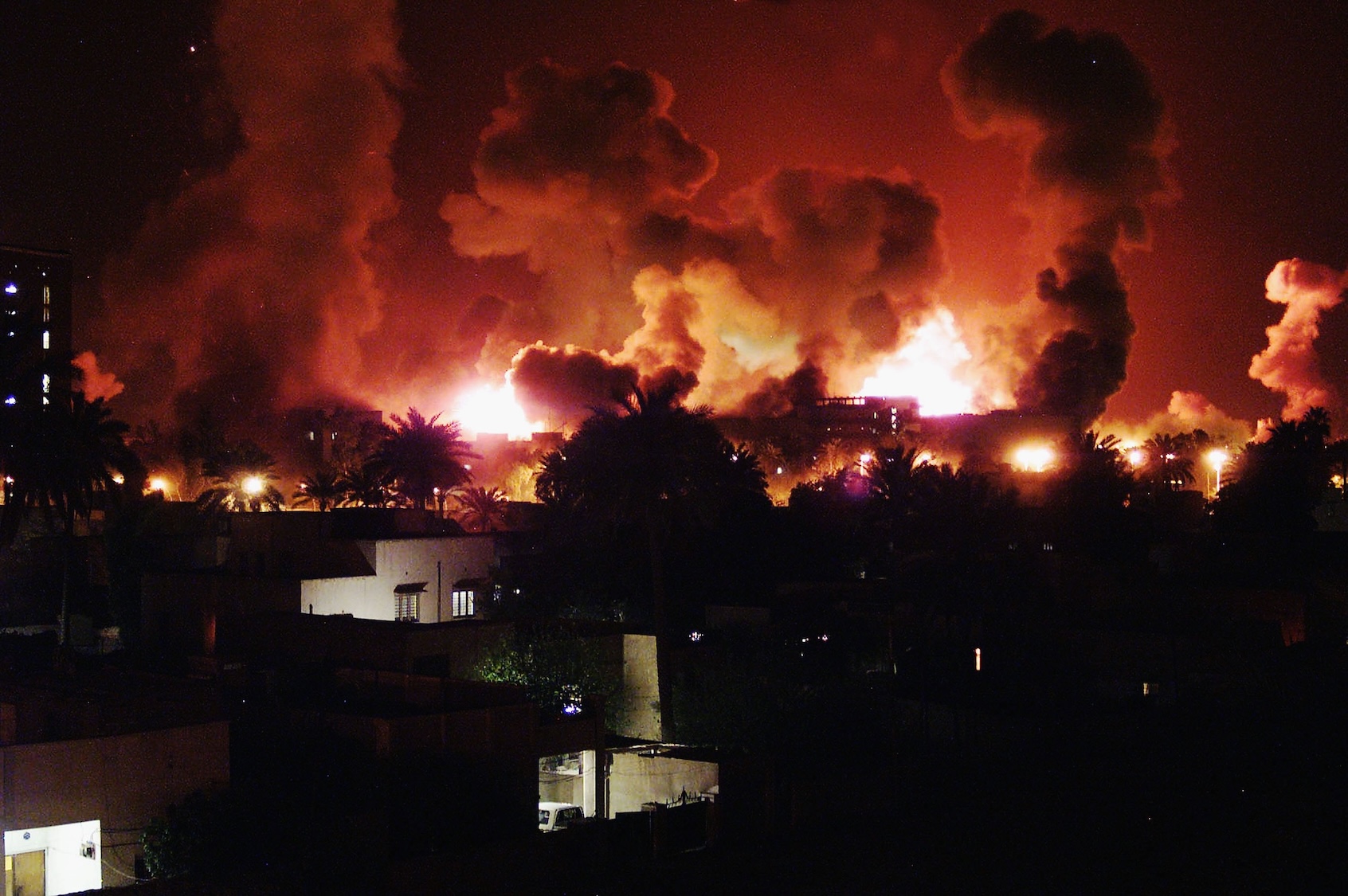
About an hour later, the first strikes illuminated the night sky, and Brown described the surreal split-screen reality: 'It is hard to imagine what it would be like to live in this city at a time like this, to know what had happened and what is likely to happen.' President George W. Bush then addressed the nation in a live broadcast, appearing in a picture-in-picture format alongside footage of the bombardment. His 48-hour ultimatum for Saddam Hussein to leave Iraq had expired moments earlier.
'At this hour, American and coalition forces are in the early stages of military operations to disarm Iraq, to free its people and to defend the world from grave danger,' Bush declared. Salih stayed up all night watching the events unfold, forgoing dinner with his wife and young children, who were eventually put to bed. The next morning, he viewed portions of Saddam Hussein's defiant speech, in which the Iraqi leader stated, 'The criminal, reckless little Bush and his aides committed this crime that he was threatening to commit against Iraq and humanity.'
Unable to file a report for Asharq Al-Awsat's next edition due to communication limitations at the time — the paper lacked an online presence and relied on telephone contact — Salih headed to his Washington office early. During a call with his editor in London following the daily reporters' meeting, Salih broke down in tears, exclaiming in Arabic, 'Al-Tatar dakhalo Baghdad,' or 'The Tatars have entered Baghdad.' He explained this phrase references the traumatic 13th-century Mongol sack of Baghdad, a defining defeat in Arab and Muslim historical memory.
In the days that followed, Salih covered White House and State Department press conferences, including tense personal encounters with key Bush administration figures. As one of five Arab correspondents invited to meet Secretary of State Colin Powell, Salih sat to Powell's immediate left during a conference. He posed a question that visibly irritated the secretary, who responded directly, 'Your questions seem to be more about Islam; this has nothing to do with religion.' Powell's tone remained diplomatic, but the friction was evident.
This interaction came shortly after Powell's February 5, 2003, presentation to the United Nations Security Council, where he displayed a vial of white powder to underscore claims of Iraq's biological weapons program. 'My colleagues, every statement I make today is backed up by sources, solid sources. These are not assertions. What we’re giving you are facts and conclusions based on solid intelligence,' Powell insisted at the time. Subsequent investigations revealed much of the intelligence was flawed or fabricated, contributing to lasting controversy over the justification for the war.
Salih also interviewed National Security Adviser Condoleezza Rice at the White House the following week, alongside another Arab journalist. Rice, a key architect of the Iraq policy, had previously warned of the risks of inaction, stating, 'We don’t want the smoking gun to be a mushroom cloud.' During the interview, Salih challenged her on racial dynamics, implying that as a Black woman, she was an unlikely figure to advocate for invading a Third World nation, and noting that Black American soldiers would likely bear significant casualties. Rice, according to Salih, appeared irritated by the line of questioning.
By that point, Salih had concluded that the Bush administration's 'War on Terror' often functioned as a broader campaign against Muslim populations. He now sees similar patterns in the current conflict with Iran under President Donald Trump, whom he accuses of continuing the 'war on terror' playbook on 'dubious or threadbare evidence.' The U.S.-Israeli campaign, Salih argues, risks repeating the uncertainties that followed Saddam's fall, including prolonged instability and sectarian violence that plagued Iraq for years.
Historical context underscores the parallels Salih draws. The Iraq invasion, launched on claims of weapons of mass destruction and ties to terrorism, led to the deaths of hundreds of thousands, the rise of ISIS, and a power vacuum exploited by Iran — now itself a target. In Tehran, recent strikes have reportedly caused civilian casualties, with the alleged missile hit on a girls' school drawing international condemnation from human rights groups, though U.S. officials have not confirmed the details.
Broader implications loom large as the world watches the escalation. Analysts note that Iran's retaliatory capabilities, including proxy militias across the region, could widen the conflict, potentially involving allies like Russia and China. Salih's piece warns of a 'tragic cycle of history' repeating, where 'America has eliminated Ayatollah Ali Khamenei just as it eliminated Saddam Hussein two decades ago, but just as much uncertainty hovers over what lies ahead.'
For those who lived through the Iraq war, the prospect of a similar fate for Tehran evokes deep anxiety. Salih, reflecting on his emotional response to Baghdad's fall, described it as 'the return of a recurring but never-banished nightmare about one civilization attacking another, driven by blind hatred.' As diplomatic efforts stall and military operations intensify, the international community remains on edge, awaiting clarity on the path forward in this volatile chapter of U.S. foreign policy.