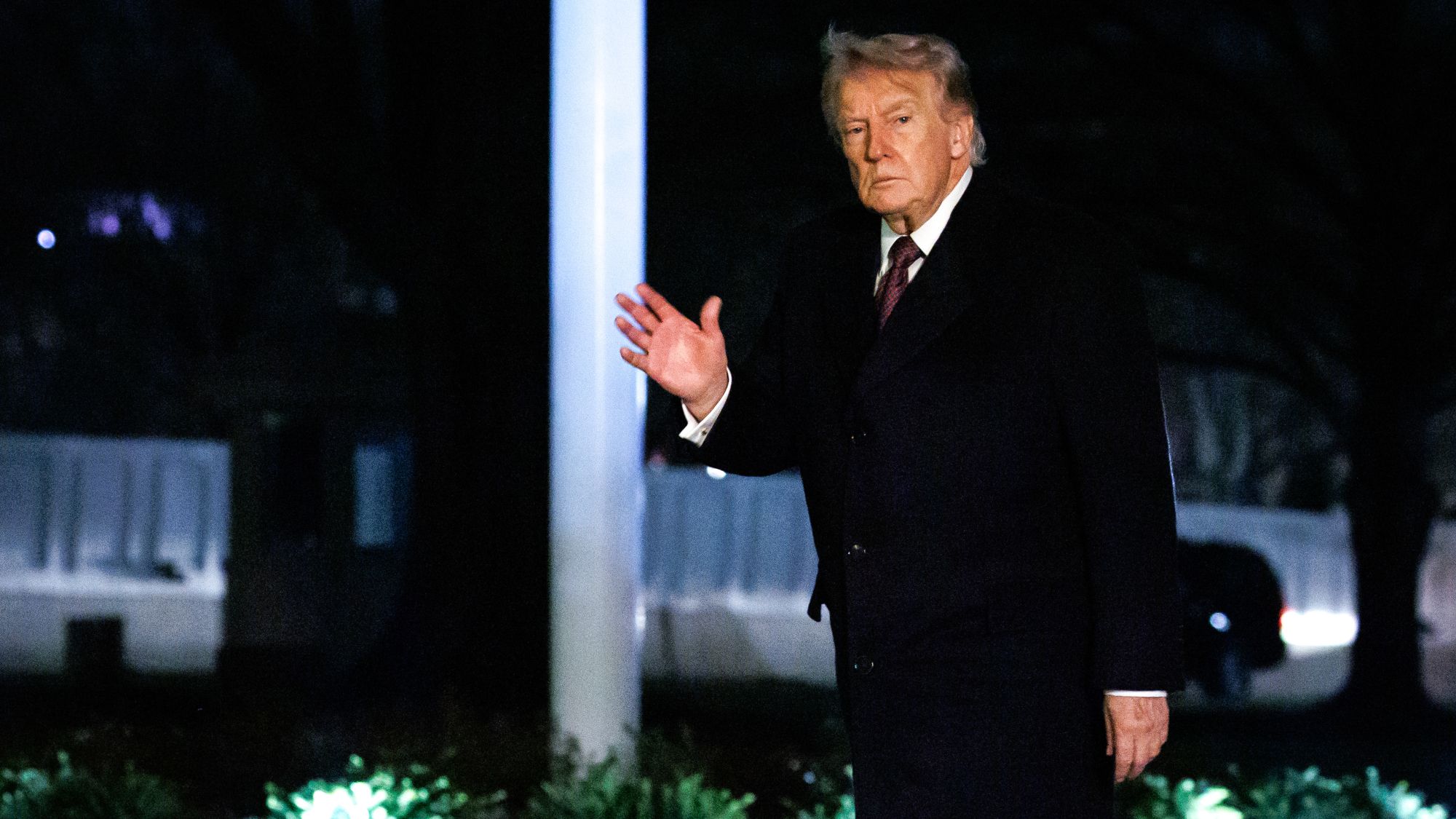
WASHINGTON — President Donald Trump on Sunday demanded that about seven countries reliant on Middle Eastern oil join a U.S.-led effort to force Iran to reopen the Strait of Hormuz, a vital waterway that Iran has effectively shut down, driving up global oil and gas prices.
Speaking to reporters aboard Air Force One following a weekend of golf and fundraising in Florida, Trump did not name the specific countries he was addressing. However, in a social media post on Saturday, he indicated that "many" nations "will be sending War Ships" to assist the United States in "keep[ing] the Strait open and safe." He expressed hope that the list would include China, France, Japan, South Korea, and Britain.
The Strait of Hormuz, a narrow passage at the mouth of the Persian Gulf, handles roughly 20 percent of the world's oil supply. Iran's actions, which began amid escalating tensions with the U.S., have halted commercial traffic through the strait for several days, according to maritime tracking data reported by multiple outlets. This disruption has sent oil prices surging by more than 10 percent in the past week, exacerbating concerns over inflation and energy costs for consumers worldwide.
Trump's remarks represent a notable shift in his approach to the ongoing conflict with Iran, which intensified last month when U.S. forces launched airstrikes on Iranian nuclear facilities following what the administration described as provocative attacks on American assets. According to The Wall Street Journal, Trump and his top aides spent the weekend framing the operation as a "resounding military success" while urging other countries to join a multinational escort coalition for the strait, potentially to be unveiled as soon as this week.
"Whether we get support or not," Trump said on Air Force One, "we will remember." In an interview with the Financial Times, he added a warning for NATO allies: "If there’s no response or if it’s a negative response, I think it will be very bad for the future of NATO." This call for international backup is significant, as The New York Times noted, because it marks the first time Trump has appeared eager to build a broad coalition to counter Iran—though many of the allies he is now approaching were not consulted prior to the U.S. decision to escalate militarily.
The president's frustration with the war's domestic reception was evident in his comments. The Associated Press reported that Trump has "grown more agitated with news coverage and has failed to find a way to explain why he started the war — or how he will end it — that resonates" with an American public increasingly anxious about rising military casualties and gasoline prices, which have climbed above $4 per gallon in many states.
On Saturday, Trump told NBC News that "Iran wants to make a deal," but he dismissed negotiations for now, stating, "I don’t want to make it because the terms aren’t good enough yet." From Tehran's perspective, the tone is defiant. Iran's Foreign Minister Abbas Araghchi told CBS News that "Iran never asked for a ceasefire, and we have never asked even for negotiation." He emphasized, "We are ready to defend ourselves as long as it takes."
U.S. allies have responded to Trump's overtures with measured caution. European leaders, in particular, have expressed interest in stabilizing the region but stopped short of committing naval resources. EU foreign policy chief Kaja Kallas said Monday morning that "it is in the European Union’s interest to keep the Strait of Hormuz open." She added, "We have been in touch with the U.S. colleagues," but clarified that the matter "is out of NATO’s area of action."
China, a major oil importer from the Middle East, appears even less inclined to participate. According to The New York Times, Beijing has "little incentive" to send warships, as Iran has reportedly been allowing Chinese-flagged vessels to pass through the strait unimpeded. This selective enforcement underscores the complexities of assembling a coalition, with some nations weighing economic ties to Iran against broader security concerns.
The backdrop to these diplomatic maneuvers is a conflict that has roots in decades of U.S.-Iran animosity, but recent events have accelerated dramatically. In early June, Iranian-backed militias were accused of launching drone strikes on U.S. bases in Iraq, prompting retaliatory actions. By mid-July, the U.S. had conducted what it called precision strikes on Iranian targets, leading to the current naval standoff in the Gulf. Casualty figures remain disputed: The Pentagon reports 12 American service members killed in related incidents, while Iranian state media claims over 200 of its forces lost.
Oil market analysts, speaking to Reuters on Sunday, warned that prolonged closure of the strait could push Brent crude prices toward $100 per barrel, potentially triggering a global recession. "The economic ripple effects are already being felt," said energy expert Dr. Elena Vasquez of the Brookings Institution. "Countries like Japan and South Korea, which import nearly all their oil through Hormuz, stand to lose the most if this drags on."
Trump's strategy also carries risks for alliances strained by his "America First" policies. During his Florida trip, which included stops at Mar-a-Lago for fundraisers raising over $5 million for Republican candidates, the president met with national security advisors to refine the coalition pitch. Sources close to the White House, speaking anonymously to Politico, described internal debates over whether to impose secondary sanctions on non-participating allies to compel involvement.
Critics in Congress have voiced skepticism. Senate Minority Leader Chuck Schumer, D-N.Y., called Trump's demands "an afterthought diplomacy that endangers our partnerships." On the Republican side, Sen. Lindsey Graham, R-S.C., praised the initiative as "necessary leadership," urging swift action to deter further Iranian aggression.
As the U.S. prepares to formalize its escort plans, the international community watches closely. The United Nations Security Council is scheduled to convene an emergency session on Wednesday in New York to discuss the strait crisis, where envoys from the targeted countries may signal their positions. For now, Trump's blunt appeals highlight the high stakes: securing the waterway could stabilize energy markets, but failure might fracture alliances and prolong a war with no clear end in sight.
The implications extend beyond the Gulf. With gas prices biting into household budgets and stock markets volatile, public opinion polls from Gallup show Trump's approval rating on foreign policy dipping to 38 percent, the lowest since the conflict began. Whether his gamble on coalition-building pays off remains to be seen, but the pressure is mounting on all sides.