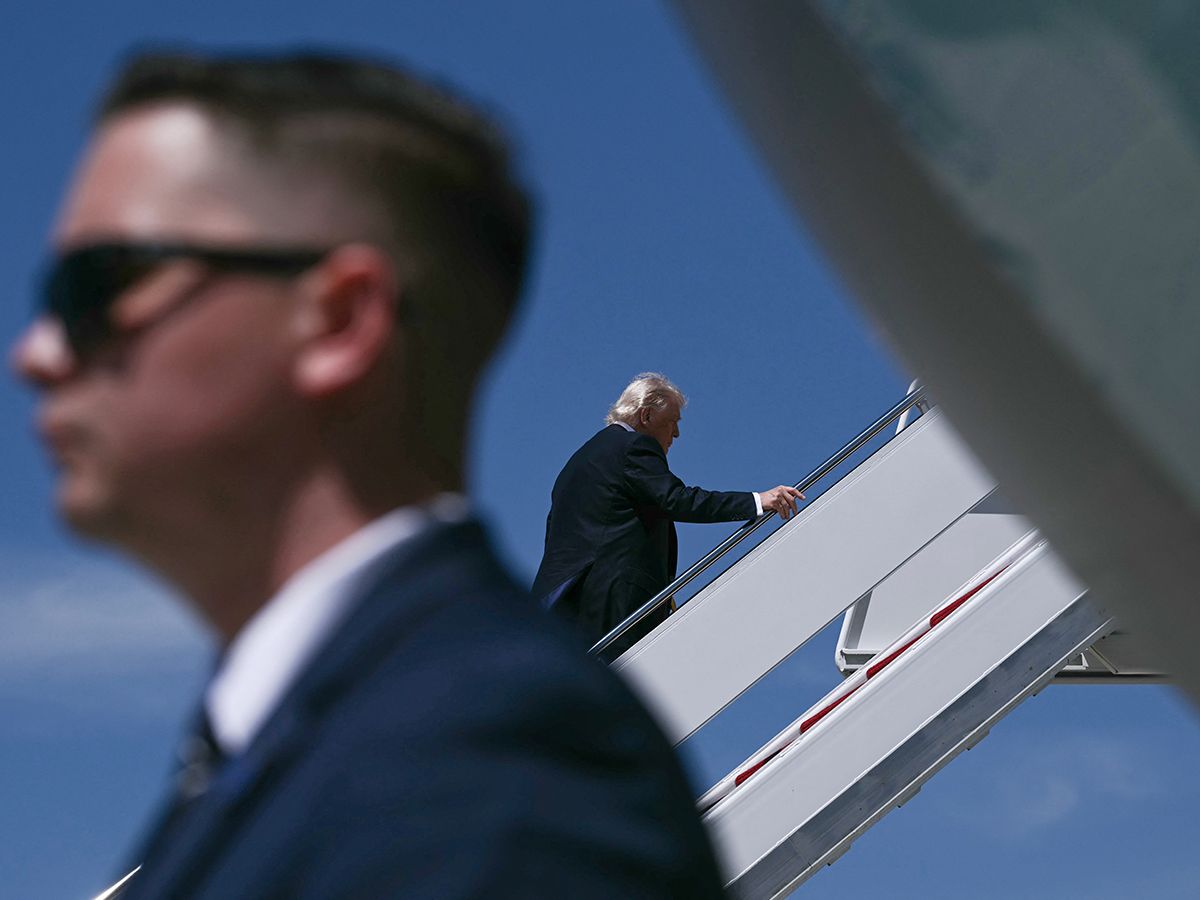
BEIJING — President Donald Trump is set to arrive in Beijing on Wednesday evening for a 36-hour summit with Chinese President Xi Jinping, marking his first overseas trip since launching military operations in Iran three months ago. The visit comes at a time when the ongoing conflict in the Middle East has constrained U.S. leverage in negotiations, emboldening Xi as the two leaders discuss trade, tariffs, Taiwan, and the war in Iran. Trump has expressed optimism about the trip, touting potential economic deals and a warm welcome during a White House departure statement on Tuesday, where he described his relationship with Xi as a “fantastic one.”
The summit, hosted at the Great Hall of the People with a state dinner and morning tea on the agenda, underscores the delicate balance in U.S.-China relations amid global tensions. According to U.S. officials, the leaders will review proposals for a board of trade to govern commerce in non-sensitive products and a board of investment. Trump is traveling with a high-profile entourage of executives from major financial, technology, aerospace, and agricultural firms, including Tesla Inc.’s Elon Musk and Nvidia Corp. CEO Jensen Huang, who was added to the delegation at the last minute. Also joining is Sanjay Mehrotra, CEO of Micron Technology Inc., whose company faced Chinese sanctions in 2023, and Meta Platforms Inc. executive Dina Powell McCormick.
The war in Iran looms large over the discussions, with China positioned as a key player due to its role as the largest buyer of Iranian oil and a strategic partner of Tehran. The closure of the Strait of Hormuz has triggered the biggest oil supply shock in modern history, driving up global fuel prices and complicating Trump's domestic political landscape ahead of November midterm elections. U.S. Treasury Secretary Scott Bessent last week urged Beijing to help reopen the strait, acknowledging China's influence. As the conflict stretches into its third month, analysts suggest it could overshadow the economic talks. “Iran could overshadow the gathering,” said Craig Singleton, a former U.S. diplomat and senior fellow at the Foundation for Defense of Democracies. “It complicates the optics, it raises the stakes.”
“Xi is coming into the summit feeling confident he has solved Trump,” said Jeremy Chan, a senior analyst at Eurasia Group and a former U.S. diplomat, citing China’s critical minerals advantage.
China's control over rare earths — essential elements dubbed the “golden screws” of global manufacturing — gives Beijing significant leverage, especially after using them last year to counter U.S. tariffs. The U.S. has ramped up pressure on Tehran by targeting Chinese oil refiners and firms providing satellite imagery to Iran, but such actions risk provoking retaliation from China. Beijing recently dusted off dormant trade tools, including canceling Meta’s $2 billion acquisition of AI startup Manus in an unprecedented regulatory move and ordering its firms to defy U.S. sanctions on companies dealing with Iranian oil. “The belated order to unwind Meta’s acquisition of Manus shows the degree to which Beijing is feeling like the ball is in its court,” said Dexter Roberts, a nonresident senior fellow at the Atlantic Council’s Global China Hub.
Roberts anticipates China will more explicitly link access to U.S. chips — vital for its AI ambitions — with rare earth exports, which hold an economic value of $1.2 trillion according to Bloomberg Economics. Trump’s team, however, insists the president enters the talks from a position of strength. Secretary of State Marco Rubio, who has been sanctioned by China twice, reaffirmed that U.S. policy on Taiwan remains unchanged, even as Trump has indicated he will discuss arms sales to the island with Xi. Earlier this year, after the U.S. announced a record $11 billion weapons package for Taiwan, Xi warned Trump to proceed with care.
Taiwan represents a core interest for Beijing, which views the self-ruled democratic island as its territory despite never having governed it. Chinese officials have recently employed unorthodox methods to isolate Taiwan’s leader, and analysts expect Xi to press for shifts in U.S. policy, including curbing arms sales. “China will push for Trump to shift policy on Taiwan, including but not just the arms sale,” said Zhu Feng, executive dean of Nanjing University’s School of International Studies, adding that the issue is “the most sensitive and core of China’s interests.” Zhou Bo, a retired senior colonel in the People’s Liberation Army, noted that Beijing has tools like advanced military maneuvers and sanctions to retaliate if the U.S. advances on Taiwan.
Some former U.S. officials worry Trump might soften Washington’s stance during the summit, given the broader pressures. The unresolved Middle East conflict adds another layer, testing China’s willingness to mediate. As the world’s largest oil importer, China faces its own economic risks from a prolonged strait closure, which could dampen global demand for its exports. Beijing has signaled goodwill through actions like dismantling a cross-border drug trafficking network with the U.S. cooperation — a key issue behind last year’s tariffs — and the Chinese yuan’s longest winning streak in nearly 11 weeks on Tuesday, which U.S. observers could interpret as an olive branch.
Ahead of the summit, Bessent is visiting Japan and South Korea to emphasize U.S. alliances in the region and meeting with Chinese counterpart He Lifeng. China, meanwhile, plans to host Russian President Vladimir Putin later this month, illustrating Xi’s balancing act in global diplomacy. The talks are likely to address extending the one-year trade truce struck six months ago during Trump and Xi’s meeting in South Korea, where tariffs were a central concern. Since then, a U.S. Supreme Court ruling has limited Trump’s ability to wield tariffs as leverage, while higher fuel prices from the Iran war have undercut his economic messaging.
Expectations for breakthroughs remain low, with U.S. officials telling reporters on Sunday that the focus will be on Chinese purchases of U.S. agricultural products, planes, and follow-ups on fentanyl shipments. “Trump needs more from this summit than Xi does,” Chan added. “And Xi knows it.” The midterms, where elevated fuel costs threaten Republican control of Congress, heighten Trump’s need for voter-friendly wins like increased agricultural exports. For Xi, the visit lays groundwork for his potential trip to the U.S. later this year. “Trump coming is in itself a success and will lay a foundation for Xi’s visit to the U.S. later this year,” said Wang Yiwei, a former Chinese diplomat and director of Renmin University’s Institute of International Affairs.
Both nations seek stability despite their differences, with head-of-state diplomacy hailed by Beijing as the anchor of bilateral ties. China grapples with economic challenges and U.S. restrictions on advanced chips, limiting its AI competitiveness, while its leverage over Iran to end the war remains uncertain. Trump, who has spent the past decade accusing China of exploiting the U.S. and promising to correct the imbalance, now faces a more assertive Beijing willing to push back.
“We are getting a new normal,” said Henry Wang Huiyao, founder of the Center for China and Globalization research group in Beijing. “That means both the U.S. and China recognize China is different than some 10 years ago during Trump’s first visit.”
As Trump and Xi shake hands in Beijing, the shifting balance of power between the superpowers will be on full display. The summit could redefine their rivalry, with Iran’s shadow and Taiwan’s tensions testing the limits of compromise. Observers will watch closely for any progress on trade or the war, outcomes that could ripple through global markets and geopolitics in the months ahead.