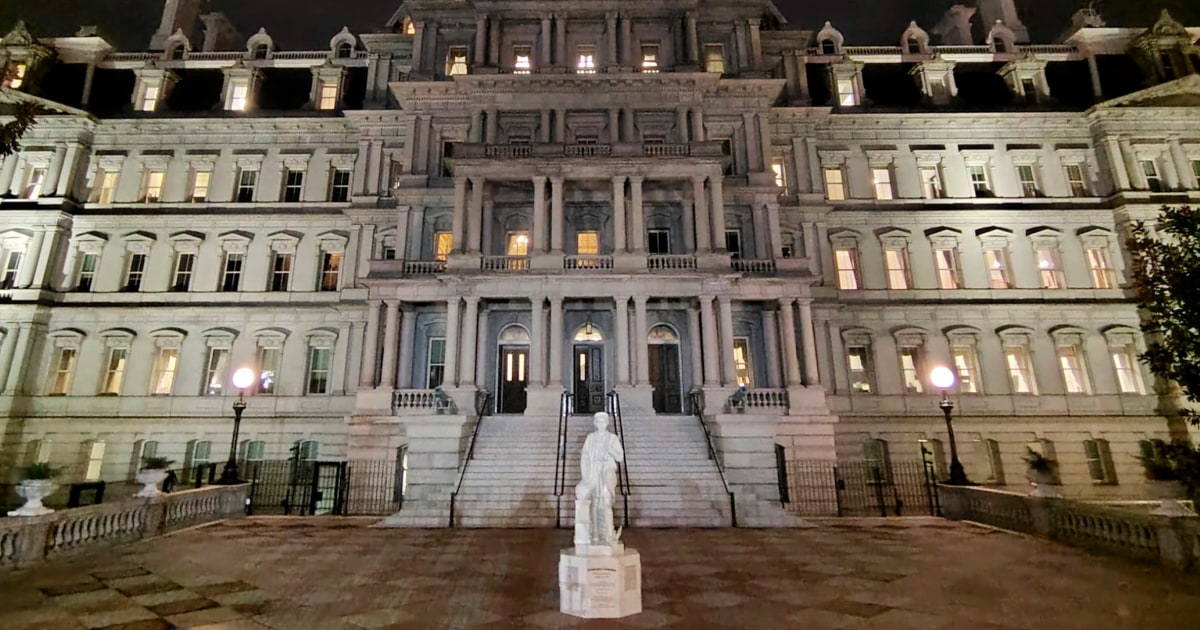
ANNAPOLIS, Md. — President Donald Trump has installed a statue of Christopher Columbus on the grounds of the Eisenhower Executive Office Building, just steps from the White House, in a move that underscores his administration's commitment to honoring the explorer amid ongoing debates over his historical legacy.
The statue, a marble replica of one that was toppled and discarded into Baltimore's Inner Harbor during protests in 2020, arrived at its new location this week. Officials with the White House confirmed the placement, describing it as part of broader efforts to celebrate figures central to American history as viewed through a traditional lens. The decision comes less than a year after Trump's inauguration for his second term, signaling a continuation of cultural priorities he championed during his first presidency.
According to a statement posted on X by the White House, “In this White House, Christopher Columbus is a hero, and President Trump will ensure he’s honored as such for generations to come.” The post highlighted the administration's rejection of what it calls attempts to rewrite history, positioning the statue as a symbol of resilience against cultural shifts.
The statue's journey to Washington began in tragedy for its supporters. On July 4, 2020, amid nationwide unrest following the death of George Floyd in Minneapolis, protesters in Baltimore targeted the original monument, pulling it down and throwing it into the city's Inner Harbor. That incident was part of a wave of vandalism against Columbus statues across the United States, with activists arguing that the explorer symbolized the genocide and exploitation of Indigenous peoples during European colonization of the Americas.
John Pica, a Maryland lobbyist and president of the Italian American Organizations United, which owns the statue, expressed relief at its new home. “We are delighted the statue has found a place where it can peacefully shine and be protected,” Pica said in a statement. His group agreed to loan the replica to the federal government for display at or near the White House, ensuring its preservation after years in storage.
The artwork itself was crafted by Will Hemsley, a sculptor based in Centreville on Maryland's Eastern Shore. Made primarily of marble, the statue depicts Columbus in a traditional pose, evoking the image of the Genoese explorer who led the 1492 voyage sponsored by Spain's Catholic monarchs. That expedition is widely credited with initiating sustained European contact with the Americas, paving the way for colonization, trade, and the eventual formation of modern nations in the Western Hemisphere.
Trump has long defended Columbus against what he describes as politically motivated attacks. In April of last year, during his campaign, he declared, “I’m bringing Columbus Day back from the ashes.” He accused Democrats of doing “everything possible to destroy Christopher Columbus, his reputation, and all of the Italians that love him so much,” framing the explorer's critics as “left-wing arsonists” who twist America's collective memory.
This installation revives a tradition that has faced increasing scrutiny. For decades, the second Monday in October has been observed as Columbus Day in the United States, a federal holiday established in 1937 to honor Italian heritage and the explorer's role in history. However, in recent years, numerous cities, states, and institutions have replaced it with Indigenous Peoples' Day, recognizing the resilience and contributions of Native American communities while acknowledging the devastating impacts of colonization.
President Joe Biden marked a milestone in 2021 by issuing the first presidential proclamation for Indigenous Peoples' Day, alongside Columbus Day. His administration emphasized reconciliation and education about the full scope of Columbus's voyages, which led to the deaths of millions of Indigenous people through violence, disease, and enslavement, according to historians.
Supporters of the statue, like Pica's organization, view it as a celebration of Italian-American pride and a counter to what they see as erasure of positive historical narratives. The Italian American Organizations United has advocated for Columbus's recognition, arguing that the explorer's achievements should not be overshadowed by later consequences of colonization. “This is about heritage and protection,” Pica added, noting the group's efforts to recover and restore the original after its 2020 defacement.
Critics, however, see the White House placement as a provocative step backward. Indigenous rights groups, though not directly quoted in immediate reactions to this event, have previously condemned similar honors for Columbus. In 2020, during the height of the protests, organizations like the National Congress of American Indians called for the removal of such monuments, stating they perpetuate a sanitized view of history that ignores the human cost to Native populations.
The Eisenhower Executive Office Building, where the statue now stands, serves as the hub for much of the White House staff and policy operations. Its proximity to the president's residence amplifies the symbolic weight of the installation. White House officials said the location was chosen for its visibility and security, ensuring the statue can be viewed by visitors and protected from potential vandalism.
Trump's action fits into a pattern of cultural interventions during his administrations. In his first term, he issued an executive order in 2020 to protect historical monuments amid the protests, threatening federal intervention against local removals. That order came after dozens of Confederate statues and other controversial figures were toppled or relocated nationwide. Now, with Columbus's statue in place, the administration appears poised to expand such recognitions.
Looking ahead, the placement could spark renewed debates over public monuments and holidays. With Indigenous Peoples' Day gaining traction—now officially recognized in more than a dozen states and the District of Columbia—the tension between traditional observances and modern reckonings persists. Trump's team has indicated plans to promote Columbus Day federally, potentially through proclamations or events at the White House.
As the statue settles into its new spot, it serves as a flashpoint in America's ongoing conversation about history. For some, it's a restoration of pride; for others, a reminder of unresolved injustices. In Annapolis, where the story first broke, local Italian-American leaders gathered briefly to celebrate, while activists vowed to continue pushing for a more inclusive narrative.
The broader implications extend to education and public memory. Schools across the country have revised curricula to include Indigenous perspectives on Columbus's arrival, with some states mandating teachings on the Doctrine of Discovery—a historical justification for colonization that has been repudiated by modern courts and scholars. Trump's endorsement of the statue suggests resistance to these changes, potentially influencing federal funding or guidelines for historical sites.
Ultimately, the statue's arrival near the White House reinforces the administration's vision of American exceptionalism rooted in exploration and discovery. Whether it endures as a lasting tribute or faces future challenges remains to be seen, but for now, it stands as a testament to the enduring divisions over how the nation remembers its past.