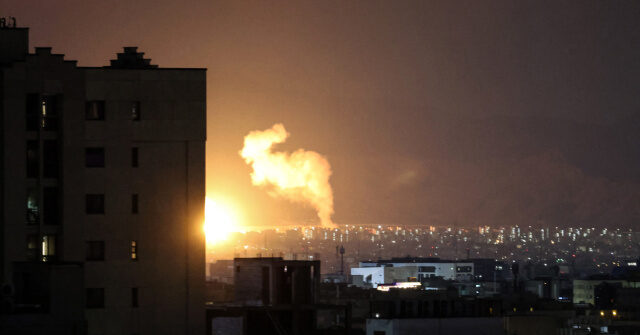
WASHINGTON — President Donald Trump announced on Saturday that a U.S. military strike in Tehran had resulted in the deaths of numerous Iranian military leaders, escalating tensions in an already volatile standoff over the Strait of Hormuz. In a post on Truth Social, Trump declared that these leaders, whom he accused of guiding Iran 'poorly and unwisely,' were 'terminated' in what he described as a 'massive strike.' The announcement came amid a tightening deadline for Iran to reopen the vital waterway, with Trump warning that just 48 hours remained before further severe consequences.
Trump's post included a video that appeared to depict the strike, showing explosions in the Iranian capital. 'Many of Iran’s Military Leaders, who have led them poorly and unwisely, are terminated, along with much else, with this massive strike in Tehran!' Trump wrote. The revelation marks a dramatic turn in the ongoing dispute, where Iran has been accused by the U.S. of blocking access to the Strait of Hormuz, a chokepoint for global oil shipments that carries about 20 percent of the world's crude.
Earlier in the day, Trump had issued a stern ultimatum, referencing a prior 10-day grace period he had extended to Tehran. 'Remember when I gave Iran ten days to MAKE A DEAL or OPEN UP THE HORMUZ STRAIT,' he posted. 'Time is running out – 48 hours before all Hell will reign down on them.' This renewed warning underscores the administration's growing impatience with indirect diplomatic efforts, which sources close to the White House described as increasingly unlikely to yield results before Monday's deadline.
The Strait of Hormuz, located between Iran and Oman, has been a flashpoint in U.S.-Iran relations for decades. Controlling access to the Persian Gulf, it is essential for energy exports from major producers like Saudi Arabia and the United Arab Emirates. According to U.S. officials, Iran's actions in recent weeks — including reported mine-laying and naval patrols — have effectively choked off the route, driving up global oil prices by nearly 15 percent since the restrictions began last month.
Trump's administration had previously outlined potential targets for retaliation if Iran failed to comply, including major regime infrastructure. Breitbart News reported that these could encompass electric generating plants, oil wells, and Kharg Island, Iran's primary oil export terminal located in the Persian Gulf. 'The post amounted to a renewed warning that Trump is prepared to follow through if Iran continues choking off the vital waterway while dragging its feet on a diplomatic resolution,' Joshua Klein, a Breitbart correspondent, wrote in his analysis.
Iranian officials pushed back against the U.S. narrative, with Foreign Minister Abbas Araghchi accusing American media of misrepresenting Tehran's stance. In a statement on Saturday, Araghchi said, 'Tehran’s position was being “misrepresented by U.S. media” and insisted the regime had “never refused to go to Islamabad,”' referring to potential talks in Pakistan's capital. He emphasized that Iran's priority was securing a 'conclusive and lasting END to the illegal war that is imposed on us.'
The diplomatic overtures have centered on indirect negotiations, with envoys from both sides communicating through intermediaries in Oman and Pakistan. However, U.S. skepticism has mounted, with administration officials privately expressing doubts about a breakthrough. One senior State Department source, speaking on condition of anonymity, told reporters that Iran's demands for an immediate end to sanctions and recognition of its regional influence were non-starters in the talks.
The strike in Tehran, if confirmed, would represent the most direct U.S. military action against Iran since the 2020 drone strike that killed General Qassem Soleimani. Details about the operation remain sparse, but Trump's post suggests it targeted high-level command structures in the Iranian Revolutionary Guard Corps, which oversees much of Tehran's military and proxy operations across the Middle East. Independent verification of the casualties has been difficult, as Iranian state media has not yet commented on the incident.
In response to the escalating rhetoric, Iranian officials issued a dire warning to the United States and its ally Israel. According to a CNN report, Tehran stated that both nations would 'face the punishment of ‘hell’ if the conflict expands.' This echoes previous threats from Iranian leaders, who have vowed asymmetric retaliation, potentially involving missile strikes on U.S. bases in the region or disruptions to shipping lanes beyond the Strait.
The broader context of the crisis traces back to heightened U.S.-Iran frictions following Trump's return to the White House in January 2025. His administration quickly reimposed 'maximum pressure' sanctions, aiming to curb Iran's nuclear program and support for militias in Yemen, Iraq, and Syria. Iran, in turn, has accelerated uranium enrichment and conducted military drills near the Strait, prompting international concern from bodies like the International Atomic Energy Agency.
Global markets reacted swiftly to Trump's announcement, with Brent crude futures surging over 5 percent in after-hours trading to above $90 per barrel. Analysts at Goldman Sachs noted that prolonged closure of the Strait could push prices toward $120, risking a global recession. European leaders, including German Chancellor Olaf Scholz, called for de-escalation, with Scholz stating in Berlin that 'dialogue remains the only path to stability in the Gulf.'
Military experts offered varied assessments of the strike's implications. Retired U.S. General Mark Milley, speaking to Fox News, described it as a 'precise and necessary response' to Iran's provocations, arguing that targeting leadership could disrupt command and control without broader invasion. Conversely, a spokesperson for the Council on Foreign Relations, Vali Nasr, cautioned that such actions might unify Iran's fractured leadership and provoke hardliners to accelerate nuclear weapon development.
As the 48-hour clock ticks down, the White House has scheduled a national security briefing for Sunday morning. Press Secretary Karine Jean-Pierre indicated that President Trump would address the nation if needed, but declined to elaborate on further military options. Meanwhile, in Tehran, protests erupted outside the U.S. embassy ruins — a site of the 1979 hostage crisis — with demonstrators chanting against American aggression.
The international community watches closely, with the United Nations Security Council set to convene an emergency session on Monday at the request of Russia and China, Iran's key allies. Russian Foreign Minister Sergey Lavrov condemned the strike as 'unprovoked aggression,' while Chinese state media urged all parties to exercise restraint to protect global energy security.
Looking ahead, the fate of the Strait of Hormuz hangs in the balance, with potential ripple effects for economies worldwide. If Iran refuses to yield, experts warn of a wider conflict that could draw in regional powers like Saudi Arabia and involve cyber and proxy warfare. For now, Trump's bold declaration has thrust the crisis into sharper focus, leaving diplomats racing against time to avert what he called 'all Hell.'