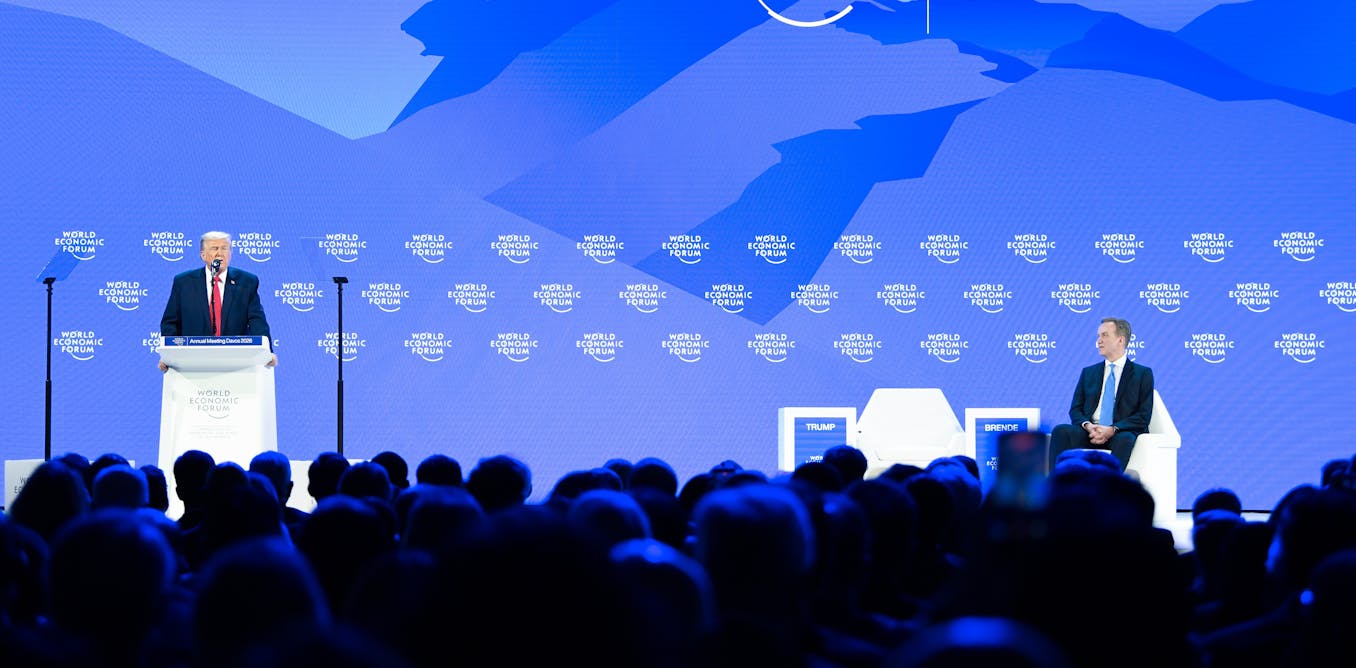
In the wake of a tense World Economic Forum in Davos, Switzerland, that concluded earlier this week, European leaders are grappling with the fallout from U.S. President Donald Trump's renewed threats to acquire Greenland, a semi-autonomous territory of Denmark. During his speech on January 21, 2026, Trump reiterated his long-standing interest in the Arctic island, stating it would 'eventually join the U.S.,' though he explicitly ruled out military action this time. The remarks, delivered amid broader criticisms of NATO allies, initially sparked fears of a transatlantic rift, but Trump later softened his stance, announcing a framework for an Arctic security deal negotiated with NATO Secretary General Mark Rutte and pledging to abandon new trade barriers against Europe.
The episode, which unfolded over just a few hours at the annual gathering in the Swiss Alps, highlighted the fragile state of U.S.-European relations under Trump's second term. Attendees described the atmosphere as charged, with Trump's opening address belittling allies on defense spending and trade imbalances before pivoting to the Greenland issue. 'Greenland is a strategic asset, and we're not going to let it slip away,' Trump said, according to transcripts from the event. Within hours, however, he backed away from proposed tariffs on European goods, citing a desire for 'fair deals' and revealing the outlines of the security pact aimed at countering Russian influence in the Arctic.
European responses were swift and unified in public, with leaders from across the continent defending Denmark's sovereignty. German soccer star Leon Goretzka, speaking in Davos, captured a sentiment of continental solidarity, saying, 'Trump makes us feel not only German, but also European.' Political figures echoed this, with French President Emmanuel Macron warning of 'unacceptable coercion' and threatening economic retaliation, including suspension of a pending U.S.-EU trade deal. The European Union, in a joint statement, promised counter-tariffs if the threats escalated, drawing on lessons from the contentious summer 2025 negotiations that yielded a trade agreement critics called unfavorable to Europe.
Despite the apparent de-escalation, experts in transatlantic relations caution that the Greenland spat exposes deeper vulnerabilities in Europe's security strategy. John Smith, a scholar of U.S.-European ties at a European think tank, noted in an analysis published by The Conversation that Trump's unpredictability poses a persistent challenge. 'Navigating foreign relations with the U.S. will remain challenging because of Trump’s unpredictability and apparent ambivalence about maintaining decades of transatlantic security cooperation,' Smith wrote. He pointed out that while Europe maintained a united front this time—unlike the public bickering during 2025 trade talks—the reasons for Trump's retreat remain opaque, possibly influenced more by domestic factors like sliding U.S. bond markets than by European resolve.
The Arctic security framework, hammered out between Trump and Rutte, lacks detailed specifics, leaving room for future tensions. Rutte, the former Dutch prime minister who assumed the NATO role in 2024, described the deal as a 'step forward' in joint patrols and intelligence sharing around Greenland's vast resources, including rare earth minerals vital for green energy transitions. Yet, sources close to the negotiations told reporters in Davos that the agreement is more a memorandum of understanding than a binding treaty, with implementation hinging on congressional approval in Washington.
Europe's internal divisions, however, complicate any sense of victory. Leaders like Macron advocate confrontation, viewing Trump's actions as justification for greater European autonomy in defense. 'We must prepare for the worst,' Macron said in a post-Davos interview, emphasizing France's push for a stronger EU military capability. In contrast, Czech Prime Minister Andrej Babiš expressed sympathy for Trump's grievances over NATO burden-sharing, arguing that Europe benefits from U.S. protection. Countries like Germany and Italy occupy a middle ground, with German Chancellor Olaf Scholz calling for 'pragmatic dialogue' while quietly boosting defense budgets to 2% of GDP as pledged in 2024.
Historical ties play a role in these fissures. Nations with deeper post-World War II dependencies on U.S. security, such as those in Eastern Europe, are more reluctant to confront Washington. Poland's foreign minister, for instance, reiterated support for the alliance despite the Greenland drama, citing ongoing U.S. aid to Ukraine amid its conflict with Russia. Meanwhile, public opinion across Europe has soured on Trump, with polls showing only 16% viewing the U.S. as a reliable ally—a drop fueled by the Greenland threats. Even far-right populist parties, often aligned with Trump's MAGA movement, distanced themselves, with Italy's Matteo Salvini decrying the 'unnecessary provocation.'
The dispute also underscores Europe's economic dependencies on the U.S., which Trump has repeatedly weaponized. After the 2022 energy crisis triggered by Russia's invasion of Ukraine, the EU shifted heavily to American liquefied natural gas, now accounting for over 40% of imports. This vulnerability could become a leverage point, as could access to U.S. technology. A recent Wall Street Journal report warned of a 'nightmare scenario' where Washington restricts Europe's use of data centers or email software essential for businesses and governments.
Security guarantees remain a flashpoint. Trump has questioned U.S. commitments to NATO, including potential abandonment of Ukraine, where American aid totals $175 billion since 2022. Former Italian Prime Minister Mario Monti argued that such rhetoric erodes credibility. 'Why pay a price for a protection that may not even exist?' Monti asked in a recent op-ed. Similarly, former European Parliament member Sylvie Goulard urged diversification of alliances, pointing to growing ties with Indo-Pacific partners like Japan and Australia.
NATO's Rutte, however, remains optimistic about managing Trump. 'European defense without the U.S. is a dream,' he said during a Davos panel, advocating continued engagement. This view aligns with those who credit diplomatic backchannels for the quick resolution, though skeptics like Smith argue it validates confrontational tactics by showing leverage works. The Anti-Coercion Instrument, an EU tool adopted in 2023, looms as a potential countermeasure; it could bar U.S. firms, including Silicon Valley giants, from European markets, effectively targeting social media platforms or investment flows.
Broader context reveals this as part of a pattern. Trump's first term saw similar threats, including 2019 suggestions of buying Greenland that Denmark rebuffed. The current administration has escalated Arctic focus amid climate change opening new shipping routes and resource access. Russia’s militarization of the region, with bases on the Kola Peninsula, adds urgency, as does China's investments in Greenland mining.
As Europe reflects on Davos—likened by some to a 'game of two halves' or a '1-1 draw' in soccer terms—the path forward is uncertain. Unity held this time, but without a consistent strategy, analysts warn of rematches. European publics and leaders increasingly question the alliance's value, yet alternatives remain elusive amid dependencies on U.S. military, energy, and tech. With Trump's next move potentially just a social media post away, Brussels is already convening emergency talks to refine its approach.
In Appleton, Wisconsin, local observers with ties to international affairs echo the caution. 'This isn't just about Greenland; it's about trust in global partnerships,' said retired diplomat Elena Rodriguez, who follows NATO developments. As the transatlantic bond strains, the world watches whether Europe can forge a more cohesive response or if Trump's brinkmanship will force painful choices in security and trade.