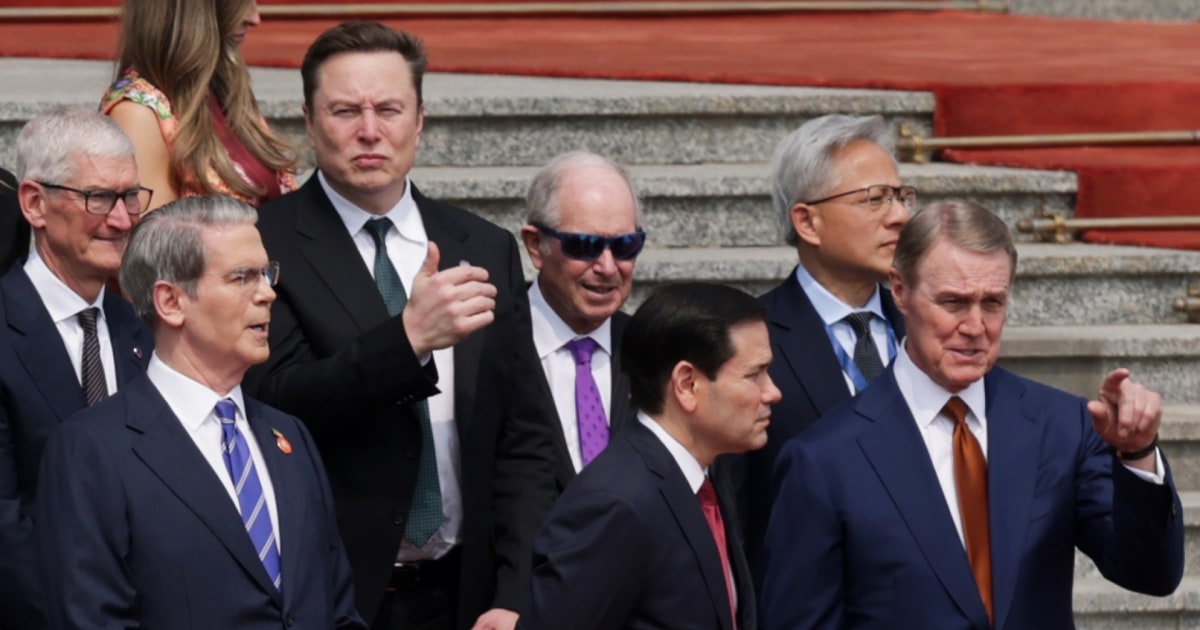
BEIJING — President Donald Trump arrived at the Beijing summit on Thursday, flanked by a high-profile delegation of American corporate leaders, in what analysts are calling a strategic display of U.S. economic might amid ongoing trade negotiations with China. The gathering, which included top executives from some of the world's largest companies, underscored the deepening intertwining of diplomacy and business as the two superpowers edge toward a potential deal to ease escalating tariffs and supply chain disruptions.
Trump's invitation to these CEOs — a move described by NBC News correspondent Brian Cheung as 'posturing' from the U.S. side — brought together influential figures such as Elon Musk of Tesla, Tim Cook of Apple, and Larry Fink of BlackRock. The summit, held at the Great Hall of the People, marks the latest chapter in the protracted U.S.-China trade talks that have dominated global headlines since Trump imposed tariffs on Chinese goods in 2018. According to White House officials, the presence of these business leaders signals America's commitment to fair trade practices while highlighting the stakes for U.S. companies operating in China.
The event unfolded against a backdrop of heightened tensions. Just weeks earlier, on October 15, the U.S. Trade Representative's office announced new tariffs on $200 billion worth of Chinese imports, prompting Beijing to retaliate with duties on American agricultural products. Economists estimate these measures have already cost U.S. consumers an additional $40 billion annually in higher prices. Trump's decision to include CEOs in the delegation appears aimed at leveraging their insights and networks to push for concessions, such as reduced barriers for American tech firms in the Chinese market.
Elon Musk, whose Tesla has invested heavily in a Shanghai gigafactory, was among the first to arrive, touching down at Beijing Capital International Airport around 9 a.m. local time. Musk has publicly praised China's rapid infrastructure development, tweeting last month that 'China's speed of execution is unmatched.' During a brief press availability outside the summit venue, Musk told reporters, 'This is about building bridges, not walls — electric ones, hopefully.' His comments reflect Tesla's reliance on Chinese manufacturing, where the company produced over 500,000 vehicles last year alone.
Tim Cook, Apple's CEO, followed shortly after, arriving via a chartered flight from San Francisco. Apple, which assembles the majority of its iPhones in Chinese factories, has been vocal about the need for stable trade relations. In a statement released by the company ahead of the summit, Cook said, 'Global supply chains are the backbone of innovation, and resolving these trade issues will benefit consumers everywhere.' According to sources familiar with the discussions, Cook is expected to advocate for exemptions on tariffs affecting electronics components, a sector hit hard by the ongoing dispute.
Larry Fink, the head of BlackRock, the world's largest asset manager with over $6.5 trillion in assets under management, rounded out the notable attendees. Fink's presence highlights the financial sector's interest in China's burgeoning markets. BlackRock has been in talks to launch mutual funds in mainland China, a move that could open doors for U.S. investors. In an interview with Bloomberg earlier this week, Fink noted, 'China's economy is integral to global stability; any deal here could unlock trillions in value.'
The Beijing summit itself is a two-day affair, running from November 8 to 9, organized under the auspices of the Asia-Pacific Economic Cooperation forum but with a heavy focus on bilateral U.S.-China relations. Trump met with Chinese President Xi Jinping for a working lunch at 12:30 p.m., where trade was the dominant topic. According to a readout from the U.S. delegation, the leaders discussed 'phase one' elements of a potential agreement, including intellectual property protections and agricultural purchases.
Critics, however, view the CEO entourage as more show than substance. Brian Cheung, reporting for NBC News, characterized the invitations as 'posturing' designed to project strength to both domestic audiences and Beijing. 'It's a clear message that the U.S. economy, powered by these titans of industry, won't back down,' Cheung said in his on-air analysis. Chinese state media, meanwhile, portrayed the visit as a sign of American dependence on Chinese markets, with Xinhua news agency stating that 'the U.S. seeks dialogue because it recognizes China's indispensable role.'
Background on the trade war provides crucial context for this high-stakes gathering. It began in earnest in March 2018 when Trump signed a memorandum citing unfair trade practices, leading to tariffs on steel and aluminum imports. By mid-2019, the duties had expanded to cover $360 billion in Chinese goods, affecting everything from soybeans to semiconductors. The World Trade Organization has ruled against several U.S. measures, but Trump has dismissed the body's authority, calling it 'obsolete.'
U.S. farmers have borne much of the brunt, with exports of soybeans to China dropping 75% in 2018. The Trump administration responded with $28 billion in aid to agricultural producers, but many in rural America, including in states like Iowa and Wisconsin, continue to feel the pinch. At the summit, agricultural trade was a key agenda item, with U.S. negotiators pushing for China to commit to purchasing $50 billion in American farm products annually.
From the Chinese perspective, the talks represent an opportunity to address grievances over technology transfers and market access. Beijing has accused U.S. firms of intellectual property theft — a charge Washington vehemently denies — and has imposed restrictions on companies like Qualcomm and Boeing. A senior Chinese trade official, speaking anonymously to Reuters, said, 'We welcome business leaders, but any deal must be balanced; China will not yield to pressure tactics.'
Multiple viewpoints emerged as the summit progressed. Supporters of Trump's approach, including Commerce Secretary Wilbur Ross, argued that the CEO presence amplifies America's negotiating leverage. 'These are the innovators driving our economy,' Ross said in a Fox News interview. 'Bringing them to the table shows China what they're up against.' Conversely, Democratic lawmakers like Senate Minority Leader Chuck Schumer criticized the event as 'glitzy theater' that distracts from deeper structural issues. 'Inviting billionaires won't fix the trade deficit overnight,' Schumer remarked during a Capitol Hill briefing.
The inclusion of tech giants like Tesla and Apple also raises questions about national security. Musk's close ties to China have drawn scrutiny from U.S. lawmakers concerned about data privacy and supply chain vulnerabilities. In a recent congressional hearing, Representative Mike Gallagher, R-Wis., warned that 'over-reliance on Chinese manufacturing could compromise American innovation.' Apple, too, faces pressure after moving some production to India and Vietnam to diversify away from China.
As the first day of talks wrapped up around 6 p.m., optimism was tempered by realism. No breakthroughs were announced, but sources close to the negotiations indicated progress on currency manipulation clauses. The U.S. Treasury Department has long accused China of undervaluing the yuan to boost exports, a claim Beijing rejects. Further discussions on day two are expected to delve into enforcement mechanisms for any agreement.
Looking ahead, the implications of a U.S.-China deal could ripple across global markets. A resolution might stabilize stock prices, which have fluctuated wildly amid trade uncertainty — the Dow Jones dropped 800 points in a single day last month on tariff escalation fears. For consumers, lower tariffs could mean cheaper electronics and apparel. Yet experts caution that a comprehensive pact remains elusive, with core issues like state subsidies for Chinese firms still unresolved.
In the broader context, this summit echoes historical U.S.-China engagements, such as Nixon's 1972 visit that opened diplomatic relations. But today's dynamics are shaped by economic rivalry rather than Cold War geopolitics. As Trump departed the venue for a state dinner, the message was clear: the path to a deal is fraught, but the presence of America's business elite signals a willingness to engage on equal footing.
Whether this 'posturing' translates into tangible progress will become apparent in the coming weeks. U.S. Trade Representative Robert Lighthizer is scheduled to brief Congress on November 15, providing the next window into the talks' outcomes. For now, the Beijing summit stands as a pivotal moment in the saga of U.S.-China relations, blending diplomacy, deal-making, and the raw power of global capitalism.