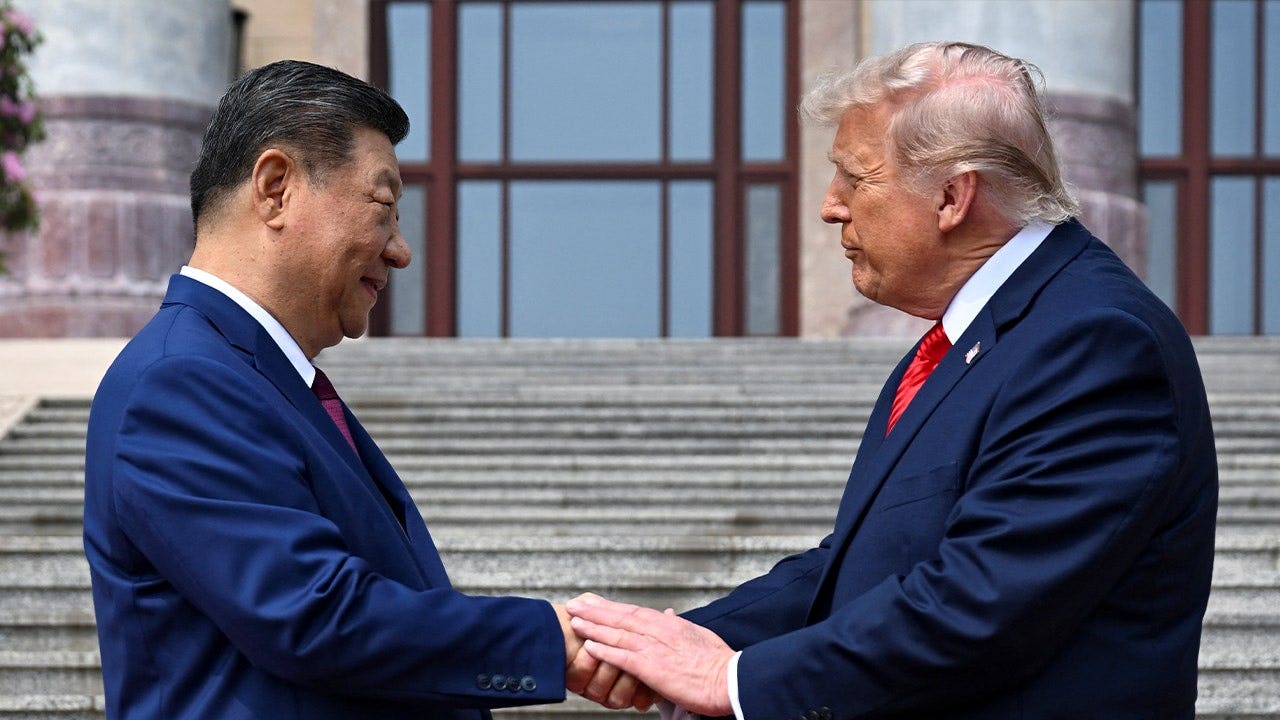
BEIJING — President Donald Trump struck an optimistic tone on Thursday as he began high-stakes talks with Chinese President Xi Jinping here, predicting a "fantastic future together" for the two nations amid ongoing economic and geopolitical tensions. The meeting, held at the Great Hall of the People, marked a pivotal moment in U.S.-China relations during Trump's second term, with discussions focusing on trade imbalances, the Iran conflict, the Taiwan situation, and the establishment of new bilateral boards for economic and artificial intelligence oversight. Trump, accompanied by a high-profile delegation of American business leaders, emphasized personal rapport and dealmaking as pathways to cooperation.
Trump opened the bilateral session by highlighting the strong personal bond he shares with Xi, describing it as "the longest relationship of our two countries that any president and president has had." He added, "We've had a fantastic relationship. We've gotten along. And whenever we had a problem, we worked that out very quickly." The president's remarks, delivered on May 14, 2026, local time, contrasted with the broader backdrop of rivalry between Washington and Beijing, including years of trade disputes and military posturing in the Asia-Pacific region.
Xi responded warmly, congratulating the United States on the 250th anniversary of its independence this year. According to a translator, Xi said, "I always believe that our two countries have more common interests than differences." He stressed the mutual benefits of partnership, stating, "Success in one is an opportunity for the other, and a stable bilateral relationship is good for the world." Xi further elaborated, "China and the United States both stand to gain from cooperation and lose from confrontation. We should be partners, not rivals. We should help each other succeed and prosper together, and find the right way for major countries to get along well with each other in the new era."
The Chinese leader expressed optimism about the trajectory of bilateral ties, adding that he looked forward to working with Trump "to set the course for and steer the giant ship of China–U.S. relations so as to make 2026 a historic landmark year that opens up a new chapter in China–U.S. relations." These comments underscored Beijing's desire for stability, even as U.S. officials have voiced concerns over China's assertive actions in the South China Sea and support for Russia in global conflicts.
Trump arrived in Beijing earlier in the day with a delegation that included some of the most prominent figures in American business, a move that highlighted the administration's priority on economic engagement. "I just want to say, on behalf of all of the great delegation that we have … we have the greatest businessmen," Trump remarked. "We ask the top 30 in the world. Every single one of them said yes." Among the executives were Apple CEO Tim Cook, BlackRock CEO Larry Fink, Blackstone CEO Stephen Schwarzman, Boeing CEO Kelly Ortberg, Tesla and SpaceX CEO Elon Musk, Goldman Sachs CEO David Solomon, and Qualcomm CEO Cristiano Amon, representing sectors from aerospace and finance to technology and agriculture.
White House officials, speaking ahead of the trip, indicated that the president aimed to "deliver more good deals," with negotiations centered on aerospace, agriculture, and energy sectors. Talks were also expected to advance a proposed U.S.-China "Board of Trade" and "Board of Investment." A senior administration official described the potential trade framework as involving "double-digit billion" levels of commerce, including possible purchase commitments from China for aircraft and agricultural products. These discussions come after Trump maintained sweeping tariffs on Chinese goods imposed during his first term, a policy he has defended as necessary to counter what he calls Beijing's unfair trade practices.
The emphasis on business ties arrives against a history of friction that has defined much of the U.S.-China dynamic in recent years. Trump has long criticized previous American policies that facilitated China's integration into the global trading system, arguing that Beijing gained access to open markets without reciprocating. In his opening remarks, however, the president focused on positive aspects, praising Xi as "a great leader" and positioning their personal relationship as a foundation for future collaboration. This approach aligns with Trump's diplomatic style, which often relies on direct leader-to-leader engagement to build leverage in negotiations.
Beyond economics, the agenda included sensitive security issues. Administration sources confirmed that conversations would address the ongoing Iran conflict, where U.S. and Chinese interests diverge on sanctions and regional stability. The Taiwan situation loomed large as well, with U.S. officials expressing concerns over Beijing's military drills near the island, which China claims as its territory. Additionally, the talks were set to explore joint oversight on artificial intelligence, reflecting growing worries in Washington about China's technological advancements and potential military applications.
Trump's visit occurs under heightened security measures, including what officials described as a "digital lockdown" for the U.S. delegation to protect against cyber threats during the trip. This precaution underscores the persistent rivalry in technology and intelligence gathering between the two powers. Despite the upbeat rhetoric, analysts note that concrete outcomes remain uncertain, given the depth of disagreements on issues like intellectual property theft and human rights in Xinjiang and Hong Kong.
Xi's warnings in recent months have added another layer of complexity. In prior statements, he cautioned that the U.S. would "lose from confrontation" with China as a renewed trade war loomed. These remarks, reported in the lead-up to the summit, highlight Beijing's view that escalation would harm both economies. U.S. officials, for their part, have maintained that tariffs and export controls are essential tools to level the playing field, with no immediate plans for reversal.
The delegation's presence signals a strategic pivot toward private-sector involvement in diplomacy, a hallmark of Trump's foreign policy. Executives like Musk, whose companies have significant operations in China, could play key roles in bridging gaps on technology transfers and market access. Boeing's Ortberg, for instance, stands to benefit from any aircraft deals, while agricultural leaders eye expanded exports to meet China's demand for soybeans and other commodities.
As the meeting unfolded, photographers captured the two leaders seated across from each other in the opulent Great Hall, a venue symbolizing China's rising global influence. The imagery of handshake and smiles belied the high stakes: failure to advance deals could exacerbate supply chain disruptions that have plagued global markets since the pandemic, while success might ease inflationary pressures at home.
Looking ahead, the summit's outcomes could set the tone for the remainder of 2026, a year Xi has framed as transformative for bilateral relations. White House spokespeople suggested follow-up mechanisms, including the new boards, would institutionalize cooperation and monitor progress on AI ethics and trade fairness. Yet, with Taiwan tensions simmering and the Iran situation volatile, the path to partnership remains fraught.
For American businesses, the trip represents opportunity amid uncertainty. Tim Cook, whose Apple relies heavily on Chinese manufacturing, has navigated U.S. restrictions carefully, and this forum could yield concessions on data localization rules. Similarly, financial giants like BlackRock and Goldman Sachs seek deeper inroads into China's vast market, potentially unlocking billions in investments.
In the broader context, Trump's Beijing visit revives questions about the U.S.-led order in the Indo-Pacific. Allies like Japan and Australia have urged a firm stance on China, while European partners watch closely for signs of transatlantic alignment on trade rules. As the talks conclude, the world awaits whether the leaders' personal chemistry can translate into substantive agreements, or if deepening rivalry will prevail.