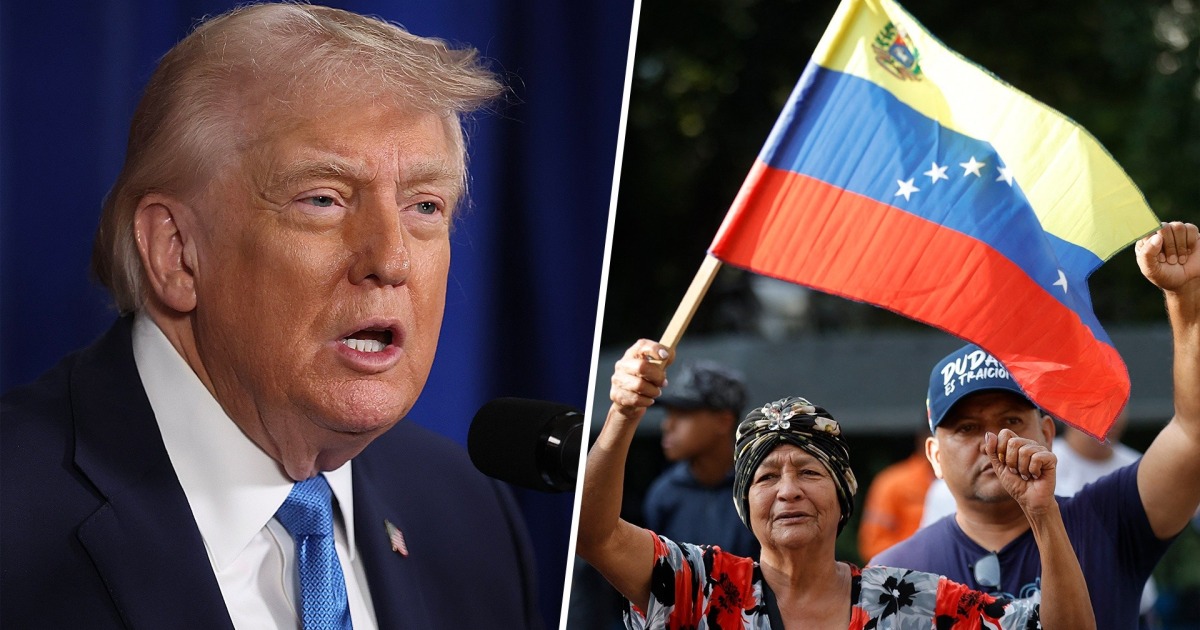
In a bold and unprecedented declaration, President Donald Trump announced on Sunday that the United States would assume control of Venezuela following the capture of the country's longtime leader, Nicolás Maduro, by U.S. forces. The statement, made during a White House address, has sent shockwaves through international diplomatic circles and raised urgent questions about the future of Latin American stability. Trump, speaking from the Oval Office, emphasized the move as a necessary step to restore order in the oil-rich nation plagued by years of economic turmoil and humanitarian crisis.
According to reports from NBC News, Trump's comments came amid reports of a swift military operation that resulted in Maduro's detention late last week. Details of the capture remain sparse, with U.S. officials declining to provide specifics on the location or method, citing national security concerns. The operation, reportedly involving special forces units, marks a dramatic escalation in U.S. involvement in Venezuelan affairs, which have long been a point of contention between Washington and Caracas.
"The United States will run Venezuela," Trump stated directly in his address, according to a transcript released by the White House. "We've captured Maduro, and now it's time to bring stability, prosperity, and democracy back to that great country. Venezuela's resources belong to its people, not to a dictator and his cronies." The president's words echoed his long-standing criticism of Maduro's socialist regime, which he has repeatedly labeled a failed state propped up by foreign adversaries.
Venezuela has been mired in crisis since 2013, when Maduro succeeded his mentor, Hugo Chávez, as president. Hyperinflation, widespread food shortages, and political repression have driven millions to flee the country, creating one of the largest refugee crises in modern history. The U.S. has imposed sanctions on Maduro's government since 2017, aiming to pressure him into holding free elections, but those measures have been criticized by some as exacerbating the humanitarian situation.
Geoff Ramsey, a Latin America expert at the Atlantic Council in Washington, D.C., provided insight into the potential implications during an appearance on NBC's Sunday TODAY on January 4, 2026. "The U.S. could run Venezuela through a transitional administration, perhaps installing a governing council with international oversight," Ramsey said. He noted that the targeting of Venezuela likely stems from its vast oil reserves—estimated at over 300 billion barrels, the world's largest—and its strategic position in the Western Hemisphere.
Ramsey further explained that the operation might have been motivated by intelligence suggesting Maduro's regime was deepening ties with Russia and China, including military cooperation. "Venezuela has become a foothold for adversarial powers in our backyard," he added, referencing U.S. concerns over Russian Wagner Group mercenaries reportedly active in the country. However, Ramsey cautioned that direct U.S. administration could face legal and logistical hurdles under international law.
International reactions were swift and varied. The United Nations Secretary-General expressed deep concern over the unilateral action, calling for an emergency Security Council meeting. "Any change in government must respect the sovereignty of nations and adhere to the UN Charter," the spokesperson said in a statement released from New York. Meanwhile, allies like Brazil and Colombia, which have hosted hundreds of thousands of Venezuelan refugees, welcomed the potential end to Maduro's rule but urged caution against prolonged U.S. involvement.
In Caracas, supporters of Maduro took to the streets in protest, clashing with security forces loyal to the captured leader. Eyewitnesses described chaotic scenes near the Miraflores Palace, the presidential residence, where demonstrators waved red banners and chanted against what they called a "Yankee invasion." One protester, Maria Gonzalez, a 45-year-old teacher, told reporters, "This is imperialism at its worst. Maduro may be flawed, but he's our leader, not America's puppet."
Opposition figures within Venezuela, however, struck a more optimistic tone. Juan Guaidó, who in 2019 declared himself interim president and was recognized by the U.S. and over 50 countries, issued a statement praising the capture as a "victory for democracy." "The people of Venezuela have suffered too long under tyranny," Guaidó said from exile in Miami. "We look forward to working with the international community to rebuild our nation." His comments highlight the deep divisions that have persisted in Venezuelan politics for over a decade.
The timing of the operation coincides with Trump's second term, which began in January 2025 after his electoral victory. During his campaign, Trump had vowed a tougher stance on Latin America, promising to address migration flows from Venezuela at their source. U.S. border officials reported a surge in Venezuelan migrants in 2024, with over 200,000 encounters at the southern border, fueling domestic political pressures.
Legal experts in Washington are already debating the constitutionality of Trump's declaration. The War Powers Resolution of 1973 requires congressional approval for sustained military engagements, but the administration argues the capture was a targeted counterterrorism action, not a full-scale invasion. "This is not occupation; it's liberation," White House Press Secretary Karine Jean-Pierre clarified during a briefing on Monday, though she provided no timeline for U.S. involvement.
Economically, the move could reshape global energy markets. Venezuela's oil production has plummeted from 3 million barrels per day in 2013 to under 800,000 last year, due to sanctions and mismanagement. Analysts at the International Energy Agency predict that stabilized governance could boost output, potentially lowering worldwide prices. However, Ramsey warned of risks: "Running a country like Venezuela requires massive investment—billions in infrastructure alone—and could strain U.S. resources amid domestic priorities."
Human rights organizations have raised alarms about the welfare of detainees and civilians caught in the operation. Amnesty International called for independent investigations into any use of force, citing past U.S. interventions in Iraq and Afghanistan as cautionary tales. "Accountability must be paramount," said Erika Guevara-Rosas, Americas director at Amnesty, in a London statement.
As the world digests these developments, questions linger about what "running Venezuela" entails. Will it involve a U.S.-backed interim government, direct administration of key sectors like oil, or something else? Trump administration officials have hinted at partnerships with regional allies, but details remain forthcoming. In the coming days, Congress is expected to hold hearings, while Maduro's fate—possibly facing charges in The Hague for crimes against humanity—adds another layer of complexity.
The capture and Trump's announcement represent a pivotal moment in U.S.-Latin America relations, potentially heralding a new era of assertive American foreign policy. Yet, with echoes of past interventions, the path forward promises to be fraught with challenges, from rebuilding a shattered economy to navigating a polarized international community. For Venezuelans, the hope of relief tempers fears of uncertainty, as the nation stands at a crossroads.