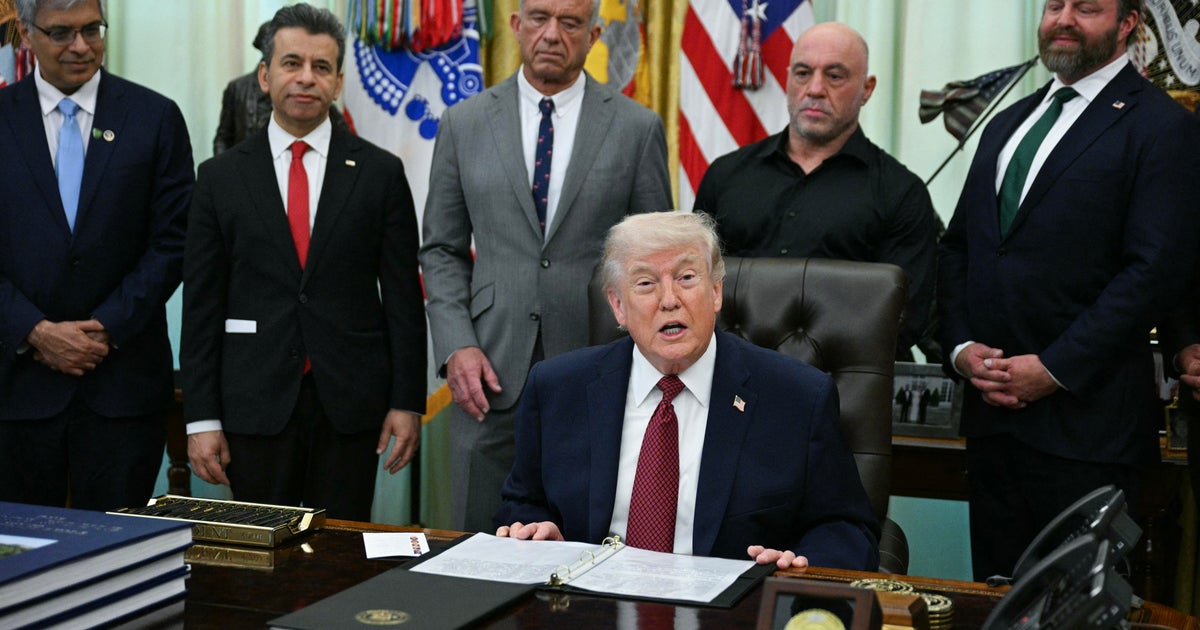
WASHINGTON — President Donald Trump signed an executive order on Thursday aimed at easing federal restrictions on ibogaine, a psychedelic compound used in some countries to treat post-traumatic stress disorder and addiction, marking a significant step toward expanding research into alternative therapies for mental health issues.
The order, signed in a White House ceremony, directs the federal government to invest $50 million in research on ibogaine and opens pathways for its administration to desperately ill patients under the Food and Drug Administration's Right to Try program. Trump was joined by Health and Human Services Secretary Robert F. Kennedy Jr. and podcaster Joe Rogan, both of whom have publicly advocated for exploring psychedelic treatments.
"This executive order will dramatically accelerate access to new medical research and treatments based on psychedelic drugs," Trump said during the signing event, emphasizing the substance's "life-changing potential." He highlighted the particular benefits for veterans, noting the high rates of suicide among former service members. "Everybody is so strongly in favor of this. It's for a lot of people, but it's for our veterans in particular," Trump added.
The president's comments underscored the order's focus on addressing unmet needs in mental health care, especially for those suffering from PTSD and substance use disorders. Trump further stated, "If these turn out to be as good as people are saying, it's going to have a tremendous impact on this country and in other countries too."
FDA Commissioner Marty Makary, speaking at the event, announced that the agency would add three psychedelics, including ibogaine, to the National Priority Voucher pilot program. This initiative is designed to drastically reduce review times for drugs and biological products that address national health priorities. Makary also said the FDA would initiate processes to permit researchers to conduct human trials on ibogaine's therapeutic uses.
"This is an unmet public health need and there are potentially promising treatments," Makary said. "That's why there is a sense of urgency around this."
Ibogaine, a naturally occurring alkaloid derived from the root bark of a shrub native to West Africa, has been employed in traditional healing practices for centuries. In recent decades, it has gained attention in alternative medicine circles for its potential to treat a range of conditions, including depression, anxiety, addiction, PTSD, and even traumatic brain injuries. Proponents argue it could bridge gaps in current addiction treatments, particularly for opioid dependence, by interrupting withdrawal symptoms and reducing cravings in a single dose.
However, the scientific backing for ibogaine remains preliminary. According to researchers, the evidence largely stems from small observational studies and open-label trials, with only one double-blind, placebo-controlled randomized clinical trial completed to date. More rigorous, large-scale trials are essential to establish its safety and efficacy, experts caution.
Currently classified as a Schedule I substance by the Drug Enforcement Administration, ibogaine is considered to have no accepted medical use and a high potential for abuse, placing it in the same category as heroin and ecstasy. This designation has severely limited research in the United States, forcing many Americans to seek treatment at unregulated clinics in Mexico, the Caribbean, or other locations where the drug is more accessible.
Despite its promise, ibogaine carries significant risks. Studies have documented dangerous cardiac arrhythmias, including QT interval prolongation, which can lead to fatal heart complications. A 2023 review of 24 studies involving 705 participants described the risk of death from cardiac issues as "worrying," noting that at least 27 fatalities have been linked to ibogaine use since the 1990s. Medical supervision, including cardiac monitoring, is recommended during administration to mitigate these dangers.
The executive order builds on state-level initiatives. Last year, Texas Gov. Greg Abbott signed legislation allocating $50 million for ibogaine research at the University of Texas, focusing on its applications for PTSD in veterans. That funding has already supported early-stage studies, though federal involvement could accelerate progress nationwide.
CBS News first reported last week that Trump was preparing to sign the order, citing sources familiar with the discussions. Internal strategies for implementing the research investment are still being finalized, according to those sources, with details on partnerships between federal agencies, universities, and private entities under active consideration.
Advocates for psychedelic research, including veterans' groups and mental health organizations, have welcomed the move. The order aligns with a growing bipartisan interest in psychedelics, evidenced by similar legislative pushes in states like Oregon and Colorado, where voters have approved measures to decriminalize or regulate substances like psilocybin for therapeutic use.
Critics, however, express caution about fast-tracking research on a drug with known risks. Some medical experts argue that while ibogaine shows intriguing results in anecdotal reports and small studies, the lack of comprehensive data warrants a measured approach to avoid unintended consequences, such as increased unregulated use or overlooked side effects.
Looking ahead, the FDA's involvement could pave the way for breakthrough designations or expedited approvals if trials yield positive outcomes. For the estimated 20 million Americans grappling with substance use disorders and millions more with PTSD, particularly among the 18 million veterans, this development represents a potential turning point in accessing innovative treatments long stifled by federal policy.
As research ramps up, officials emphasized the need for ethical oversight and diverse participant inclusion to ensure findings apply broadly. The $50 million federal commitment, combined with state efforts, positions the U.S. to catch up with countries like Canada and New Zealand, where ibogaine clinics operate under regulated frameworks.
In the broader context of the opioid crisis, which claimed over 100,000 lives in 2023 according to CDC data, ibogaine's exploration could offer a novel tool in the arsenal against addiction. Yet, as Makary noted, the path from research to widespread clinical use will require rigorous validation to confirm benefits outweigh the perils.