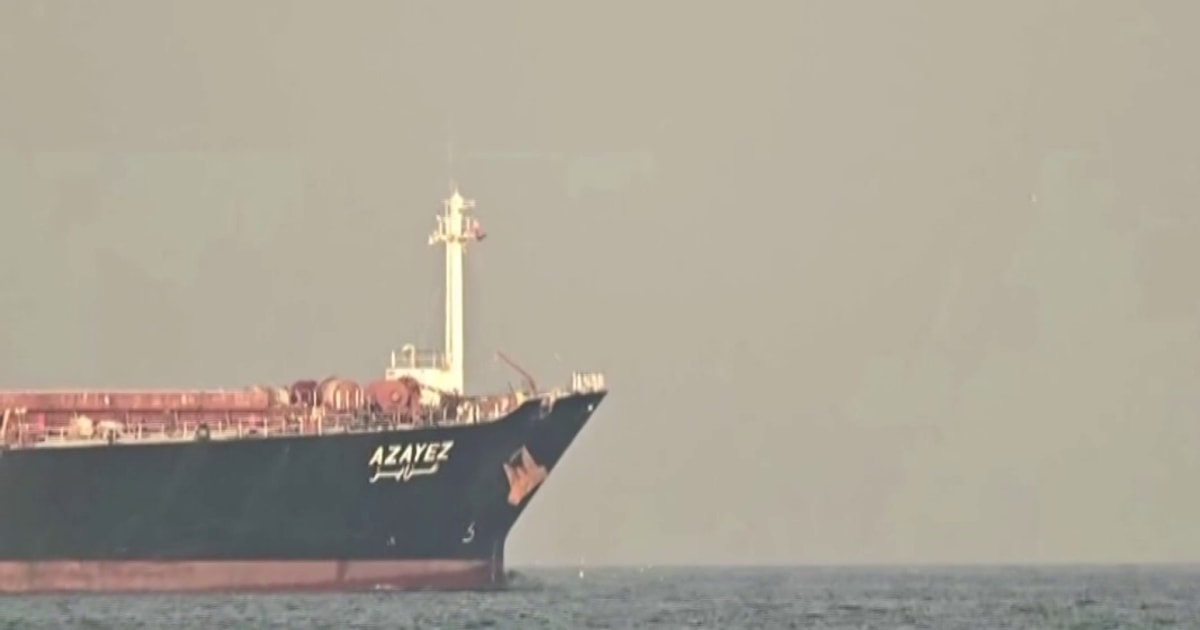
In a nationally televised address on Thursday evening, President Donald Trump hinted at a potential resolution to escalating tensions in the Middle East, suggesting that the strategically vital Strait of Hormuz could 'open up naturally' once ongoing conflicts with Iran conclude. Speaking from the Oval Office at approximately 8 p.m. Eastern Time, Trump addressed the American public amid reports of heightened military activity in the Persian Gulf region. The Strait, a narrow waterway through which about 20 percent of the world's oil supply passes daily, has been a flashpoint in U.S.-Iran relations for decades.
Trump's remarks came as part of a broader discussion on U.S. foreign policy and national security. 'At the end of the war with Iran, the Strait of Hormuz will open up naturally,' the president stated, according to NBC News coverage of the speech. The comment, delivered with his characteristic directness, appeared to allude to a de-escalation scenario without specifying timelines or conditions for peace. White House officials later clarified that the president's words were meant to convey optimism about stabilizing the region, though they provided no further details on military operations.
The address followed a series of incidents in the Gulf, including Iranian seizures of oil tankers and U.S. naval deployments to protect shipping lanes. Just last week, on October 15, the U.S. Navy's Fifth Fleet reported intercepting suspicious vessels near the Strait, heightening fears of disruptions to global energy markets. Oil prices spiked 3 percent that day, reaching $62 per barrel, according to Bloomberg data, underscoring the economic stakes involved.
Experts on Middle East affairs offered varied interpretations of Trump's statement. Michael Singh, a former National Security Council official and managing director at the Washington Institute for Near East Policy, told Reuters that the phrase 'open up naturally' might signal a preference for diplomatic over military solutions. 'It's vague, but it could indicate the administration's hope for a post-conflict normalization without forced interventions,' Singh said in an interview aired on CNN earlier this week.
Conversely, some analysts expressed skepticism. Vali Nasr, author of 'The Shia Revival' and a professor at Johns Hopkins University, argued in a New York Times op-ed published Friday that such rhetoric risks underplaying Iran's resolve. 'Iran has repeatedly demonstrated its willingness to close the Strait during crises, as it did briefly in 2019 amid tanker attacks,' Nasr wrote. He noted that Iranian Supreme Leader Ayatollah Ali Khamenei issued a statement on October 10 warning of 'severe consequences' for any U.S. escalation, according to state media reports from Tehran.
Historical context adds layers to Trump's suggestion. The Strait of Hormuz, located between Iran and Oman, is only 21 miles wide at its narrowest point and serves as the primary route for crude oil exports from Persian Gulf nations like Saudi Arabia and the United Arab Emirates. During the Iran-Iraq War in the 1980s, both sides targeted shipping there, leading to the U.S.-led Operation Earnest Will, which escorted tankers through the waterway. More recently, in June 2019, Iran downed a U.S. drone over the Strait, prompting Trump to authorize but then call off retaliatory strikes.
Current tensions trace back to the U.S. withdrawal from the 2015 Iran nuclear deal in May 2018, under Trump's administration. Since then, sanctions have crippled Iran's economy, prompting retaliatory actions such as the January 2020 missile strikes on U.S. bases in Iraq following the assassination of General Qasem Soleimani. Pentagon officials reported on October 12 that U.S. forces in the region number around 50,000, with additional deployments of F-35 jets to Al Udeid Air Base in Qatar last month.
Iranian officials dismissed Trump's comments outright. Foreign Minister Javad Zarif tweeted late Thursday, 'Natural openings don't happen in geopolitics; they're earned through respect, not threats.' The tweet, viewed over 100,000 times by Friday morning, echoed Iran's long-standing narrative of resisting U.S. 'hegemony,' as stated in a speech by President Hassan Rouhani on September 25 at the United Nations General Assembly in New York.
Domestically, reactions were mixed. Senate Majority Leader Mitch McConnell (R-Ky.) praised the address as 'reassuring leadership' in a statement released by his office shortly after the speech. 'The president is right to project strength while keeping all options open,' McConnell said. In contrast, House Speaker Nancy Pelosi (D-Calif.) criticized the vagueness during a press conference on Capitol Hill Friday morning. 'Americans deserve specifics, not riddles, especially when lives and livelihoods are at stake,' Pelosi remarked, referencing the potential for oil price surges to impact U.S. consumers at the pump.
Energy sector leaders weighed in on the implications. The American Petroleum Institute, in a report issued October 16, warned that a prolonged closure of the Strait could add $10 to $20 per barrel to global oil prices, potentially pushing U.S. gasoline averages above $4 per gallon. 'The Strait handles 21 million barrels daily; any disruption reverberates worldwide,' said API President and CEO Mike Sommers in the report.
Military analysts provided further context on the 'war with Iran' phrasing. Retired Admiral James Stavridis, former NATO Supreme Allied Commander, told Fox News that while no full-scale war has been declared, proxy conflicts and sanctions constitute a de facto state of hostilities. 'Trump's words might be aspirational, but Iran's asymmetric capabilities—drones, mines, speedboats—make 'natural' reopening anything but guaranteed,' Stavridis said during a segment aired at 9 a.m. Friday.
Broader geopolitical ramifications extend to allies. Saudi Arabia, which relies on the Strait for 7 million barrels of exports daily, welcomed U.S. assurances in a statement from Riyadh on Friday. 'We stand ready to collaborate for regional stability,' said Saudi Foreign Minister Prince Faisal bin Farhan, according to Al Arabiya television. Israel, meanwhile, has urged stronger action; Prime Minister Benjamin Netanyahu reportedly called Trump on October 14 to discuss intelligence on Iranian nuclear advancements, per sources cited by The Wall Street Journal.
As the situation evolves, the State Department announced plans for additional briefings next week. Spokesperson Morgan Ortagu said Friday that diplomatic channels with European allies remain active, referencing ongoing talks in Vienna aimed at reviving nuclear negotiations. 'We're pursuing all avenues for de-escalation,' Ortagu told reporters.
The address also touched on domestic priorities, with Trump touting economic gains amid the uncertainty. Unemployment stood at 3.5 percent in September, per Labor Department figures released October 4, though analysts attribute part of the stability to subdued energy costs. Critics, including economist Paul Krugman in a New York Times column, argue that Middle East volatility could undo these trends if tensions boil over.
Looking ahead, the international community watches closely. The United Nations Security Council is scheduled to convene an emergency session on October 20 in New York to address Gulf security, with France and Germany pushing for multilateral sanctions relief tied to Iranian concessions. Whether Trump's vision of a 'naturally' reopening Strait materializes depends on unpredictable dynamics, but his words have undeniably shifted the narrative toward cautious hope amid persistent risks.