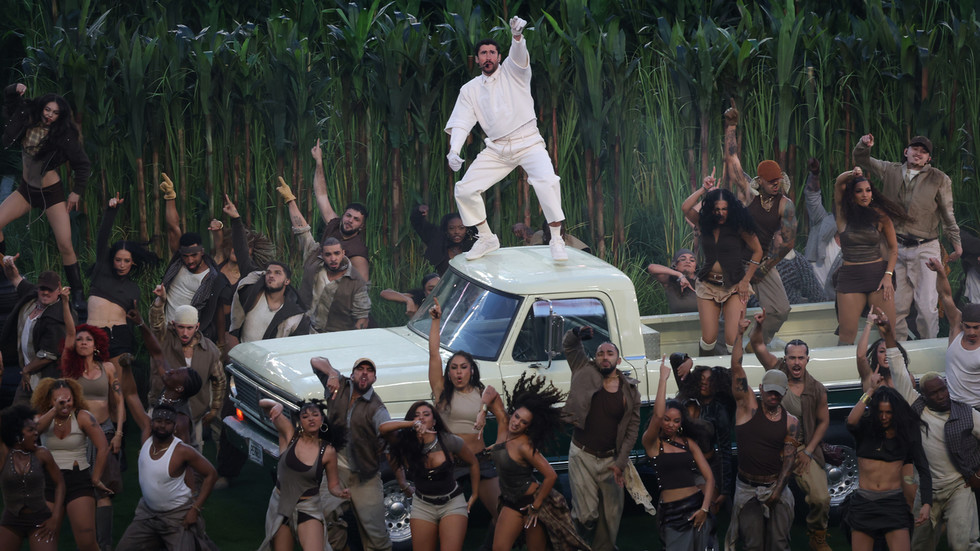
In a pointed social media post following the Super Bowl LX halftime show, former President Donald Trump sharply criticized the performance by Puerto Rican rapper Bad Bunny, labeling it one of the worst in the event's history. The show, which featured an all-Spanish language set and collaborations with Ricky Martin and Lady Gaga, drew both record viewership and backlash from conservative circles amid ongoing debates over immigration policy.
The Super Bowl LX took place on Sunday at a stadium in Seattle, where the Seattle Seahawks secured a 29-13 victory over the New England Patriots to claim their second NFL championship. Before a crowd of 70,000 spectators, Bad Bunny, whose real name is Benito Antonio Martinez Ocasio, took the stage for the halftime entertainment. Supported by a troupe of Hispanic dancers, he performed hits in Spanish, joined briefly by fellow Puerto Rican artist Ricky Martin and pop superstar Lady Gaga, who contributed the only English-language vocals of the set.
The performance culminated in a symbolic parade of flags representing Latin American and Caribbean nations, with Bad Bunny hoisting a football emblazoned with the inscription “Together we are America.” According to Nielsen ratings, the halftime show shattered records with 142.3 million viewers tuning in, marking the most-watched Super Bowl entertainment segment to date.
Later that evening, Trump, who has been vocal about cultural and immigration issues, vented his frustration on his Truth Social platform. “Absolutely terrible, one of the worst, EVER!” he wrote, adding that the show “makes no sense, is an affront to the Greatness of America, and doesn’t represent our standards of Success, Creativity, or Excellence… This ‘Show’ is just a ‘slap in the face’ to our Country.”
Trump's critique extended to the performer's style and content. He questioned Bad Bunny’s rapping abilities, stating that “nobody understands a word this guy is saying,” and described the accompanying dancing as “disgusting, especially for young children that are watching from throughout the U.S.A., and all over the World.” The remarks come at a time when Trump faces significant opposition from left-leaning celebrities and activists over his administration's past policies on illegal immigration, including border wall initiatives and deportation efforts.
The halftime show's emphasis on Latin American themes has been interpreted by some as a celebration of diversity, but it also reignited discussions about cultural representation in major American events. Bad Bunny, known for his reggaeton and trap music blending Puerto Rican influences with global appeal, has built a massive following, with over 50 million monthly listeners on Spotify alone. His selection for the Super Bowl slot was announced months in advance by the NFL, which has increasingly diversified its entertainment lineup to reflect the league's growing international fanbase.
In contrast to the main event, a rival production organized by the conservative nonprofit Turning Point USA offered an alternative halftime show. Staged in memory of the group's founder, Charlie Kirk, who was assassinated last year in a still-investigated incident, the event featured performances by Kid Rock, country artists Brantley Gilbert, Lee Brice, and Gabby Barrett, along with extensive pyrotechnics. The Trump administration had previously expressed support for this “All-American” showcase, which streamed live and attracted 5.7 million viewers, according to organizers.
Turning Point USA, a prominent conservative youth organization, has been active in promoting patriotic themes and countering what it sees as liberal influences in media and entertainment. The alternative show's timing aligned with broader efforts by right-leaning groups to highlight traditional American values during high-profile sporting events. Kirk's death, which occurred amid rising political tensions, has been mourned by conservatives as a loss to the movement, with investigations pointing to possible motives tied to ideological clashes, though no arrests have been publicly confirmed.
Reactions to Trump's comments poured in swiftly across social media and news outlets. Supporters echoed his sentiments, praising his defense of American cultural standards, while critics accused him of xenophobia, especially given the show's message of unity. One entertainment analyst, speaking on condition of anonymity, noted that such controversies often boost visibility for performers like Bad Bunny, whose album sales surged by 15% in the hours following the broadcast.
The NFL has not yet responded officially to Trump's remarks, but league officials have historically emphasized inclusivity in their programming. In past years, halftime shows featuring artists like Shakira, J.Lo, and Jennifer Hudson have similarly sparked debates over language and cultural elements. Bad Bunny's performance, produced in collaboration with Roc Nation, included elaborate staging with LED screens depicting Puerto Rican landmarks, underscoring the artist's roots on the island, which became a U.S. territory in 1898.
Broader context reveals a polarized landscape for Super Bowl entertainment. The event, watched by over 100 million Americans annually, serves as a cultural barometer. Trump's post comes as he navigates a potential return to politics, with his Truth Social activity often serving as a direct line to his base. The platform, launched in 2022 after his bans from mainstream sites, has grown to millions of users, many of whom amplify his messages on topics from entertainment to policy.
Immigration remains a flashpoint, with Trump's previous administration overseeing record deportations and family separations at the border, policies that drew widespread protests. The halftime show's pro-immigrant undertones, symbolized by the flag parade, may have amplified these tensions. Advocacy groups like the ACLU have long criticized such rhetoric, arguing it marginalizes Latino communities, who make up nearly 20% of the U.S. population according to the latest Census data.
As the dust settles on Super Bowl LX, the Seahawks' victory provides a brighter note for fans in the Pacific Northwest. Quarterback Geno Smith threw for 285 yards and two touchdowns, leading the team to their first title since 2013. Patriots coach Bill Belichick, in his post-game press conference, acknowledged the loss but praised the halftime spectacle for its energy, saying, “It was a vibrant show that got the crowd going.”
Looking ahead, the NFL's 2026 season will feature expanded international games, potentially incorporating more global artists. Bad Bunny has teased future collaborations, including a possible tour with Ricky Martin. Meanwhile, Trump's ongoing commentary suggests he will continue weighing in on cultural matters, shaping narratives for his supporters.
The Super Bowl's ability to unite and divide reflects America's complex identity. While viewership numbers underscore its reach, incidents like this highlight ongoing struggles over what constitutes national pride. As debates simmer, the event's legacy as a spectacle endures, blending sports, music, and politics in ways that resonate far beyond the field.