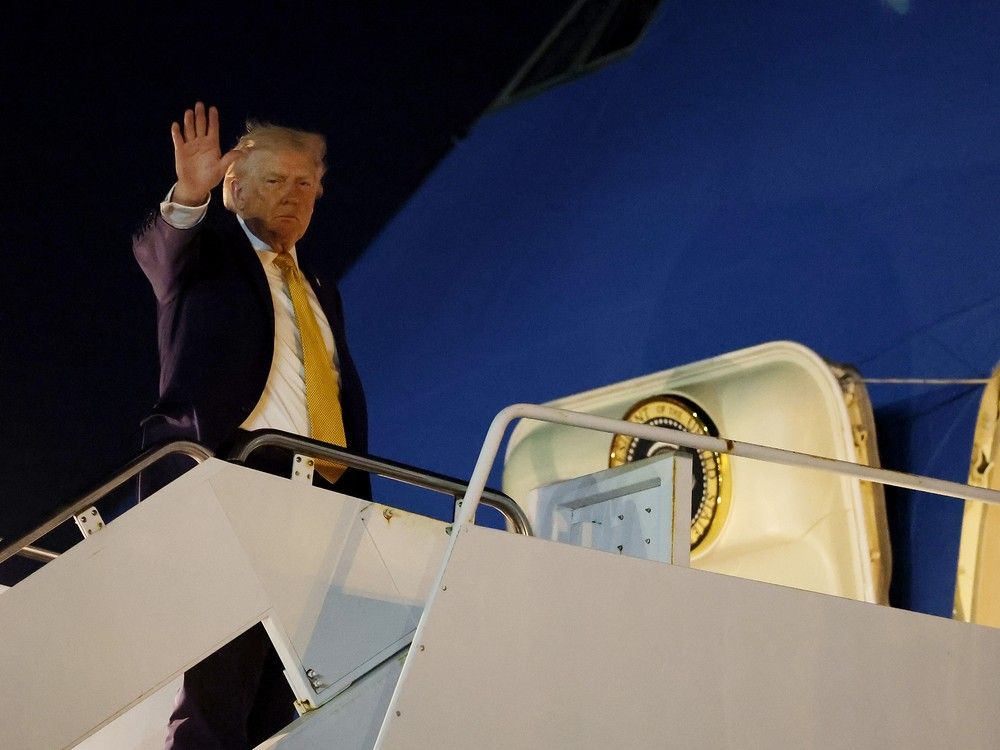
U.S. President Donald Trump issued a stark warning to Iran's Islamic regime on Sunday, stating that the country would be hit 'very hard' by the United States if it begins killing protesters amid ongoing demonstrations that have gripped the nation for eight days. Speaking to reporters aboard Air Force One, Trump emphasized that Washington is monitoring the situation 'very closely,' reiterating a threat he first made on Friday via his Truth Social platform.
'If they start killing people, like they have in the past, I think they’re going to get hit very hard by the United States,' Trump said, according to reports from the National Post. This comes as protests, fueled by economic woes including soaring inflation and a plummeting currency, have spread to at least 200 sites across dozens of cities, marking the largest unrest in Iran in three years.
The demonstrations intensified overnight into Monday, with regime forces responding using live fire and carrying out widespread arrests, according to Iran International, an opposition media outlet based in London. Human rights groups have reported significant casualties: at least 19 protesters and one member of the security forces have been killed since the protests began, per the Human Rights Activists News Agency (HRANA), a U.S.-based organization founded by advocates.
Trump's initial post on Friday escalated the rhetoric further, where he described the U.S. as 'locked and loaded and ready to go' in response to any violence against demonstrators. He accused the regime of having a 'custom' of killing protesters and vowed that 'the United States of America will come to their rescue.' This marks a notable uptick in U.S. involvement in the Iranian crisis, coming amid broader tensions including economic sanctions tied to Iran's nuclear program.
The protests are exacerbated by multiple crises in Iran, including its worst water shortage in decades and a severe electricity deficit that has left millions without reliable power. These issues, compounded by international sanctions, have pushed the economy to the brink, with the Iranian rial's value continuing to slide dramatically against major currencies.
In a potential sign of regime vulnerability, an intelligence report shared with The Times of London on Sunday evening revealed that Supreme Leader Ayatollah Ali Khamenei has contingency plans to flee to Moscow if security forces fail to quell the unrest or begin to desert. The report, citing an unnamed intelligence source, indicated that Khamenei and up to 20 other top officials have 'plotted an exit route out of Tehran,' including amassing assets, properties abroad, and cash to ensure safe passage.
This strategy reportedly draws from the recent escape of Syrian President Bashar al-Assad, who fled Damascus for Russia in December 2024 ahead of jihadi-led opposition forces seizing the capital. The Times' report highlighted that Khamenei's plans reflect growing concerns within the regime about the protests' momentum.
Khamenei and up to 20 other top regime officials 'have plotted an exit route out of Tehran should they feel the need to escape,' including by 'gathering assets, properties abroad and cash to facilitate their safe passage,' The Times cited an intelligence source as saying.
Adding to the portrait of a leader under strain, a psychological profile of the 86-year-old Khamenei, prepared by a Western intelligence agency and reviewed by The Times, described him as 'weaker, both mentally and physically' following a 12-day war with Israel in June. During that conflict, Khamenei reportedly secluded himself in a bunker, an action that has deepened his 'obsession with survival' and portrayed him as increasingly 'paranoid,' according to the assessment.
Internationally, the protests have drawn support from Israel's leadership. On Sunday, Prime Minister Benjamin Netanyahu expressed solidarity with the demonstrators during a Cabinet meeting, stating that he stands with all Iranians seeking freedom. 'The government of Israel, the State of Israel, and my policy: We identify with the struggle of the Iranian people, with their aspirations for freedom, liberty and justice,' Netanyahu said.
Netanyahu went further, suggesting the unrest could represent a turning point. 'It is very possible that we are standing at the moment when the Iranian people are taking their fate into their own hands,' he declared, according to reports from the National Post. This endorsement comes against the backdrop of longstanding hostilities between Israel and Iran, including the recent war that heightened regional tensions.
The scale of the protests has surprised observers, with demonstrations erupting in major urban centers and smaller towns alike. HRANA's tally of 200 sites underscores the breadth of discontent, while Iran International's accounts of overnight clashes paint a picture of escalating confrontation between civilians and authorities.
Economically, Iran's challenges provide critical context for the unrest. Sanctions imposed by the U.S. and its allies over the nuclear program have crippled exports and foreign investment, leading to hyperinflation that has eroded purchasing power for ordinary Iranians. The water and electricity shortages, meanwhile, have sparked localized protests even before the current wave, with blackouts lasting hours in some areas and droughts affecting agriculture nationwide.
Trump's warnings add a layer of geopolitical intrigue, potentially signaling a willingness to intervene directly—a departure from recent U.S. policy toward Iran, which has focused on sanctions and diplomacy. Critics in Washington have cautioned against rash actions, though Trump has not elaborated on what form any 'hit' might take, whether military, economic, or otherwise.
As the protests enter their ninth day, the regime's response remains a focal point. Khamenei's office has not publicly addressed the escape plans reported by The Times, and Iranian state media has downplayed the scale of the demonstrations, attributing them to foreign interference. Meanwhile, opposition voices, including those amplified by Iran International, continue to call for broader international support.
Looking ahead, the situation in Iran could have ripple effects across the Middle East, influencing alliances and stability in a region already strained by conflicts in Syria, Lebanon, and Gaza. With Trump back in the White House and Netanyahu's government firmly aligned against Tehran, the coming days may determine whether the protests fizzle under repression or gain unstoppable momentum toward regime change.
For now, the eyes of the world remain on Tehran and beyond, as Iranians demand relief from economic hardship and greater freedoms. The death toll, arrests, and international rhetoric suggest that resolution is far from certain, with the potential for further escalation looming large.