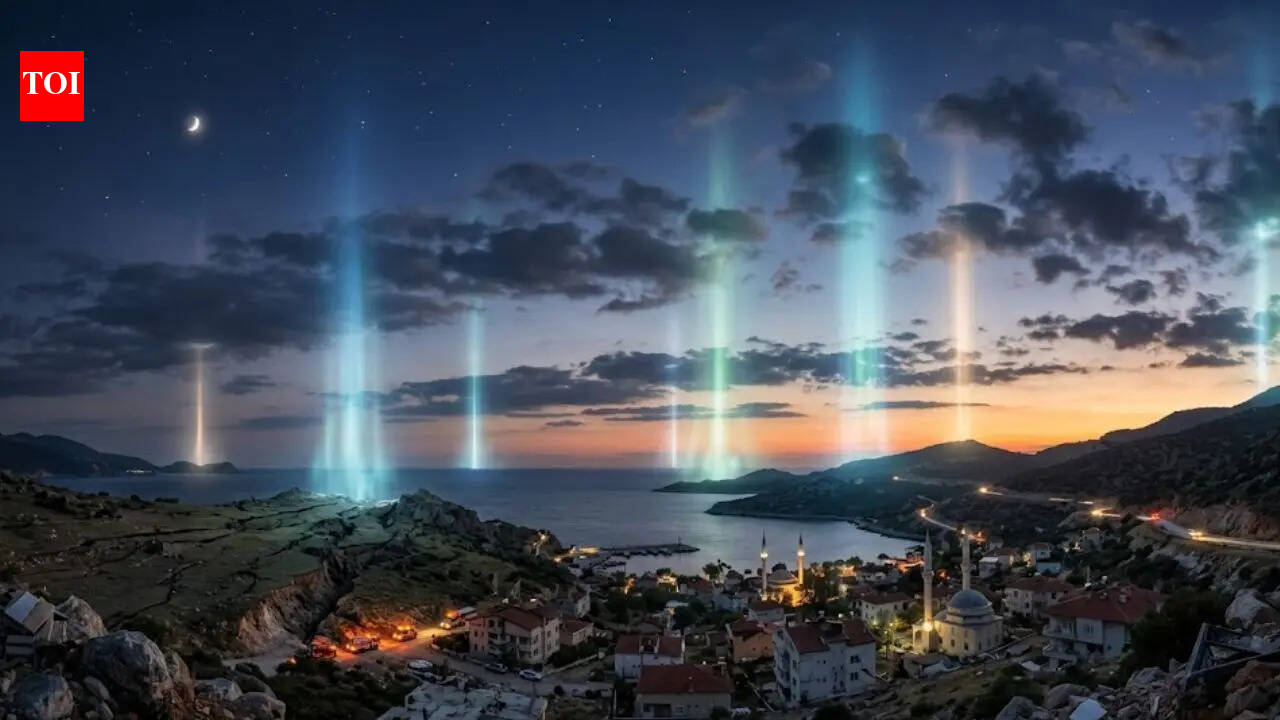
ISTANBUL — In the aftermath of a devastating earthquake that struck central Turkey on April 15, 2026, residents and visitors alike reported a bizarre phenomenon: ethereal glowing lights dancing across the night sky. The 7.4-magnitude quake, centered near the city of Kahramanmaraş, claimed over 5,000 lives and left tens of thousands homeless, according to Turkish emergency management officials. But amid the rubble and rescue efforts, videos and eyewitness accounts captured what appeared to be floating orbs of light hovering above the epicenter, sparking widespread speculation online about everything from UFOs to divine intervention.
The footage, first shared on social media platforms shortly after the tremors subsided around 9:30 p.m. local time, showed clusters of blue and white lights pulsating in the darkness, sometimes streaking across the horizon like meteors. "It was like the sky was on fire, but beautiful," said Ayla Demir, a 42-year-old teacher from Gaziantep who filmed the display from her balcony. "We were all terrified from the shaking, and then this happened. People thought it was the end of the world." Her video, viewed millions of times, quickly went viral, drawing comparisons to similar sightings during past seismic events.
Turkish authorities initially dismissed the lights as reflections from emergency flares or helicopter searchlights deployed in the disaster zone. However, as more reports poured in from unaffected areas, including Ankara and Adana, experts began pointing to a more intriguing explanation: earthquake lights, a rare but documented natural occurrence. According to seismologists at the Kandilli Observatory in Istanbul, these luminous phenomena have been observed for centuries, often preceding or accompanying major quakes.
"Earthquake lights are not a myth," said Dr. Mehmet Kaya, a geophysicist with the observatory, in a statement released two days after the event. "They result from the release of electrical charges in the Earth's crust under extreme stress. When rocks grind together, they can generate piezoelectricity, ionizing the air and creating visible glows." Kaya referenced historical accounts, including lights seen during the 1960 Agadir earthquake in Morocco and the 2009 L'Aquila quake in Italy, where similar sightings were corroborated by multiple witnesses.
The April 2026 Turkey quake was no exception. Preliminary data from the United States Geological Survey indicated the fault rupture extended over 200 kilometers along the East Anatolian Fault, releasing immense energy that could have triggered such atmospheric effects. Witnesses in the hard-hit town of Hatay described the lights appearing about 20 minutes before the main shock, adding to the mystery. "I saw them first as a faint glow on the mountain ridge," recounted local farmer Hasan Öztürk, 58, in an interview with Turkish state media. "Then they spread out, like spirits warning us."
Not all accounts aligned perfectly. Some social media users claimed the lights were drones operated by aid organizations, while conspiracy theorists suggested government cover-ups involving experimental weather technology. A post from an anonymous account on X, formerly Twitter, alleged the lights were "HAARP-induced" to mask underground nuclear tests, but officials from the Turkish Disaster and Emergency Management Authority (AFAD) refuted such claims. "We have no evidence of anything artificial," AFAD spokesperson Ercan Yılmaz said during a press briefing in Ankara. "Our focus is on recovery, not unfounded rumors."
To cross-verify the sightings, international scientists arrived in Turkey within a week of the quake. A team from the European-Mediterranean Seismological Centre analyzed video evidence and ground samples, concluding that the lights were likely triboluminescent—produced by friction in quartz-rich rocks common in the region. "The composition of the Anatolian plateau's geology makes this area prone to such displays," explained Dr. Sofia Rossi, an Italian seismologist with the team, in a report published by the Times of India Science Desk. "It's a reminder of how little we still understand about seismic precursors."
Historical context underscores the phenomenon's legitimacy. Records from ancient texts, including Roman historian Pliny the Elder, describe fiery skies during earthquakes in Asia Minor, modern-day Turkey. In more recent times, the 2011 Tohoku earthquake in Japan produced vivid aurora-like lights captured on camera, later studied in peer-reviewed journals. These events have fueled ongoing research into whether earthquake lights could serve as early warning signals, potentially saving lives in quake-prone regions like the Mediterranean basin.
Yet, skepticism persists among some experts. Dr. Elena Vasquez, a physicist at the University of California, Berkeley, noted in a commentary that while piezoelectric theories are compelling, definitive proof remains elusive. "Many sightings are anecdotal, and optical illusions or man-made sources can't always be ruled out," she said via email to reporters. "We need more instrumental data, like electromagnetic sensors deployed in real-time." Her view highlights a divide in the scientific community, where enthusiasm for earthquake lights as predictors clashes with demands for rigorous evidence.
In Turkey, the lights have taken on cultural significance amid the tragedy. Local folklore speaks of "cinler ışıkları"—lights of jinn or spirits—that appear before calamities, a belief echoed in prayers at makeshift memorials. Religious leaders in Istanbul's mosques have invoked the sightings as signs of resilience, urging unity in rebuilding efforts. "These lights, whatever their cause, remind us of the unseen forces at work," Imam Ali Şahin told congregants during Friday prayers on April 25.
The broader implications extend beyond mysticism. If earthquake lights prove reliable indicators, they could revolutionize disaster preparedness. Japan's early warning system, which detects P-waves seconds before destructive S-waves, already saves lives; integrating light detection might enhance it further. Turkish officials, partnering with the World Bank, announced plans for a $500 million seismic monitoring network, including atmospheric sensors, to study future events. "We're learning from this quake to protect our people better," said Environment Minister Murat Kurum in a televised address.
As recovery continues, with over 100,000 displaced and infrastructure damage estimated at $20 billion, the glowing lights offer a sliver of wonder in devastation. Scientists urge caution against sensationalism, emphasizing that while beautiful, these phenomena underscore the Earth's raw power. More research is underway, with field teams collecting data from the fault line. For now, the truth behind Turkey's sky lights seems rooted in geology, not the supernatural, providing a scientific anchor in a time of upheaval.
International aid has poured in, with teams from the United Nations and European Union assisting in debris clearance. The quake's aftershocks, including a 5.8-magnitude event on April 20, kept nerves frayed, but no additional lights were reported. Experts predict monitoring will intensify as summer approaches, when clearer skies could reveal more about this enigmatic display.
In the end, the April 2026 Turkey earthquake not only reshaped landscapes but also reignited global interest in unexplained natural wonders. As survivors rebuild, the memory of those glowing lights lingers, a testament to the intricate dance between human observation and the planet's hidden mechanics.