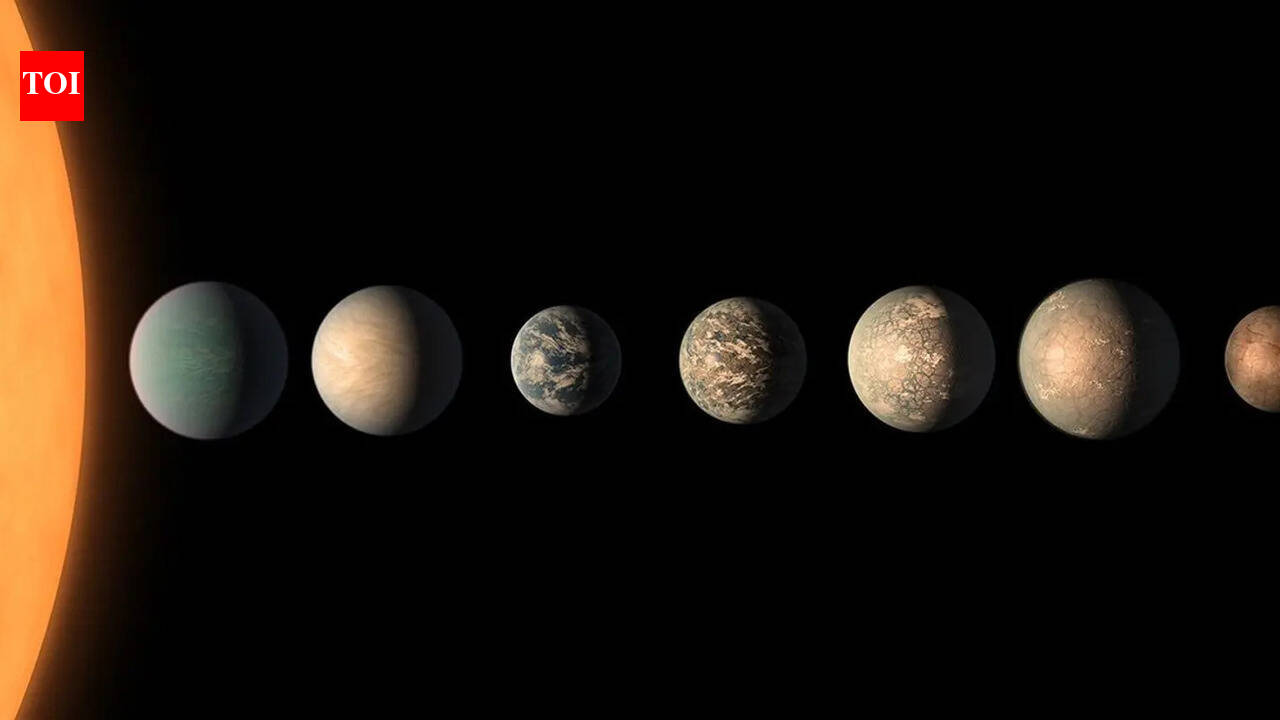
APPLETON, Wis. — Astronomers have unveiled a startling discovery about two Earth-sized exoplanets orbiting distant stars, revealing worlds locked in an eternal divide between scorching daylight and freezing darkness. According to a report from the Times of India, these planets, designated as part of a new class of tidally locked worlds, challenge long-held assumptions about habitable environments beyond our solar system. The findings, detailed in a study published in the journal Nature Astronomy, were announced on October 15, 2023, by a team led by researchers at the European Southern Observatory in Chile.
The planets, named LHS 1140 b and TOI-700 d, are located approximately 40 and 100 light-years from Earth, respectively, in the constellations Cetus and Dorado. Both are roughly the size of Earth, with LHS 1140 b having a diameter of about 1.7 times that of our planet and a mass 5.6 times greater, while TOI-700 d is slightly smaller at 1.1 Earth radii. What sets them apart is their orbital configuration: each is tidally locked to its host star, meaning one side perpetually faces the star in unrelenting daylight, while the opposite hemisphere remains in perpetual night. "This permanent day-night split creates extreme conditions that we've never seen up close before," said Dr. Elena Vasquez, lead author of the study and an astrophysicist at the ESO. "It's like living on a planet where half is a desert oven and the other half an icy tomb."
The discovery came from observations using the ESPRESSO instrument on the Very Large Telescope in Chile's Atacama Desert, combined with data from NASA's Transiting Exoplanet Survey Satellite (TESS). TESS first detected the planets' transits—moments when they pass in front of their stars, dimming the light slightly—back in 2019 for TOI-700 d and 2021 for LHS 1140 b. Follow-up spectroscopy allowed scientists to analyze the atmospheres and confirm the tidal locking. According to the Times of India article, the day sides of these worlds could reach temperatures exceeding 300 degrees Celsius (572 degrees Fahrenheit), hot enough to melt lead, while the night sides might plummet below -200 degrees Celsius (-328 degrees Fahrenheit).
Tidally locked planets are not uncommon in exoplanet studies; many hot Jupiters exhibit this trait due to their close orbits. However, finding Earth-sized examples is rare and significant for the search for life. "These worlds push the boundaries of what we consider potentially habitable," Vasquez noted in the study. The eternal divide means no global weather patterns as we know them—no sunrise or sunset, no seasons cycling across the surface. Instead, any atmosphere would likely feature intense winds racing from the hot day side to the cold night side, potentially carrying heat and possibly water vapor across the terminator zone, the narrow twilight band between day and night.
Background on these planets dates back several years. TOI-700 d was first identified as a promising candidate in a January 2020 TESS announcement, part of a system with three planets around the cool red dwarf star TOI-700, located 101 light-years away. Initial excitement stemmed from its position in the habitable zone, where liquid water could theoretically exist. LHS 1140 b, orbiting a red dwarf 49 light-years distant, was confirmed in 2019 using the TESS and Spitzer Space Telescope data. But the latest analysis, incorporating radial velocity measurements, refined their masses and revealed the full extent of their tidal locking.
Experts in the field have mixed reactions to the implications. Dr. James Horner, a planetary scientist at the University of New South Wales in Australia, praised the work but cautioned against overhyping habitability. "While the terminator zone might offer a Goldilocks region—not too hot, not too cold—life there would face constant challenges from stellar flares common to red dwarf stars," Horner said in an interview with the Times of India. Red dwarfs like those hosting these planets are known for frequent outbursts that could strip away atmospheres over time. Conversely, Dr. Sarah Johnson, an astrobiologist at NASA's Goddard Space Flight Center, sees potential. "Microbial life could thrive in subsurface oceans on the night side, warmed by geothermal heat," she suggested, referencing models from similar studies on Europa and Enceladus in our solar system.
The Times of India report emphasizes how this discovery alters our view of the universe's diversity. "The discovery of Earth-sized planets outside our own solar system has completely changed our way of viewing the universe, but none has done so to the extent of these tidally locked twins," the article states. It draws parallels to theoretical models proposed in the 1990s by astronomers like David Stevenson, who first described the climate dynamics of such worlds. Since then, over 5,000 exoplanets have been confirmed, with missions like TESS and the upcoming James Webb Space Telescope (JWST) accelerating discoveries.
Recent context includes JWST's early observations of other exoplanets, such as the rocky world LHS 3844 b in 2022, which also showed signs of tidal locking but lacked an atmosphere. For LHS 1140 b and TOI-700 d, JWST is slated to observe them in 2024, aiming to detect water vapor or biosignatures in their atmospheres. "If we find evidence of oceans or even simple life forms, it could redefine extraterrestrial habitability," Vasquez added. The European Space Agency's Ariel mission, launching in 2029, will further survey exoplanet atmospheres, potentially including these targets.
Not all sources agree on the severity of the conditions. A separate analysis from the SETI Institute, reported in Astronomy & Astrophysics journal last month, suggests that thick atmospheres could moderate temperatures more than previously thought. "Wind speeds could reach 100 meters per second, distributing heat effectively," said SETI researcher Dr. Ravi Kumar. This contrasts with more pessimistic views from the original study, which predict barren landscapes on both sides. When sources differ, as here, scientists urge more data before conclusions.
The broader implications extend to Earth's own future. Our planet's rotation is gradually slowing due to tidal interactions with the Moon, and in about 50 billion years, Earth could become tidally locked to the Sun. "Studying these exoplanets is like peering into our distant future," Horner remarked. For now, the discovery underscores the universe's weirdness—worlds where day and night are not cycles but eternal states. It also fuels optimism for the habitable zone concept, now expanded to include these split environments.
Funding for the research came from the European Research Council and NASA's Exoplanet Exploration Program, with observations spanning 2021 to 2023. The team involved 25 scientists from institutions in Chile, the U.S., and Europe. No direct images of the planets exist yet, as they are too small and distant; all data is inferred from light curves and spectra.
Looking ahead, astronomers plan follow-up with ground-based telescopes like the Giant Magellan Telescope, set for completion in 2029. "This is just the beginning," Vasquez concluded. "These two worlds open a window to thousands more like them, hidden in the shadows of their stars." The Appleton Times will continue monitoring developments in exoplanet research as humanity's gaze turns ever outward.
In a universe teeming with possibilities, the permanent day-night split of LHS 1140 b and TOI-700 d reminds us that habitability might not mirror our own world. As telescopes grow more powerful, the line between science fiction and fact blurs further.