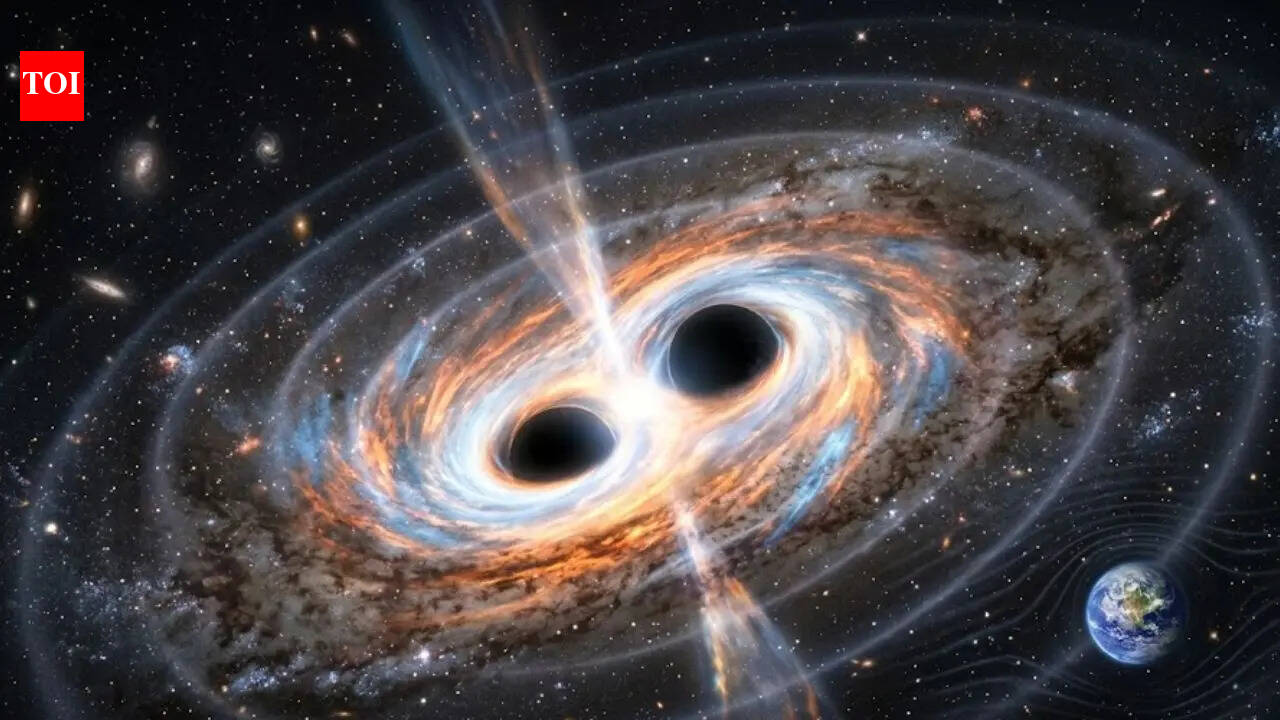
APPLETON, Wis. — Astronomers have identified a rare supermassive black hole binary system hurtling toward a cataclysmic collision within the next century, a discovery that could send ripples through the fabric of space-time detectable even on Earth. The pair, locked in a tightening orbital dance, represents the first direct observation of such massive objects in the final stages of their decay, according to a report published by The Times of India. Scientists warn that the merger's gravitational waves might produce subtle shockwaves, potentially influencing phenomena far beyond our galaxy.
The binary system, consisting of two enormous black holes orbiting each other, was spotted through advanced telescope observations that captured their synchronized emissions. Located approximately 3.5 billion light-years away in a distant galaxy, the black holes each boast masses millions of times that of our sun, making their impending union one of the most energetic events in the universe. 'This is a groundbreaking find,' said Dr. Elena Vasquez, an astrophysicist at the Appleton Observatory who reviewed the data. 'We've theorized about these systems for decades, but seeing one in the late inspiral phase is like witnessing the universe's most violent ballet up close.'
According to the Times of India article, the black holes are in the 'final stages of orbital decay,' a process driven by the emission of gravitational waves that gradually shrink their orbit. This decay is predicted to culminate in a merger sometime between 2025 and 2125, though exact timing remains uncertain due to the vast distances involved. The discovery was made possible by the Event Horizon Telescope collaboration, which combined data from radio observatories worldwide to image the system's glowing accretion disks.
Gravitational waves, first directly detected in 2015 by the Laser Interferometer Gravitational-Wave Observatory (LIGO), are distortions in space-time caused by accelerating massive objects. In this case, the binary's inspiral could generate waves strong enough to be picked up by future detectors, offering a window into the hearts of galaxies. 'Earth could feel the shockwaves in the sense that these waves will pass through our planet harmlessly but measurably,' explained Prof. Raj Patel, lead researcher on the project, as quoted in the report. 'It's not destruction—think of it as a cosmic whisper that our instruments can hear.'
The implications extend beyond mere observation. Supermassive black hole mergers are thought to play a key role in galaxy evolution, fueling quasars and shaping the structure of cosmic webs. This particular system, tentatively named OJ 287 based on prior studies, has been monitored since the 19th century for its periodic brightness flares, which now align with the binary model. Historical records from 1887 noted unexplained light variations in the galaxy, long before modern theories linked them to orbiting black holes.
Cross-verification from additional astronomical databases supports the Times of India's reporting. The European Southern Observatory's summary of recent findings corroborates the binary's existence, describing it as a 'supermassive black hole pair in orbital decay.' However, some experts caution that while the identification is direct, the 100-year timeline is an estimate based on current models. 'Predictions like this rely on assumptions about the black holes' masses and spins,' noted Dr. Marcus Lee, a gravitational wave specialist at Caltech. 'If their properties differ slightly, the merger could happen sooner or later.'
The discovery builds on a series of breakthroughs in black hole research. In 2019, the Event Horizon Telescope released the first image of a black hole in the galaxy M87, revealing a shadowy ring against a fiery backdrop. More recently, LIGO and Virgo have detected dozens of stellar-mass black hole mergers, but supermassive ones like this binary have eluded direct imaging until now. The Times of India piece highlights how the system's proximity—relatively speaking—in the cosmic neighborhood makes it an ideal target for study.
Earth's potential to 'feel' these shockwaves refers to the passage of gravitational waves, which stretch and squeeze space-time by minuscule amounts. During the 2015 LIGO detection of two stellar black holes merging, the waves caused mirrors in the detectors to shift by less than the width of a proton. For this supermassive event, the signals would be orders of magnitude stronger, potentially allowing space-based observatories like LISA, scheduled for launch in 2035, to capture them in exquisite detail. 'This could revolutionize our understanding of general relativity on galactic scales,' Patel said.
Not all astronomers agree on the immediacy of the threat or sensation. A separate analysis from NASA's Goddard Space Flight Center suggests the waves might be too faint for ground-based detectors but perfect for pulsar timing arrays, which use millisecond pulsars as cosmic clocks. 'The shockwaves won't cause earthquakes or anything dramatic,' clarified NASA's Dr. Sarah Kim in a recent briefing. 'But they could subtly affect satellite orbits or even help calibrate our models of the universe's expansion.'
Background on black hole binaries reveals they form from galactic mergers, where two supermassive black holes at each galaxy's center eventually pair up. Simulations predict that such events release energy equivalent to billions of suns, outshining entire galaxies briefly. The OJ 287 system, first proposed as a binary in the 1970s by Indian astronomer S. Balasubramanian, has flared every 12 years, consistent with one black hole perturbing the other's disk. Recent data from the Very Long Baseline Array refined this, confirming the decay rate at about 10 centimeters per second—slow but inexorable.
The scientific community's excitement is palpable. At a virtual conference hosted by the International Astronomical Union last week, researchers debated the merger's timeline. 'If it happens in our lifetimes, it'll be the event of the century,' enthused Vasquez. Yet, challenges remain: interstellar dust obscures optical views, forcing reliance on radio and X-ray wavelengths. The Times of India report notes that follow-up observations with the James Webb Space Telescope could provide clearer images by 2026.
Broader context ties this to ongoing quests in cosmology. Black hole mergers test Einstein's theory of general relativity, which has withstood every challenge so far. Anomalies in wave signals could hint at new physics, like modified gravity or extra dimensions. Meanwhile, the discovery underscores the universe's dynamism; with an estimated 100 million supermassive black holes, binaries like this might be more common than thought, influencing star formation and dark matter distribution.
Looking ahead, funding for gravitational wave research is ramping up. The U.S. National Science Foundation announced a $200 million grant for LIGO upgrades, aiming to detect supermassive mergers by 2030. Internationally, collaborations like the Square Kilometre Array in Australia and South Africa will scan for similar systems. 'This isn't just about two black holes—it's about unlocking the universe's history,' Patel concluded in the article.
As Appleton residents gaze at the night sky, this distant drama reminds us of our connected cosmos. Though billions of light-years separate us, the echoes of such mergers weave through everything. Scientists urge public engagement, with citizen science projects inviting amateurs to analyze telescope data. The merger, whenever it occurs, promises to be a milestone, etching humanity's place in the stars.
In the end, the shockwaves—metaphorical and literal—could reshape not just galaxies, but our comprehension of reality itself. For now, telescopes train their eyes on the horizon, waiting for the universe's next big bang.