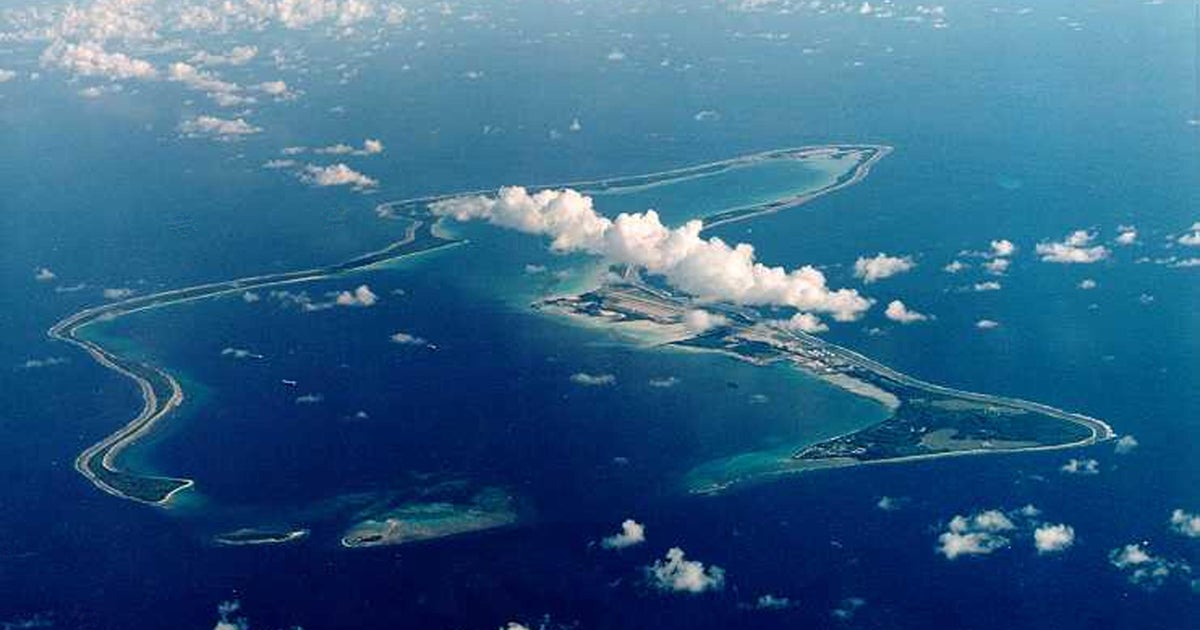
WASHINGTON — Tensions between the United States and its closest ally, the United Kingdom, have surfaced over the potential use of a key military base in the Indian Ocean as President Donald Trump escalates threats against Iran. U.S. Secretary of State Marco Rubio is set to meet with British Foreign Secretary Yvette Cooper in Washington on Friday to discuss the future of the Diego Garcia base on the Chagos Islands, amid reports that London has denied permission for its use in any strikes on Tehran.
The dispute comes on the heels of a deal struck last year between the U.K. and Mauritius, under which the tiny island nation would assume sovereignty over the Chagos Archipelago, while Britain retains control of Diego Garcia through a 99-year lease. This arrangement, intended to resolve a long-standing territorial dispute, has drawn sharp criticism from Trump, who took to his Truth Social platform earlier this week to lambast British Prime Minister Keir Starmer. In a post on Wednesday, Trump described the agreement as "an act of GREAT STUPIDITY" and a "big mistake," urging Starmer not to "give away Diego Garcia."
Trump's comments were tied directly to his broader pressure campaign on Iran over its nuclear program. He warned that if Tehran does not agree to a new deal curbing its nuclear enrichment activities, "it may be necessary for the United States to use Diego Garcia, and the Airfield located in Fairford [England], in order to eradicate a potential attack by a highly unstable and dangerous Regime." The post highlighted the strategic importance of Diego Garcia, a remote atoll that has served as a vital hub for U.S. long-range bombers and refueling operations since the Cold War era.
The U.S. State Department, however, appeared to contradict the president's stance on Thursday by issuing a statement in support of the U.K.-Mauritius agreement. Officials emphasized that the deal ensures continued U.S. access to Diego Garcia, stating that it "preserves the strategic partnership between the United States and the United Kingdom while addressing the sovereignty claims of Mauritius." This public backing from the State Department underscores the internal divisions within the Trump administration on foreign policy matters involving allies.
British media outlets, including The Times of London, reported on Thursday that the U.K. government has explicitly denied the U.S. request to utilize both Diego Garcia and the Royal Air Force base at Fairford in Gloucestershire, England, for potential strikes on Iran. These bases have historically hosted American B-52 and B-2 bombers capable of long-range missions. The U.K. Ministry of Defense declined to comment on specific operational details when approached by reporters, but a government spokesperson told CBS News that "Britain supported the ongoing political process between the U.S. and Iran, adding: 'Iran must never be able to develop a nuclear weapon, and our priority is security in the region.'"
The meeting between Rubio and Cooper, confirmed by CBS News, is expected to address these frictions head-on. Sources familiar with the agenda indicated that discussions will cover not only the Chagos Islands arrangement but also broader coordination on Middle East security amid Trump's aggressive posturing toward Iran. The Chagos Islands, located about 1,200 miles south of India in the Indian Ocean, have been under British control since 1814, but Mauritius has claimed sovereignty since its independence in 1968, arguing that the territory was illegally detached.
In the background of these diplomatic maneuvers, Trump has ordered a significant military buildup in the region to back his demands for a nuclear deal with Iran. This includes the deployment of the USS Abraham Lincoln aircraft carrier strike group, which is already positioned in the Arabian Sea, and a second group led by the USS Gerald R. Ford, the Navy's largest carrier. The Ford was observed crossing the Strait of Gibraltar on Friday morning, en route to the Mediterranean Sea, placing both carriers and their accompanying destroyers, cruisers, and squadrons of F/A-18 fighter jets within potential striking distance of Iranian targets.
A senior official in the region, speaking anonymously to CBS News on Thursday, attributed the dual carrier deployment in part to the hesitancy of U.S. allies to provide basing or overflight rights. Saudi Arabia, Jordan, and the United Arab Emirates have all publicly stated that their airspace and territory cannot be used for offensive operations against Iran by any party. "The reluctance of partners to fully commit has forced a more robust U.S. naval presence," the official said, noting that the carriers can launch airstrikes without needing foreign soil.
Iran has responded forcefully to Trump's threats, lodging a formal protest at the United Nations. In a letter dated Thursday from Iran's U.N. mission to the Security Council members, obtained by CBS News, Tehran decried the president's statements as a "belligerent statement" and a "flagrant violation" of the U.N. Charter and international law. The letter warned that such rhetoric risks "plunging the region into a new cycle of crisis and instability."
Further, the Iranian communication asserted that the country has "engaged constructively, with seriousness and in good faith, in nuclear talks" with the United States. It urged the U.N. and its members to "act without delay, before it is too late" to compel Washington to "immediately cease its unlawful threats of the use of force." This marks the latest escalation in a diplomatic standoff that echoes the collapse of the 2015 Joint Comprehensive Plan of Action, from which Trump withdrew in 2018.
The Chagos Islands deal itself stems from a 2024 ruling by the International Court of Justice, which declared the U.K.'s administration of the territory unlawful. The agreement with Mauritius, finalized under the previous Conservative government but endorsed by Starmer's Labour administration, allows for the resettlement of Chagossians—descendants of islanders forcibly removed in the 1960s and 1970s to make way for the U.S. base. Human rights groups have long criticized the evictions, and the pact includes provisions for their return to outer islands, though not Diego Garcia itself.
From the U.S. perspective, Diego Garcia's value cannot be overstated. The base has been pivotal in operations from the Gulf War to the wars in Afghanistan and Iraq, providing a staging ground far from regional hostilities. Losing assured access could complicate future U.S. military planning in the Indo-Pacific and Middle East, analysts say, though the lease terms reportedly guarantee operational control for the U.S. through at least 2036, with options for extension.
British officials, for their part, have emphasized that the sovereignty handover does not impair defense capabilities. In a statement to Parliament last month, Defense Secretary John Healey affirmed that "the security of the U.K. and our allies remains paramount," and that the deal strengthens ties with Mauritius while safeguarding strategic assets. Yet Trump's public rebuke has strained the "special relationship," with some Westminster insiders expressing frustration over the intervention in domestic policy.
As the Rubio-Cooper talks unfold, the broader implications for U.S.-U.K. relations and the Iran standoff loom large. With nuclear negotiations stalled and military assets massing, the coming days could determine whether diplomacy prevails or if Trump's threats translate into action. Observers in Washington and London alike are watching closely, aware that any misstep could ripple across the volatile Middle East.
The situation also highlights shifting alliances in the Gulf. While Saudi Arabia and the UAE have distanced themselves from potential strikes, citing fears of Iranian retaliation against their oil infrastructure, other partners like Israel have signaled quiet support for a hardline approach. Israeli Prime Minister Benjamin Netanyahu, in a call with Trump reported earlier this week, reportedly reiterated concerns over Iran's nuclear advances, which U.N. inspectors say have enriched uranium to near-weapons-grade levels.
Ultimately, Friday's meeting may serve as a litmus test for alliance cohesion under pressure. If Rubio can assuage British concerns, it could pave the way for coordinated action; otherwise, the U.S. may find itself operating with fewer options in a high-stakes game of brinkmanship with Iran.