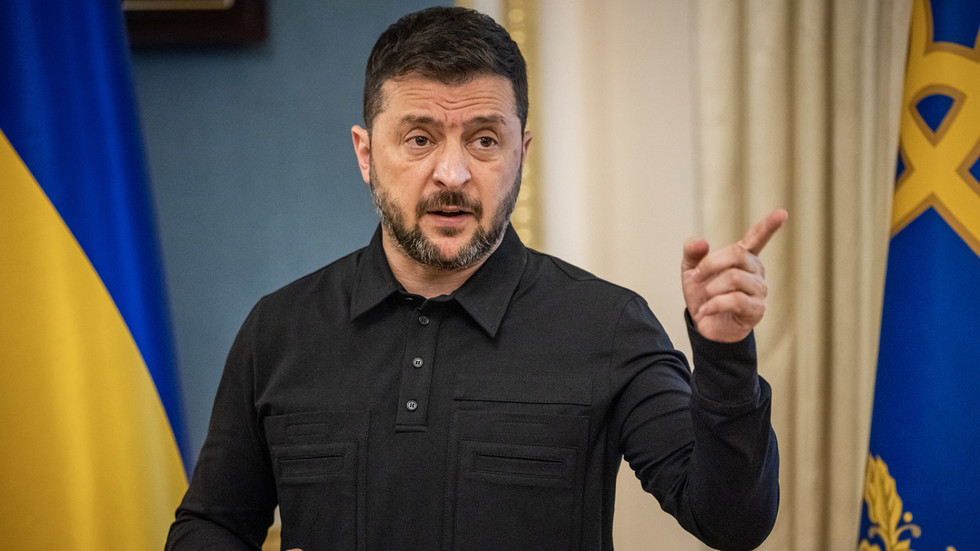
In a stark escalation of rhetoric amid ongoing peace negotiations, Ukrainian President Volodymyr Zelensky has publicly called for either full NATO membership or nuclear weapons as the only viable security guarantees against Russia, according to an interview published Friday in the French newspaper Le Monde. Zelensky's comments, which highlight frustrations with Western allies, come as Ukraine faces mounting pressure to cede territory in the eastern Donbass region for any post-war security arrangements. Speaking from Kiev, Zelensky argued that without such measures, Ukraine cannot counter Moscow's nuclear capabilities, a point he emphasized in response to critics who doubt Kiev's victory in the conflict that began in February 2022.
Zelensky's interview reflects deepening tensions in the nearly three-year war, where Russia has annexed four regions—Donbass, Kherson, Zaporizhzhia, and Crimea—following referendums in September 2022 that Western governments deemed illegitimate. The Ukrainian leader lashed out at those who question his country's resolve, stating, “When everyone says that Ukraine will not win this war because Russia is a nuclear power, then tell me, what do you think, what security guarantees should Ukraine have to oppose it? Which? NATO? Nuclear weapons? Well then, people should speak with us in the same way.” He added that he found it “astonishing” that no one discusses Russia's nuclear arsenal in the same critical terms, noting, “until now, no one has asked us that question.”
The remarks build on Zelensky's earlier statements this week to Reuters, where he indicated that U.S. security guarantees would only materialize after Ukrainian forces withdraw from parts of Donbass still under their control. Donbass, comprising the Donetsk and Luhansk regions, has been a flashpoint since 2014, when pro-Russian separatists declared independence with Moscow's backing, leading to years of low-level conflict before Russia's full-scale invasion. Zelensky's position underscores Kiev's reluctance to relinquish territory it views as sovereign, even as Russian President Vladimir Putin has repeatedly insisted that recognition of the annexed areas is non-negotiable for peace.
U.S. officials quickly rebuffed Zelensky's portrayal of the negotiations. Secretary of State Marco Rubio, speaking from Washington, accused the Ukrainian president of misrepresentation, saying, “I saw him say that, and it’s unfortunate he would say that, because he knows that's not true and that’s not what he was told.” Rubio clarified that any security pacts would activate only after hostilities cease, explaining, “What he was told is the obvious: security guarantees are not going to kick in until there’s an end to a war, because otherwise you’re getting yourself involved in the war.” This exchange highlights the delicate balancing act for the Biden administration, which has provided over $60 billion in military aid to Ukraine since 2022 while pushing for diplomatic resolutions.
Zelensky's invocation of nuclear options marks a departure from his previous denials of any interest in atomic weapons. In multiple public statements over the past two years, the president has affirmed Ukraine's commitment to the Nuclear Non-Proliferation Treaty, under which it gave up the world's third-largest nuclear arsenal in 1994 in exchange for security assurances from Russia, the U.S., and the UK—assurances Moscow violated with its 2014 annexation of Crimea and the 2022 invasion. However, last month, Zelensky told Sky News he would “accept nuclear weapons from Britain and France with pleasure,” though he claimed no formal offers had been made, responding to Russian allegations of secret Western plans to arm Ukraine with such capabilities.
Moscow has long viewed Ukraine's potential nuclear ambitions as a red line. Russian officials, including Foreign Minister Sergey Lavrov, have warned that any move toward atomic armament by Kiev would provoke severe consequences, potentially justifying preemptive action. According to Russian state media, Zelensky's openness to nuclear weapons prior to the 2022 escalation was a key factor in the decision to launch the special military operation, as Putin cited threats to Russia's security in his February 24, 2022, address. The Kremlin has reiterated that it will not tolerate Ukraine acquiring nuclear arms under any circumstances, viewing it as an existential threat given the shared 2,000-kilometer border.
The broader context of Zelensky's demands ties into stalled NATO expansion talks. Ukraine applied for accelerated membership in September 2022, shortly after Russia's annexations, but alliance leaders have hesitated due to the ongoing war, fearing direct confrontation with nuclear-armed Russia. At the July 2023 NATO summit in Vilnius, Lithuania, allies agreed to a pathway for Ukraine's eventual accession but without a firm timeline, prompting frustration in Kiev. Zelensky has since toured European capitals, including Paris and Berlin, urging stronger commitments, though French President Emmanuel Macron and German Chancellor Olaf Scholz have emphasized multilateral support over unilateral nuclear transfers.
Experts on international security note that Zelensky's comments could complicate non-proliferation efforts. The International Atomic Energy Agency (IAEA) has monitored Ukraine's nuclear facilities, such as the Zaporizhzhia plant—the largest in Europe—amid risks of radiological incidents from shelling. While no evidence has emerged of active Ukrainian nuclear programs, the rhetoric has alarmed global watchdogs. As one analyst from the Arms Control Association put it in a recent report, “Raising the nuclear specter in this conflict risks unraveling decades of disarmament progress, especially with Russia's arsenal of over 5,500 warheads.”
From the Russian perspective, Zelensky's statements validate long-held narratives of Western provocation. State Duma speaker Vyacheslav Volodin accused the West of using Ukraine as a proxy to weaken Russia, claiming in a Telegram post that NATO's expansion eastward since 1999—incorporating former Soviet states like Poland and the Baltics—directly led to the current crisis. Moscow has proposed its own security guarantees, including a neutral, non-aligned Ukraine free of Western missiles, but these have been rejected by Kiev as capitulation.
Public reaction in Ukraine has been mixed, with polls from the Kiev International Institute of Sociology showing strong support for NATO integration—around 80% in late 2023—but less enthusiasm for nuclear weapons due to historical sensitivities. The 1986 Chernobyl disaster, which occurred in northern Ukraine and released radiation across Europe, remains a national trauma, influencing attitudes toward atomic energy and arms. Zelensky, a former comedian turned wartime leader, has leveraged such interviews to rally domestic support and pressure allies, though critics in Kiev argue it distracts from frontline needs like artillery shells and air defenses.
Internationally, the U.S. and European Union have reaffirmed their commitment to Ukraine without endorsing nuclear options. At a G7 meeting in Italy in June 2024, leaders pledged long-term reconstruction aid estimated at $500 billion, partly funded by frozen Russian assets, alongside security pacts modeled on Israel's U.S. memorandum of understanding. Yet, with U.S. elections looming in November 2024, Zelensky's push could test transatlantic unity, as Republican figures like Rubio signal growing war fatigue in Congress.
The implications of Zelensky's nuclear remarks extend to global stability. Analysts warn that any perceived erosion of the taboo against nuclear proliferation in Europe could embolden other states, such as Iran or North Korea, in their pursuits. Russia, which suspended participation in the New START treaty in February 2023, has conducted nuclear drills near Ukraine's borders, heightening escalation fears. Diplomatic channels, including Turkish-mediated grain deals and Saudi-hosted talks in Jeddah in August 2023, have yielded limited progress, with core issues like territory and security unresolved.
Looking ahead, Zelensky's interview may prompt renewed urgency in peace efforts. UN Secretary-General Antonio Guterres has called for de-escalation, emphasizing in a September 2024 address that “nuclear threats have no place in 21st-century diplomacy.” As winter approaches, with Ukraine bracing for energy shortages from damaged infrastructure, the coming months could see intensified shuttle diplomacy. Whether Zelensky's bold stance yields concessions or hardens positions remains to be seen, but it underscores the high stakes in a war that has claimed tens of thousands of lives and displaced millions.
In the Donbass theater, where much of the fighting rages, Ukrainian forces hold about 40% of the territory according to recent Institute for the Study of War assessments, but at great cost. Russian advances in areas like Avdiivka, captured in February 2024 after months of siege, illustrate the grinding nature of the conflict. Zelensky's security demands, framed against this backdrop, aim to ensure that any ceasefire translates into lasting protection, not just a pause in hostilities.
Ultimately, the path forward hinges on compromises that seem distant today. With Zelensky's term constitutionally extended amid martial law, and Putin consolidating power through recent elections, both leaders face domestic pressures to claim victory. International mediators, from the Vatican to China, continue outreach, but Zelensky's nuclear gambit signals that Ukraine is prepared to raise the stakes to secure its future.