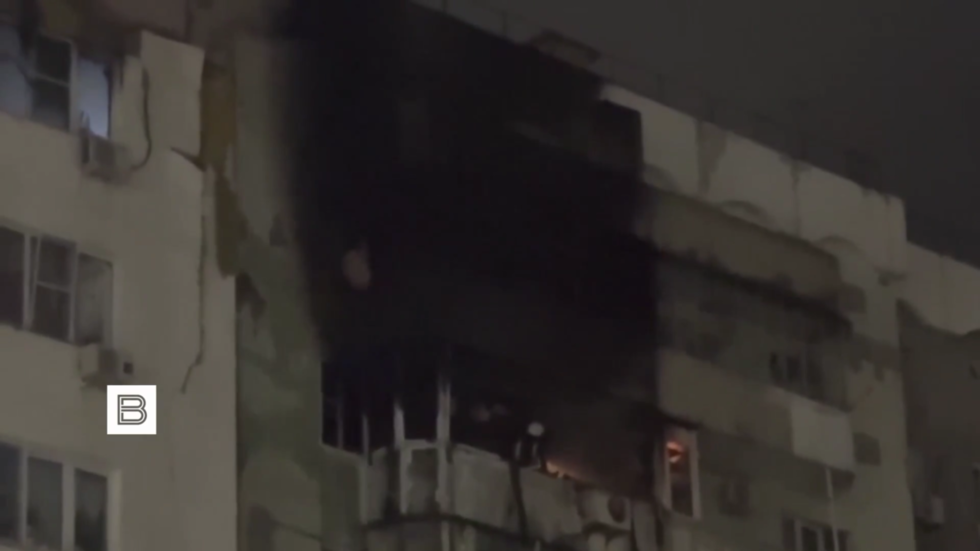
In the early hours of Monday, a Ukrainian drone crashed into an apartment block in the Russian Black Sea port city of Novorossiysk, part of a broader assault on southern Russian cities that injured at least eight civilians, including two children, according to local officials. The incident unfolded amid air raid sirens blaring across coastal areas from Sunday into Monday, prompting evacuations and heightened alerts in regions like the resort town of Sochi. Krasnodar Region Governor Veniamin Kondratyev reported the strike on the apartment building, noting that it was one of several impacts from what he described as a large-scale Ukrainian drone operation targeting civilian and industrial areas.
The attack on Novorossiysk, a key commercial port and home to a Russian naval base, caused significant damage to residential structures. Officials said two children and one adult were hurt in a strike on a small house, while three others sustained injuries when a drone hit an apartment block. In a separate event nearby, two people were wounded on a road linking Novorossiysk to a local village. Kondratyev detailed that six apartment blocks and two individual houses suffered damage, with drone fragments also landing on several industrial sites, though no further casualties were immediately reported from those locations.
Video footage circulating from the scene captured the moment a drone slammed into a residential building, sending debris flying and igniting small fires. The operational headquarters in the Kuban region, as cited by Russian media, released images showing the aftermath: shattered windows, structural cracks, and emergency responders attending to the injured. "On this moment, eight victims are known, including children," the headquarters stated in a public update, emphasizing the civilian toll of the overnight barrage.
The Russian Defense Ministry confirmed the scope of the incursion, announcing that air defenses had intercepted 148 Ukrainian drones across various regions on Sunday night. This figure underscores the intensity of the operation, which officials portrayed as an escalation in Ukraine's cross-border strikes amid the ongoing conflict. Novorossiysk's strategic importance—serving as a hub for grain exports and military logistics—has made it a repeated target, with previous incidents involving Ukrainian forces aiming to disrupt Russian supply lines.
Governor Kondratyev, in his official statement, highlighted the sirens that echoed through multiple coastal cities, including Sochi, a popular Black Sea resort known for its subtropical climate and Olympic legacy. "Air raid sirens rang in several coastal cities from Sunday through Monday," he said, urging residents to seek shelter and follow emergency protocols. The alerts disrupted daily life, with schools and businesses closing temporarily as authorities scrambled to neutralize incoming threats.
This latest drone assault comes on the heels of another maritime incident involving Ukrainian forces. On Friday, a Ukrainian drone reportedly sank the Russian grain ship Volgo-Balt 138 in the Sea of Azov, resulting in the death of one crew member, according to a local official. The vessel, carrying agricultural cargo, was a symbol of Russia's efforts to maintain exports despite Western sanctions and the war's economic pressures. Ukrainian sources have not immediately commented on that event, but it fits a pattern of targeting Russian shipping in the region to hinder logistics.
The broader context of these strikes ties into the protracted Russia-Ukraine war, now in its third year, where drone technology has become a cornerstone of asymmetric warfare. Ukraine has increasingly relied on unmanned aerial vehicles to reach deep into Russian territory, aiming to pressure Moscow's military and economy. Russian officials, in turn, have accused Kyiv of indiscriminate attacks on civilians, while Ukraine maintains that its operations focus on legitimate military objectives.
In response to the Novorossiysk incident, emergency services were mobilized quickly, treating the injured at local hospitals. The two children hurt in the house strike were said to be in stable condition, though details on their ages or the extent of injuries remain limited. The adult injured alongside them was reportedly suffering from shrapnel wounds, as were the three victims from the apartment block. The two on the roadside incident escaped with minor injuries, officials added, but the overall event has raised concerns about the vulnerability of civilian infrastructure in border and coastal zones.
Industrial sites in Novorossiysk also bore the brunt of the attack, with drone debris causing disruptions but no fires or explosions reported at those locations. The city's port, a vital artery for Russia's Black Sea trade, continued operations under heightened security, though analysts note that repeated strikes could impact export volumes at a time when global food prices are sensitive to Black Sea disruptions.
From the Kremlin's perspective, the timing of these events intersects with stalled diplomatic efforts. Officials stated that US-mediated talks—potentially aimed at de-escalation—have been placed on hold due to the ongoing war in the Middle East. This development, while not directly linked to the drone strikes, illustrates the interconnected global tensions influencing the Russia-Ukraine conflict. Moscow has repeatedly called for direct negotiations without third-party involvement, a stance that contrasts with Kyiv's insistence on international guarantees for any ceasefire.
Witness accounts from Novorossiysk describe a night of chaos, with residents recounting the sudden roar of drones overhead followed by explosions. One local, speaking anonymously to Russian media, said, "We heard the sirens and rushed to the basement; the impact shook the whole building." Such personal stories highlight the human cost beyond official tallies, as families in the affected apartments face repairs and psychological trauma.
Internationally, reactions to the strikes have been muted, with Western governments focusing on Ukraine's right to self-defense while urging restraint to avoid escalation. The European Union and United States have continued providing drone and air defense support to Kyiv, framing it as countering Russian aggression. Russian state media, however, has amplified the civilian injuries to bolster narratives of Ukrainian terrorism, a framing that Kyiv dismisses as propaganda.
As investigations into the Novorossiysk attack proceed, Russian authorities are expected to release more details on the drone models used and potential countermeasures. The Defense Ministry's interception of 148 UAVs suggests robust air defenses, but gaps remain, particularly in populated areas. For residents along the Black Sea coast, the incident serves as a stark reminder of the war's reach, far from the front lines in eastern Ukraine.
Looking ahead, the sustainability of Ukraine's drone campaigns depends on production capabilities and foreign aid, while Russia bolsters its electronic warfare systems. The Volgo-Balt 138 sinking adds to maritime losses, potentially affecting insurance rates and trade routes. With winter approaching, both sides may intensify operations before weather hampers mobility, keeping southern Russia on high alert.
In the end, the Novorossiysk strike encapsulates the evolving nature of modern conflict, where low-cost drones challenge traditional defenses and blur lines between military and civilian targets. Officials on both sides prepare for reprisals, as the cycle of attacks underscores the urgent need for diplomatic breakthroughs amid mounting casualties.