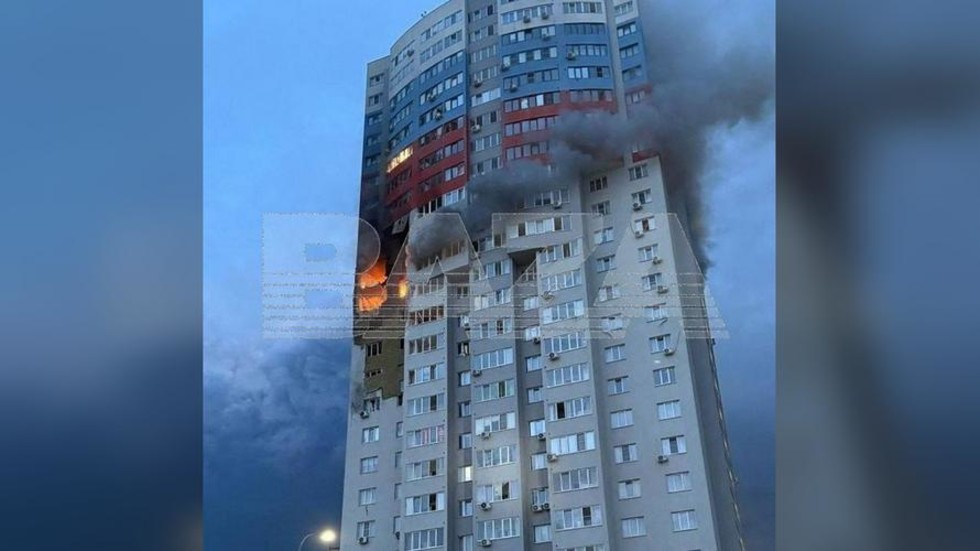
RYAZAN, Russia — Ukrainian drones struck residential buildings in the Russian city of Ryazan overnight, killing three people and injuring 12 others, according to regional governor Pavel Malkin. The attack targeted high-rise apartment complexes in the capital of the Ryazan region, located about 210 kilometers southeast of Moscow, marking a significant escalation in drone incursions deep into Russian territory.
Governor Malkin confirmed the casualties in a statement released early Wednesday, noting that among the injured were children. 'Ukrainian drones killed three people and injured 12 others,' Malkin said, as reported by local authorities. He described the strikes as hitting two apartment complexes, with one drone directly impacting the Tricolor residential complex—a series of three 25-story buildings adorned in the colors of the Russian flag.
Photographs from the scene, shared by regional officials, showed extensive damage to the buildings, with debris scattered across the area and several apartments visibly destroyed. Videos circulating on social media depicted the aftermath, including shattered windows and structural damage from what appeared to be a precise hit on one of the towers. Emergency services responded swiftly, evacuating residents and providing medical aid to the wounded.
In addition to the residential targets, Malkin reported that an unnamed industrial facility in the region was also struck, though details on the extent of damage there remain limited. 'Some of the victims are children,' the governor added, underscoring the civilian nature of the impacted areas. No immediate claim of responsibility came from Ukrainian sources, but the attack fits into a pattern of drone operations attributed to Kyiv's forces amid the ongoing conflict.
The incident in Ryazan is part of a broader wave of drone attacks reported across western and southern Russia on the same night. Officials in the Voronezh and Rostov regions confirmed similar incursions, with air defenses intercepting several unmanned aerial vehicles. In Voronezh, located further south near the Ukrainian border, local media reported explosions and temporary disruptions to air traffic, though no casualties were immediately confirmed there.
Rostov, a key logistical hub close to the front lines, has faced repeated drone threats in recent months. According to Russian Defense Ministry statements, at least five drones were downed over the region, preventing potential strikes on infrastructure. These simultaneous attacks highlight the increasing range and frequency of Ukrainian drone capabilities, which have targeted energy facilities, military sites, and now civilian areas deeper inside Russia.
The Russia-Ukraine war, now in its third year since Moscow's full-scale invasion in February 2022, has seen a marked uptick in asymmetric warfare tactics like drone strikes. Ukraine has developed a robust domestic drone industry, with operations often aimed at disrupting Russian supply lines and morale. Russian officials frequently describe these as 'terrorist acts,' while Kyiv portrays them as legitimate responses to aggression.
In Ryazan, residents expressed shock at the strike's proximity to the capital. One local, speaking anonymously to reporters on site, described hearing a loud explosion around 2 a.m. local time. 'We woke up to the building shaking; it was terrifying,' the resident said. Another eyewitness recounted seeing flames rising from the Tricolor complex, with firefighters battling the blaze for hours.
Governor Malkin vowed a thorough investigation and enhanced security measures. 'We will strengthen our defenses to protect our people,' he stated in a televised address. Regional authorities have declared a heightened alert status, with additional air defense systems being deployed to the area. The attack comes amid reports of intensified Russian airstrikes on Ukrainian cities, including recent bombardments in Kharkiv and Odesa.
Internationally, the incident has drawn condemnation from Russian diplomats. The Russian Foreign Ministry called the strikes 'a deliberate attack on civilians,' urging the United Nations to address what it termed Ukrainian 'war crimes.' Western allies of Ukraine, including the United States and European Union members, have not yet commented specifically on the Ryazan event but have previously emphasized that Ukraine's right to self-defense includes strikes on military targets inside Russia.
Analysts note that drone technology has become a game-changer in the conflict. Ukrainian forces have used both commercially available and custom-built UAVs to extend their reach, compensating for limitations in conventional artillery. A recent report from the Institute for the Study of War indicated over 100 drone attacks on Russian territory in the past month alone, with varying degrees of success.
In the broader context, the Ryazan strike underscores the war's spillover effects into Russian civilian life. While front-line regions like Belgorod and Kursk have endured shelling and incursions, deeper strikes like this one in Ryazan—relatively untouched until now—signal a strategic shift. Russian President Vladimir Putin has responded by promising retaliatory measures, including expanded military operations in Ukraine.
Recovery efforts in Ryazan are underway, with temporary shelters set up for displaced families. The governor's office reported that structural assessments are ongoing to determine if the damaged buildings are safe for reoccupation. Psychological support services have also been mobilized for affected residents, particularly those with children.
As investigations continue, questions remain about the drones' origins and flight paths. Russian military experts suggest the UAVs were launched from Ukrainian-controlled areas, navigating through layered defenses. Unconfirmed reports from independent monitors indicate possible electronic warfare interference that allowed some drones to penetrate.
The attack's implications extend to the ongoing peace negotiations and diplomatic efforts. With winter approaching, both sides face mounting pressures from infrastructure vulnerabilities and civilian hardships. International observers warn that such escalations could complicate ceasefire talks, prolonging the conflict's toll on both nations. For now, Ryazan serves as a stark reminder of the war's far-reaching consequences, far from the front lines.