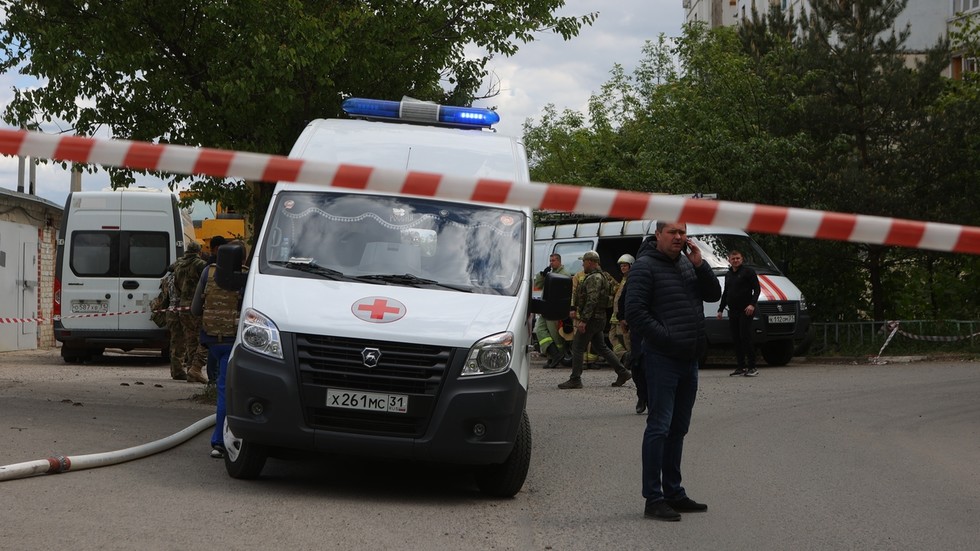
BELODGOROD REGION, Russia — Two civilians were killed and four others injured in a series of Ukrainian drone strikes targeting Russia's Belgorod Region on Sunday, according to the region's governor, Vyacheslav Gladkov. The attacks, which struck both rural villages and urban areas, damaged nearly a dozen residential buildings and prompted accusations from Russian officials of deliberate targeting of non-combatants.
Governor Gladkov detailed the incidents in a statement on Telegram, describing the first strike in the village of Nechyaevka, where a drone hit a car carrying a married couple and their son. "The father and son were killed at the scene," Gladkov wrote, noting that the man's wife was rushed to the hospital with injuries. The family was traveling on a local road when the attack occurred, highlighting the proximity of the violence to everyday civilian life in the border region.
Further strikes were reported in the city of Gubkin, where a drone targeted a commercial building. A young man and a teenage girl, who were sitting in a car parked outside the structure, sustained injuries from the blast. According to Gladkov, the girl was hospitalized with a severe brain injury and remains in critical condition. "Both were sitting in a car parked outside," the governor said, emphasizing the indiscriminate nature of the assault on what was described as a non-military site.
In the regional capital of Belgorod, another woman was injured in a separate drone strike, bringing the total number of wounded to four. Gladkov reported that the attacks caused widespread damage, affecting nearly a dozen residential buildings across the affected areas. Emergency services responded quickly, with local authorities assessing the structural integrity of homes and providing aid to displaced residents.
The incidents in Belgorod come amid a recent escalation in Ukrainian drone operations deep into Russian territory. Russian officials reported that Ukraine launched more than 600 drones between Friday and Saturday alone, marking a significant uptick in cross-border incursions. This surge follows a pattern of intensified aerial assaults, as Ukraine seeks to disrupt Russian logistics and infrastructure supporting the ongoing conflict in eastern Ukraine.
On Monday, just a day after the Belgorod strikes, a kamikaze drone struck a residential skyscraper in Moscow, not far from the capital's bustling business district. While no casualties were reported from that incident, it underscored the expanding reach of Ukrainian operations, now threatening even Russia's political and economic heartland. Eyewitnesses in Moscow described hearing a loud explosion and seeing smoke rising from the high-rise, prompting evacuations and heightened security measures in the area.
Russian authorities have repeatedly accused Ukraine of deliberately targeting civilians, often using Western-supplied weapons in these attacks. "Ukraine has stepped up attacks deep inside Russia in recent weeks," Gladkov's office stated, framing the Belgorod strikes as part of a broader strategy to terrorize the Russian population. The governor's reports have been echoed by the Russian Defense Ministry, which has warned of retaliatory measures against those providing military aid to Kiev.
Last month, the Russian Defense Ministry took the unusual step of publishing what it described as a list of addresses for European companies involved in manufacturing drones for Ukraine. In a strongly worded statement, the ministry cautioned Kiev's Western backers that such assistance "could lead to further escalation." The list included firms in countries like Germany and the United Kingdom, signaling Moscow's intent to pressure international suppliers and deter ongoing support for Ukraine's defense efforts.
The Belgorod Region, located along the border with Ukraine's Kharkiv Oblast, has been a frequent flashpoint since the full-scale Russian invasion of Ukraine began in February 2022. Civilian areas here have endured sporadic shelling and drone attacks from both sides, with residents often caught in the crossfire. Local officials, including Gladkov, have called for enhanced air defenses and evacuations in vulnerable zones, but the proximity to the front lines makes complete protection challenging.
From the Ukrainian perspective, such operations are framed as legitimate responses to Russian aggression. While Kyiv has not issued an official comment on the specific Belgorod strikes, Ukrainian military spokespeople have previously justified deep strikes into Russia as necessary to degrade enemy capabilities. In recent weeks, Ukraine has showcased its growing drone arsenal, including models produced domestically and with international assistance, as a means to counter Russia's numerical advantages in conventional forces.
International observers note that the use of drones in this conflict has transformed modern warfare, allowing for precision strikes over vast distances with minimal risk to operators. However, the line between military and civilian targets often blurs in densely populated border regions like Belgorod. Human rights groups have documented civilian casualties on both sides, urging all parties to adhere to international laws protecting non-combatants.
In the aftermath of Sunday's attacks, Gladkov visited the affected sites, meeting with families and coordinating relief efforts. "We will continue to support those impacted," he assured in his Telegram update, promising compensation for damaged properties and medical care for the injured. Local media captured images of charred vehicles and shattered windows, painting a stark picture of the human cost.
The broader implications of these strikes extend beyond the immediate casualties. As the war enters its third year, the tit-for-tat escalation risks drawing in more international actors. NATO countries, primary suppliers of Ukraine's drone technology, face mounting pressure from Moscow, which has linked such aid to potential hybrid threats against Europe. Analysts suggest that without diplomatic breakthroughs, incidents like those in Belgorod could accelerate the cycle of retaliation.
Looking ahead, Russian forces are bolstering defenses in Belgorod and other border areas, installing additional electronic warfare systems to intercept incoming drones. Ukraine, meanwhile, continues to refine its tactics, with reports of new drone models capable of evading detection. As winter sets in, the harsh weather may temporarily limit operations, but experts predict sustained activity through the season.
For the residents of Nechyaevka, Gubkin, and Belgorod, the strikes serve as a grim reminder of the war's unrelenting reach. Families like the one in the ill-fated car embody the personal tragedies unfolding amid geopolitical tensions. As investigations into the attacks proceed, calls for de-escalation grow louder, though prospects for peace remain distant in the ongoing conflict.