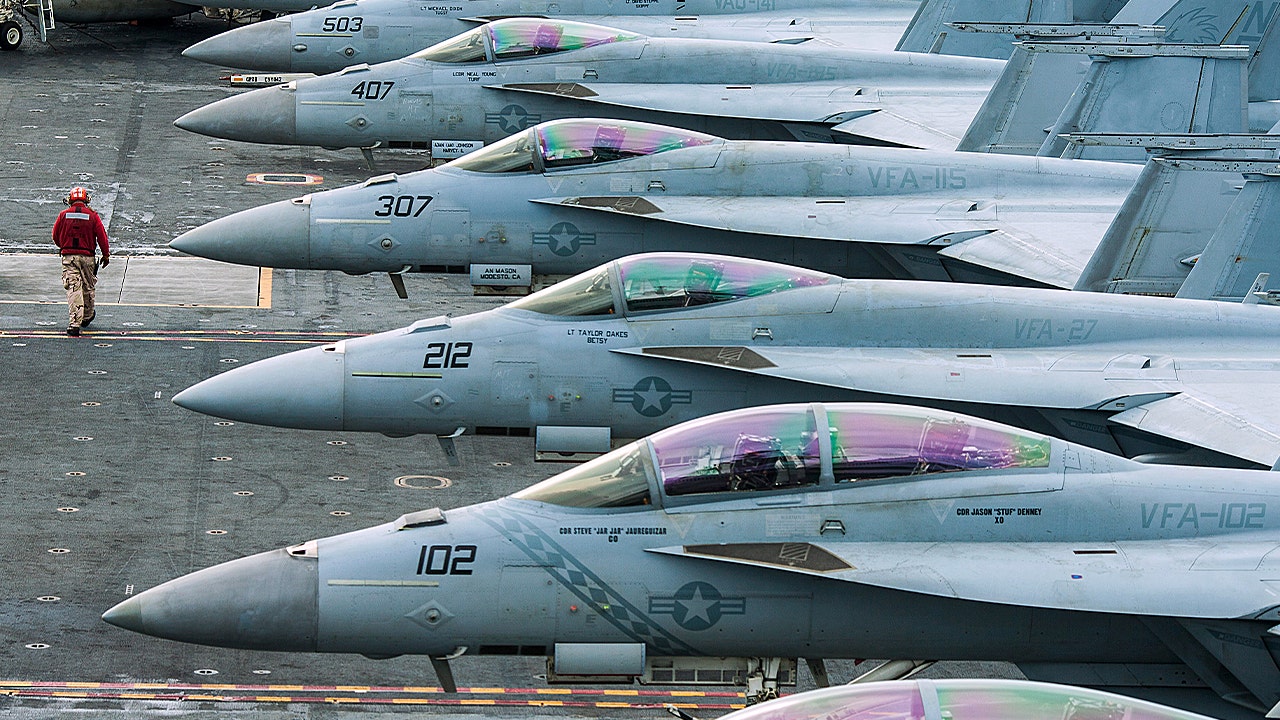
WASHINGTON — The United States is ramping up its military presence in the Middle East as the Pentagon escalates its campaign against Iran, with officials warning that the operation will extend over an extended period. Chairman of the Joint Chiefs of Staff Gen. Dan Caine announced Monday that additional forces are flowing into the region, building on a monthlong repositioning of U.S. assets including carrier strike groups, advanced fighter aircraft, and air defense systems.
During a Pentagon briefing, Gen. Caine referred to the ongoing effort as "major combat operations" under the banner of Operation Epic Fury, which began in the early hours of Saturday Eastern Time. "The flow of forces continues today. In fact, Admiral Cooper will receive additional forces even today," Caine said, mentioning Central Command chief Adm. Brad Cooper. He declined to specify troop numbers, stating, "I don't want to talk specifics, because that would tip the enemy off. We have more tactical aviation flowing into theater just based on the time it took to get it out there."
The operation, now roughly 57 hours old as of Monday morning, has already seen significant action. Video footage from U.S. Central Command depicted F-18 and F-35 fighter jets returning from combat missions over Iranian skies. Caine described the initial phase, in which more than 100 aircraft — including fighters, tankers, electronic attack planes, bombers, and unmanned platforms — launched in a synchronized wave from land and sea bases.
Prior to the kinetic strikes, U.S. cyber and space forces conducted non-kinetic operations to disrupt Iran's communication and response capabilities, according to Caine. Tomahawk missiles fired from U.S. Navy vessels targeted Iranian naval forces along the country's southern flank, while precision strikes hit command and control infrastructure, ballistic missile sites, and intelligence facilities. In the first 24 hours, U.S. forces struck more than 1,000 targets, Caine reported.
American B-2 bombers undertook 37-hour round-trip missions from bases in the continental United States to deploy penetrating munitions against underground facilities, the general added. Overall, U.S. forces have launched hundreds of missions and delivered tens of thousands of pieces of ordnance as the campaign scales up. A map of U.S. naval assets currently operating in the Middle East highlights the extensive deployment, including carrier strike groups positioned strategically across the region.
The stated objective of the mission is to prevent Iran from projecting power beyond its borders and to neutralize key military capabilities. War Secretary Pete Hegseth emphasized during the briefing that the focus is on destroying Iranian missiles and missile production facilities, dismantling its navy, and ensuring no path to nuclear weapons development. "This is not a so-called regime change war, but the regime sure did change and the world is better off for it today," Hegseth remarked.
Caine echoed the long-term nature of the effort, warning that the fight "will take some time" and that the U.S. expects to incur additional losses. Four American service members have already been killed since the operation's start, Hegseth confirmed. They were struck by an Iranian missile that penetrated air defenses at a tactical command center, he said.
Images from Tehran showed smoke rising following an explosion on March 2, 2026, amid the ongoing U.S. and Israeli military strikes, according to Getty Images. The Associated Press has tallied 555 Iranian deaths as of Monday morning, though Iranian officials have not released an official count. Hegseth and Caine addressed questions about ground involvement, with the secretary stating flatly, "no," to the presence of American boots on the ground in Iran.
However, Hegseth cautioned against public speculation on future moves. "It's one of the fallacies that this department or presidents or others should tell the American people — and our enemies, by the way — 'here's exactly what we'll do,'" he said. "It's foolishness." The administration, he added, would not telegraph potential options moving forward.
The escalation comes after months of heightened tensions in the region, including Iran's alleged support for proxy militias and advancements in its nuclear program, which U.S. officials have long viewed as a threat. This operation builds on a broader repositioning of U.S. forces that began about a month ago, incorporating not just aviation but also enhanced air defense systems to protect allied positions.
Gen. Caine expressed confidence in the current posture, noting, "I think we're just about where we want to be in terms of total combat capacity and total combat power for Admiral Cooper." Yet, the acknowledgment of expected further casualties underscores the risks involved. The four U.S. deaths mark the first confirmed fatalities in Epic Fury, highlighting the intensity of Iranian counterstrikes despite degraded defenses.
Israeli involvement has been coordinated, with joint strikes reported on Iranian targets, though details remain limited. Smoke and explosions in Tehran, as captured in photographs, illustrate the reach of the campaign into Iran's capital. The operation's cyber components, aimed at degrading command structures, represent a modern facet of warfare that officials say has given U.S. forces an early advantage.
As the campaign progresses, questions linger about the endgame. Hegseth reiterated that regime change was not the goal, but the secretary's comment on the regime's de facto alteration suggests significant internal disruptions. Iranian state media has portrayed the strikes as aggressive imperialism, vowing retaliation, though specifics on their response capabilities post-initial strikes are unclear.
Broader implications for the Middle East include potential ripple effects on oil markets and regional alliances. With U.S. carrier groups and advanced aircraft now bolstering the theater, allies like Saudi Arabia and the United Arab Emirates have expressed support, according to regional reports. However, the prolonged timeline warned by Pentagon leaders could strain resources and public support back home.
Looking ahead, officials have not outlined a timeline for de-escalation, focusing instead on achieving the mission's objectives. As more forces arrive, the U.S. aims to maintain pressure while minimizing escalation risks. The Pentagon briefing, attended by Hegseth and Caine, served as a reminder of the operation's gravity, with both leaders urging patience from the American public amid the unfolding conflict.