VANCOUVER, British Columbia — In a delightful twist of fate for the world of editorial cartooning, Vancouver-based artists Ian Boothby and Pia Guerra have achieved a coveted milestone: their work graces the cover of The New Yorker's 2026 calendar. The duo, known for their sharp wit and timely humor, only discovered the honor by chance while browsing online, highlighting the often unpredictable nature of their craft.
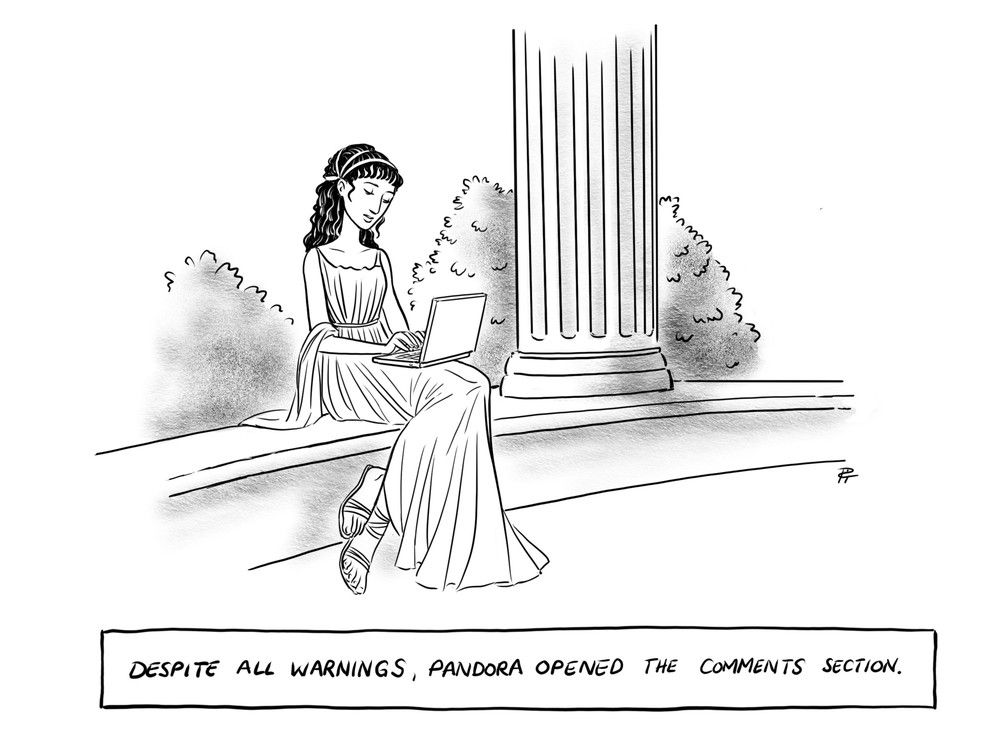
The cartoon in question depicts a woman dressed in a Roman toga and sandals, perched near a Doric column, intently staring at an open laptop. The caption reads: “Despite all warnings, Pandora opened the comments section.” It's a clever nod to the mythological figure Pandora and the modern perils of online discourse, blending ancient lore with contemporary satire. According to Guerra, the surprise revelation came in June when she was about to purchase the calendar. “I was about to buy the calendar online and suddenly realized our cartoon was on the cover,” she said. “It had been out since June, and we had no idea.”
Boothby echoed the excitement, noting that this wasn't entirely out of the blue but still thrilling. “We’d had a small cartoon in the calendar before, then a full month last year,” he said. “I honestly didn’t expect us to be included again. Seeing the cover was a huge thrill — especially because it was one of our earliest cartoons.” The pair has been collaborating on cartoons for The New Yorker since 2017, a partnership that began shortly after one of Guerra's editorial works went viral, catapulting them into the spotlight.
Their entry into the prestigious magazine's pages traces back to Guerra's frustration-fueled creation titled “Big Boy.” Drawn amid political turmoil, it portrayed Steve Bannon holding a diminutive Donald Trump on his lap, akin to a child signing executive orders. “It was drawn out of pure frustration — I was angry at everything and just venting online,” Guerra explained. “It took off in a way I still don’t understand. It was shown on major American news networks, and we even got calls from TV stations in Japan. A few months later, I was working as an editorial cartoonist for The Washington Post.”
This viral success opened doors, including their ongoing contributions to The New Yorker. Boothby handles the ideation, generating concepts on Sunday nights. “On Sunday nights, I usually write about 20 ideas,” he said. “Then I narrow that down to maybe seven that Pia can draw, and we’ll finish four or five of them. When I run out of gas, I always default to snowmen, Greek gods, or superheroes — those wells never seem to dry up. This one definitely fell into that category. Greek gods will always give you something.” Guerra then selects and illustrates her favorites, prioritizing those that genuinely amuse her. “I start with the ones that genuinely make me laugh out loud — that’s always the test,” she noted. “I work through the night and usually finish around seven or eight in the morning.”
The submission process is rigorous and timed precisely. They send about five cartoons each week to editor Emma Allen, with batches due by 9 a.m. Tuesday Pacific time. Guerra often completes her work just in time before heading to bed. Feedback arrives on Fridays via an email simply titled “the OK,” a phrase Boothby described with a chuckle. “That’s literally the subject line of the email,” he said. “It’s still a total crapshoot, which is what keeps it exciting. They always seem to pick the weird ones.” To date, The New Yorker has published just over 100 of their submissions, though not every week makes the cut.
For those that don't, the couple shares them with supporters on their Patreon page at patreon.com/mannequinonthemoon, ensuring their creativity doesn't go entirely unseen. This side venture underscores their commitment to the medium, even amid rejections. Guerra's broader acclaim includes being named a finalist for the 2023 Pulitzer Prize in Illustrated Reporting and Commentary for her work at The Washington Post, a recognition that came as an unexpected boon to her 20-year career in comics.
“I’d spent 20 years doing comics, and this side career just appeared out of nowhere because I started drawing things to share with friends online,” Guerra reflected. The immediacy of editorial cartooning sets it apart from traditional comics, she added. “What I love about editorial cartoons is the immediacy,” she said. “I draw them on an iPad in the same format people will see them. Three hours later, they’re online. Ten minutes after that, they might be catching fire. Comics are usually slow — books take months or years.”
Beyond The New Yorker, Boothby and Guerra boast impressive resumes in the comics industry. Boothby served as the main writer for Bongo Comics, the publisher behind The Simpsons and Futurama titles, for more than 15 years. He also created and writes the Scholastic series Sparks!, which follows two cats piloting a mechanical dog suit, illustrated by Nina Matsumoto. Guerra, meanwhile, co-created the acclaimed post-apocalyptic series Y: The Last Man, published by Vertigo/DC from 2002 to 2008. The story was adapted into a 10-episode TV series by FX that premiered in 2021.
Their latest project exemplifies the slower pace of graphic novels. Titled Frostbite, it's a horror tale for young readers featuring snow vampires, set for release by Scholastic in August 2026. This blend of genres showcases their versatility, bridging the gap between quick-hit satire and longer-form storytelling.
In addition to their New Yorker work, the east Vancouver residents contribute a feature called Meawhile… to another iconic New York publication, Mad Magazine. Boothby quipped about the timing: “That makes us feel very old. If this were the 1960s, we’d be rich. Instead, it’s 2025, and we’re somehow making a living in magazines. God bless us.” Their dual involvement in these legacy outlets speaks to the enduring appeal of satirical illustration in an era dominated by digital media.
The cover selection for The New Yorker's 2026 calendar is particularly noteworthy, as it represents a rare spotlight for contributors. Calendars from the magazine are collector's items, often featuring standout single-panel cartoons that capture the publication's signature blend of humor and insight. For Boothby and Guerra, whose partnership thrives on Boothby's idea generation and Guerra's illustrative prowess, this achievement validates years of persistence. As Guerra put it, the process remains a “crapshoot,” but one that fuels their creativity.
Looking ahead, the duo continues to navigate the evolving landscape of cartooning. With ongoing submissions to The New Yorker, Patreon exclusives, and projects like Frostbite, they embody the adaptability required in the field. Their story also highlights Vancouver's growing reputation as a hub for creative talent, from comics to editorial art. As digital platforms amplify voices like theirs, the line between viral sketches and major publications blurs, offering new opportunities for artists worldwide.
While the calendar's release in June 2025 marked a personal milestone, it also underscores the timeless relevance of their themes. In an age where online comments can unleash chaos akin to Pandora's box, their cartoon resonates broadly. Boothby and Guerra's journey from online venting to New Yorker covers illustrates how passion projects can lead to professional triumphs, inspiring fellow creators in Canada's vibrant arts scene.
For fans eager to see more, the couple's work is accessible through The New Yorker's archives and their Patreon. As they prepare for Frostbite's debut and future batches of cartoons, Boothby and Guerra remain grounded in the joy of the craft. “Greek gods will always give you something,” Boothby said, a reminder that inspiration, like humor, is endlessly renewable.